If you’re looking to trade crypto futures, our experts recommend that you start with BTCC, PrimeXBT, or Kraken. BTCC takes the top spot with more than 370 futures pairs, leverage of up to 250x, competitive trading fees, and optional KYC for crypto users. PrimeXBT has multi-asset trading range and leverage of up to 200x on crypto futures, while Kraken offers a more established and regulated futures trading environment.
Crypto futures let you speculate on the price of digital assets without actually owning them. With these high-stakes predictions comes the option to trade using leverage. In this guide, we’ll walk you through the definition of crypto futures, how they compare to spot trading, and why the platforms above are leading the pack.
Best Crypto Futures Trading Platforms in 2026 Ranked
Here’s an overview of our top picks for the best crypto futures trading platforms:
- BTCC: Futures exchange with 370+ pairs, up to 250x leverage, and optional KYC
- PrimeXBT: Multi-asset futures platform with up to 200x leverage on crypto
- Kraken: Reputable futures exchange with a robust desktop trading app
- Coinbase: Major U.S. crypto exchange with CFTC-regulated crypto futures
- MEXC: KYC-optional crypto futures platform with advanced trading tools
- Binance: High-liquidity futures trading platform with over 250 trading pairs
- LBank: Top exchange for trading futures on emerging crypto tokens
- Bitbase: No-KYC crypto futures platform with up to 150x leverage
- Margex: Feature-rich futures trading platform with ultra-fast execution
- BingX: Futures exchange with robust copy trading and social trading
- OKX: Popular exchange with a wide range of perpetual futures and 125x leverage
Reviewing the Top Crypto Futures Trading Sites
The following sections will give you brief yet comprehensive reviews of our top 11 crypto futures trading platforms. We reviewed each site similarly, and each analysis provides largely the same type of information, making it easier for you to compare them.
1. BTCC: Futures Exchange With 370+ Pairs and Up to 250x Leverage
BTCC has operated since 2011 and is absolutely focused on crypto futures trading – the platform lists more than 370 futures pairs, covering major cryptocurrencies and altcoins, with a maximum leverage of up to 250x depending on the market.
Standard futures trading fees are 0.03% for makers and 0.048% for takers, and depositing 200 USDT automatically upgrades you to VIP1, where fees fall to 0.025% and 0.045%. We also spot zero-fee trading on many cryptocurrency markets.
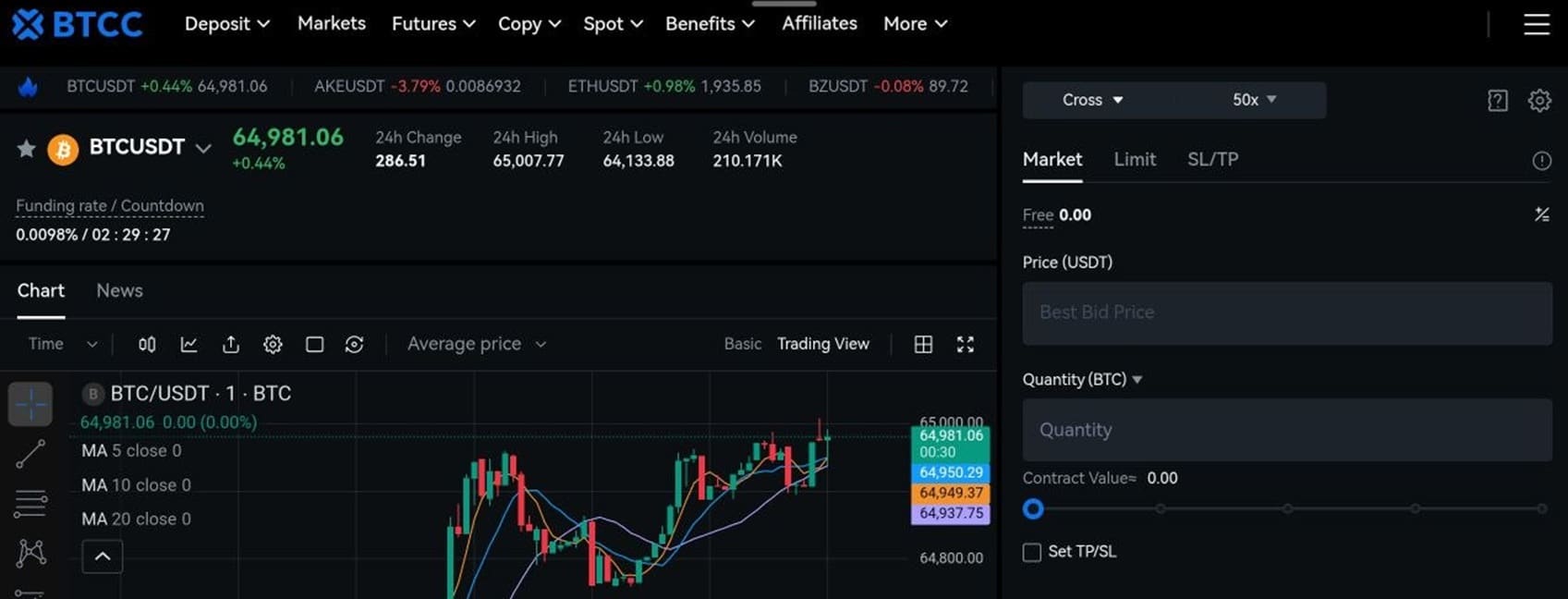
Traders are not limited to crypto – we like how BTCC provides access to gold, commodities, stocks, and other traditional markets, with zero trading fees on its TradFi pairs at the time of writing. This gives futures traders a way to speculate across several asset classes from the same platform.
KYC is optional, so users who do not complete identity verification can still make cryptocurrency deposits (with daily crypto withdrawals capped at 10,000 USDT for no-KYC users). BTCC also publishes proof-of-reserves reports showing reserve ratios above 100%.
New users can qualify for welcome rewards worth up to 30,000 USDT – with a 50 USDT “sign-up and complete first trade” offer currently running.
BTCC also offers a first-futures-trade promotion providing loss coverage, subject to the campaign’s eligibility requirements and terms.
Pros:
- More than 370 futures trading pairs
- Maximum leverage of up to 250x
- Operating since 2011
- Optional KYC for crypto traders
- Reduced futures fees from VIP1
- TradFi markets including stocks, gold, and commodities
Cons:
- 250x leverage carries very high liquidation risk
- Non-KYC withdrawals limited to 10,000 USDT per day
- Welcome rewards require users to complete qualifying tasks
Best Features
- 370+ crypto futures pairs
- Up to 250x leverage
- Zero-fee TradFi and selected crypto markets
- Easy to make deposits via crypto, Visa, Mastercard, and Interac e-Transfer (for Canadian users)
2. PrimeXBT: Multi-Asset Futures Trading Platform With Up to 200x Leverage
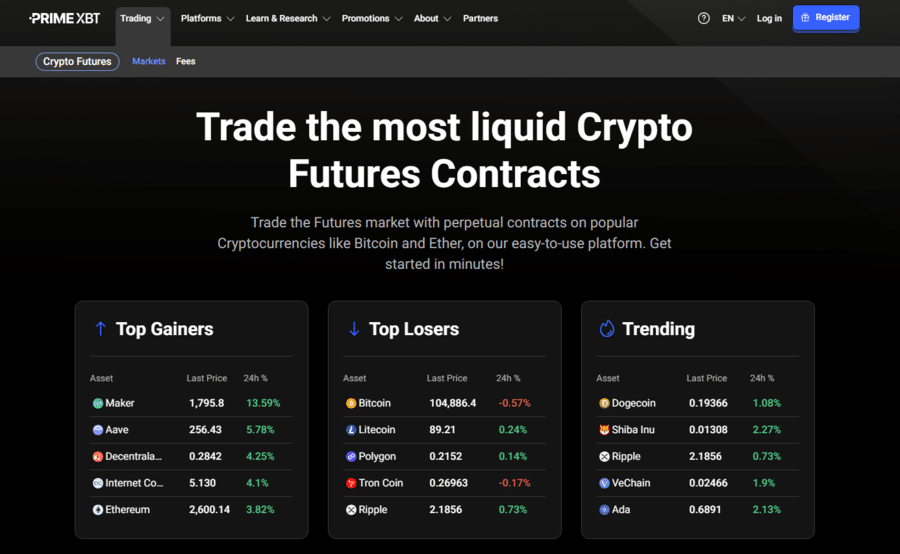
PrimeXBT is a versatile trading platform that allows you to trade various financial instruments, not just cryptocurrencies. This includes forex, commodities, and stock indices. The main attraction is high leverage. You can get up to 200x leverage on crypto futures and up to 1,000x on forex, while some commodities and indices get up to 500x.
Besides crypto futures that are primarily perpetual swaps, you also get crypto CFDs or crypto contracts for differences, where you don’t have to have crypto at all to trade them.
The site supports around 40 cryptocurrencies, resulting in fewer trading pairs than on other platforms. However, that’s made up for by the fact that fees are somewhat lower, typically 0.01% for makers and 0.045% for takers.
Pros:
- Access to markets outside of crypto
- Advanced copy trading
- 200x leverage on crypto
- Use crypto to margin other trades
Cons:
- CFDs can be very risky
- Complex for beginners
Best Features
- Multi-asset trading platform
- Copy trading
- Exchange and built-in wallet
3. Kraken: Reputable U.S. Crypto Futures Exchange with Unified Desktop Trading App
Kraken is a reputable cryptocurrency exchange that has been on the market since the early days of cryptocurrency, dating back to 2011. It’s reliable, secure, and offers a robust trading platform for futures contracts that’s regulated by the UK’s Financial Conduct Authority.
You get to trade perpetual, fixed maturity, and multi-collateral futures. Fixed maturity contracts have fixed expiry dates, while multi-collateral lets you use a wide range of cryptocurrencies as collateral. The only downside is that maximum leverage goes up to 50x.
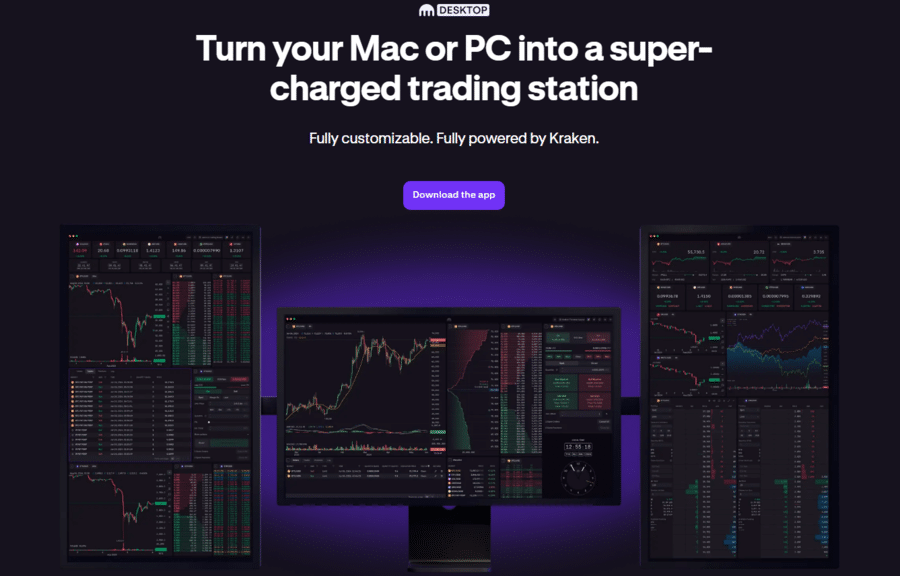
Users can trade both online and through Kraken’s desktop platform, which is highly customizable and supports use on several windows. You can find out more in our full Kraken review.
Pros:
- Highly reputable platform
- Multi-collateral margining
- Great customer support
- Highly transparent
Cons:
- Low max leverage
- Fewer trading pairs
Best Features
- Desktop trading app for Mac and PC
- Multi-collateral wallet
- Advanced trading interface through Kraken Pro
4. Coinbase: Major U.S. Exchange with CFTC-regulated Crypto Futures
Coinbase is the largest U.S. crypto exchange and it stands out as one of the only places to trade CFTC-regulated crypto futures for BTC, ETH, XRP, and more. In total, Coinbase offers 15 CFTC-regulated contracts with leverage up to 10x.
For traders outside the U.S., Coinbase also has a wider selection of around 150 perpetual futures contracts tradeable with either USD or USDC. Leverage is limited to 50x, lower than other futures exchanges, but Coinbase has a level of trust, liquidity, and safety that other exchanges simply can’t match.
Another reason to choose Coinbase is its outstanding trading platform, which is suitable for both beginner and experienced futures traders. You get access to web and mobile platforms that include a full charting suite, Level 2 order book data, risk management tools, and more.
Pros:
- CFTC-regulated crypto exchange
- 10x leverage on regulated futures contracts
- Powerful trading suite
- Large user base contributes to high liquidity
Cons:
- Limited selection of futures contracts
- Relatively low leverage limits
Best Features
- CFTC-regulated crypto futures for 15 tokens
- Coinbase Advanced trading platform
- Highly responsive customer support
5. MEXC: KYC-optional crypto futures platform with advanced trading tools
MEXC is one of our top picks for a good reason. It covers a robust set of USDT-margined and Coin-margined perpetual futures, and offers very high leverage of up to 200x on select pairs. On BTC and ETH, you can get as much as 500x on occasion.
The brand is well-suited for advanced traders, offering a range of advanced trading tools, including grid trading bots and copy trading, as we explore in more detail in our Best Crypto Copy Trading Platforms guide. That said, beginners will need some time to adjust.
Lastly, it’s essential to note that as one of the top crypto exchanges, MEXC occasionally publishes proof of reserves to ensure traders are aware that their funds are backed up.
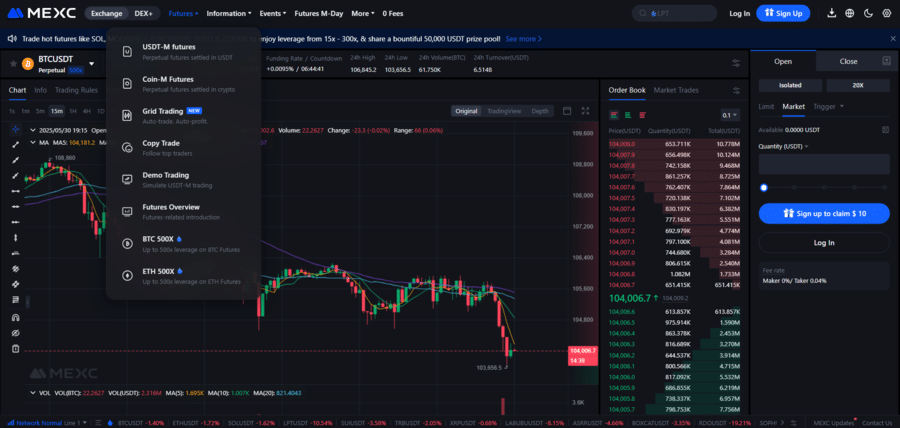
Pros:
- Up to 200x leverage
- More than 700 futures markets
- Both USDT and Coin-margined contracts
- 0% maker and 0.02% taker fees
Cons:
- Steep learning curve for beginners
Best Features
- Copy trading
- High-performance trading engine
- High leverage trading pairs
6. Binance: High Liquidity Platform With Over 250 Futures Trading Pairs
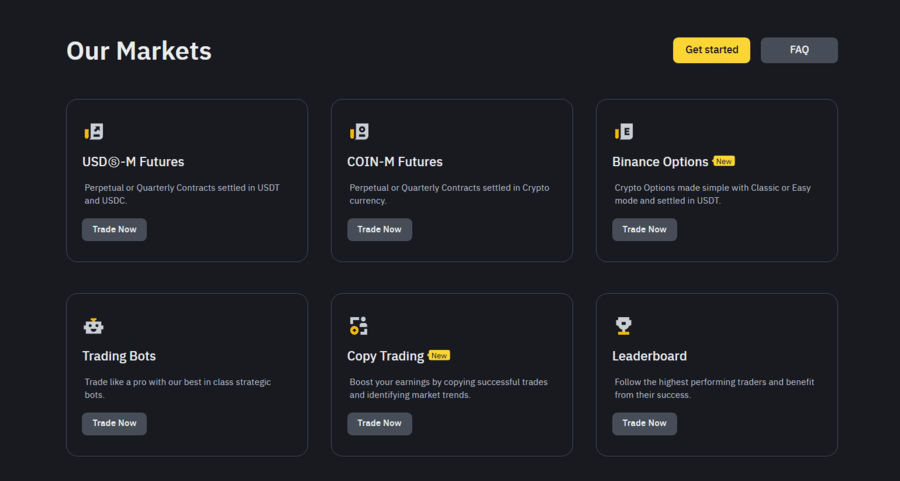
Binance is the global leader among cryptocurrency exchanges, as it’s the largest platform by trading volume. It excels in futures trading as well, offering more than 250 pairs and leverage of up to 125x on major pairs.
You’ll find a good deal of perpetual, quarterly, and bi-quarterly futures contracts. Most options will be USDT-margined, USDC-margined, and Coin-margined.
The fee structure varies depending on the cryptocurrency in which the futures are margined and your VIP level. For contracts settled in a cryptocurrency like BTC or ETH, makers pay 0.02% and takers pay 0.05% at the start, but the fees get progressively lower the higher your VIP level. You can also get discounts by holding Binance Coin (BNB).
Pros:
- High selection of trading pairs
- A competitive fee structure
- High leverage on several major pairs
- Over 250 trading pairs
Cons:
- Overwhelming amount of information
Best Features
- Advanced trading interface
- Several collateral options
- Demo account
7. LBank: Top Exchange for Trading Futures on Emerging Crypto Tokens
LBank is our top-rated crypto futures exchange for trading new and emerging cryptocurrencies. The exchange is frequently among the first platforms to offer futures for new tokens, and it offers a massive selection of more than 600+ perpetual futures. Each week, LBank adds a new tranche of futures for emerging cryptos for a limited time for traders to explore.
LBank offers up to 125x leverage on contracts for major tokens, putting it in league with other high leverage futures platforms. Trading fees start from 0.0200% maker and 0.0600% taker, and there are volume discounts available for experienced traders.
Best of all, LBank is fully KYC-optional for traders who deposit and withdraw crypto rather than fiat. That makes it one of the leading anonymous crypto futures platforms. Just keep in mind that LBank isn’t available for U.S. traders at this time.
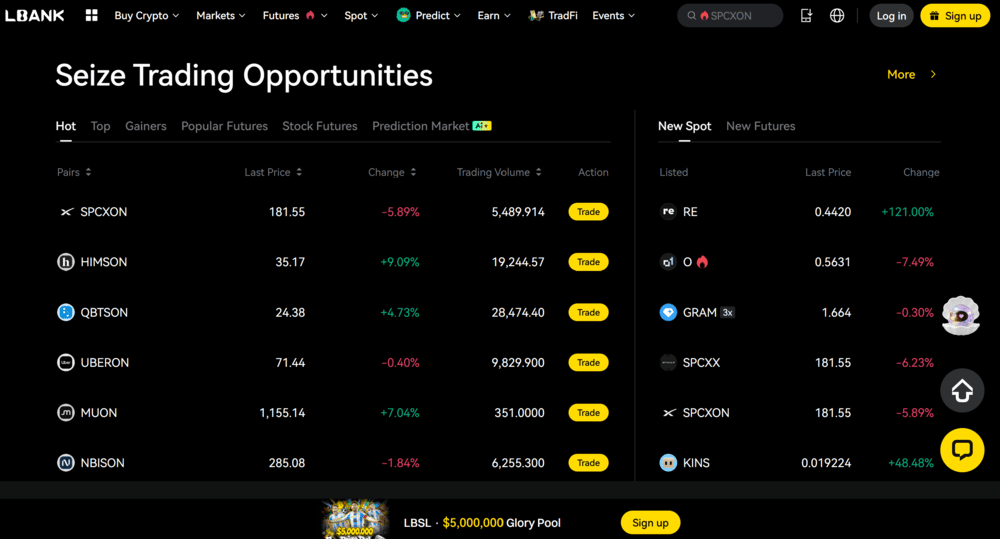
Pros:
- 600+ futures including for emerging tokens
- Trade with up to 125x leverage
- KYC optional for crypto deposits and withdrawals
- User-friendly futures trading platform
Cons:
- Not available in the U.S.
- Fiat transactions require KYC checks
Best Features
- Copy trading
- Futures trading bots
- New emerging tokens to trade every week
8. Bitbase: No KYC Crypto Futures Platform with up to 150x Leverage
Bitbase is another attractive crypto futures trading platform for traders who value privacy. This global exchange doesn’t require KYC to trade perpetuals with USDT and USDC, and there are no deposit limits on unverified deposits. Withdrawal limits on non-KYC verified accounts are up to $500,000 per day in crypto.
Bitbase offers trading on 400+ futures with up to 150x leverage, making it one of the best platforms for both choice of tokens to trade and margin. Fees start at only 0.02% for makers and 0.06% for takers. Bitbase provides all the trading tools you need, including TradingView charts and advanced order management features, as part of a proprietary trading platform for web and mobile.
While Bitbase doesn’t require KYC checks, it is still a fully regulated exchange licensed by several E.U. countries. However, it is not available to U.S. futures traders at this time.
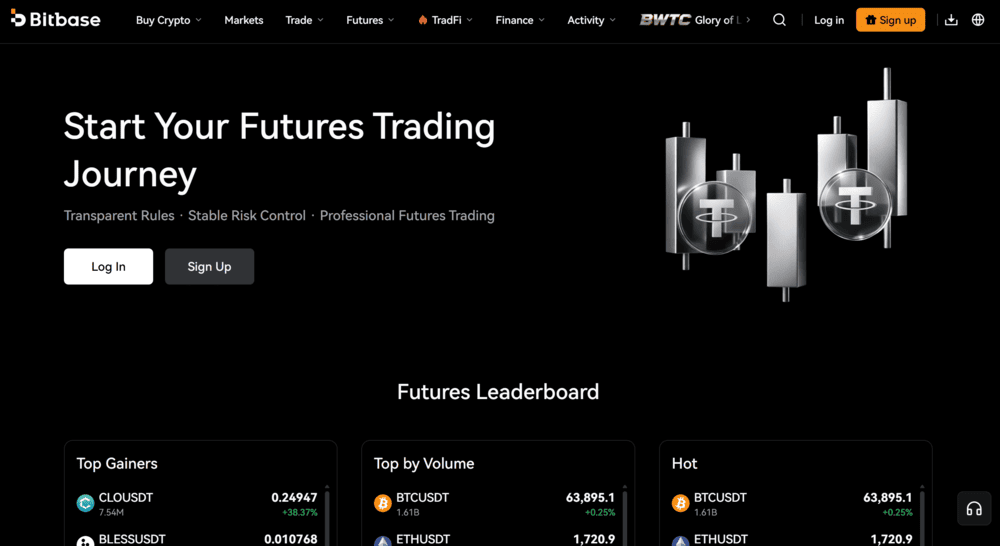
Pros:
- Trade 400+ contracts with USDT and USDC
- No KYC required
- Advanced trading platform included
- Regulated in the E.U.
Cons:
- Doesn’t offer copy trading or trading bots
- Not available in the U.S.
Best Features
- Up to 150x leverage on most trading pairs
- TradingView charts
- $500,000 withdrawal limit for unverified accounts
9. Margex: Feature-rich Futures Trading Platform with Ultra-fast Execution
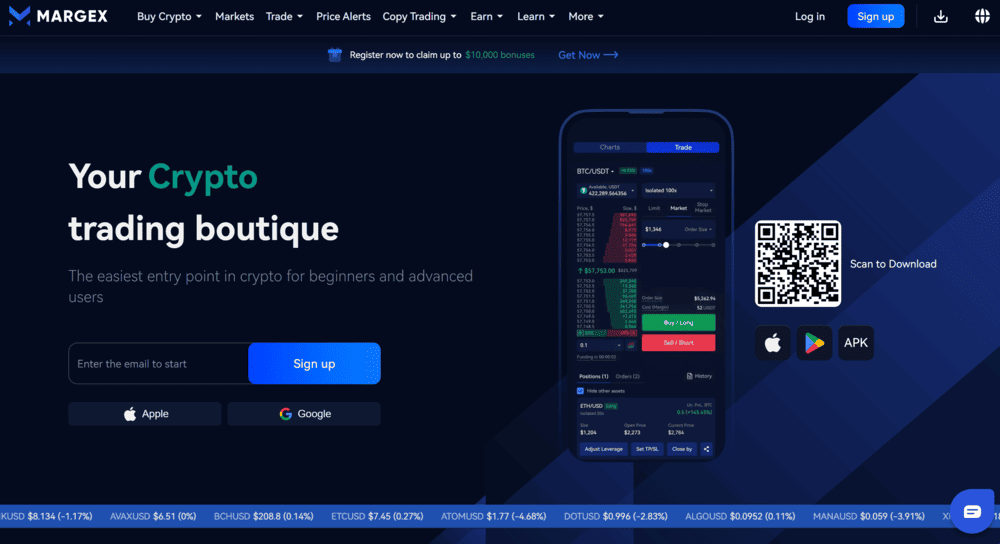
Margex stands out as one of the best crypto futures platforms for advanced traders who need robust tools and speedy, reliable executions in fast-moving markets. It’s frequently hailed as one of the most liquid crypto futures exchanges and offers a professional-grade platform that experienced traders love.
With Margex, you get access to a limited selection of 55 perpetual futures traded against USDT and leverage up to 100x. While that’s a smaller selection of contracts than other exchanges, Margex’s focus on major pairs ensures quick execution without slippage. You also benefit from trading tools built specifically for major contracts, without distractions from emerging altcoins while trading on Margex.
Margex also has one of the best copy trading offerings we’ve seen, with more than 100 pro traders available to follow and trade with. There’s no additional cost to copy trade and top traders on the platform can claim up to $10,000 in bonuses.
Pros:
- Professional-grade trading platform
- Competitive fees from 0.019% maker/0.06% taker
- Up to $10,000 in trading bonuses available
- KYC optional
Cons:
- Limited selection of crypto futures contracts
- Doesn’t offer trading bots
Best Features
- Copy trading with 100+ pro traders
- Ultra-fast execution with minimal slippage
- Advanced trading platform with built-in risk management
10. BingX: Copy Trading Feature With Over 20,000 Elite Traders to Copy
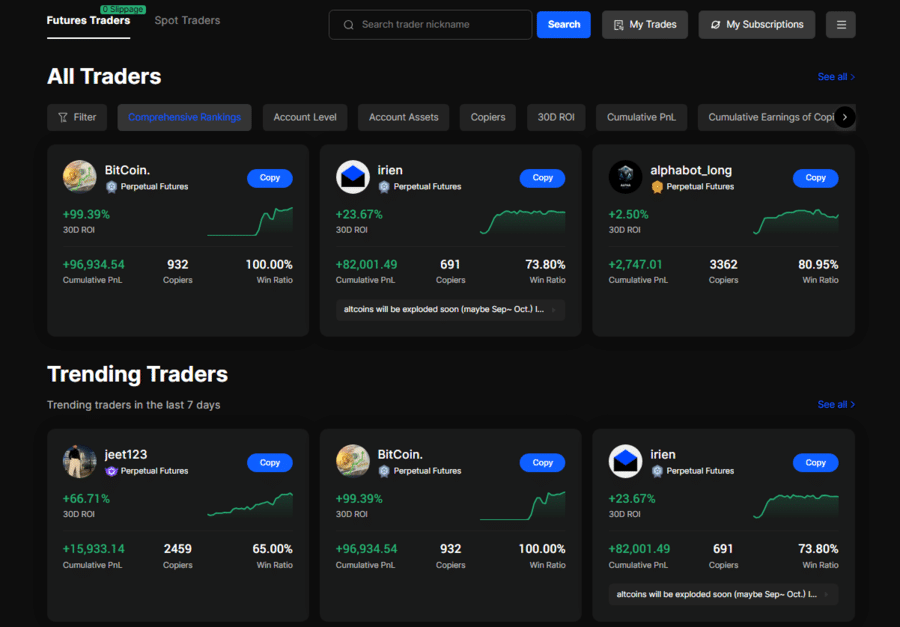
BingX is primarily known as a copy and social trading crypto platform where you can follow and replicate trades from over 20,000 traders. The best ones are also ranked on leaderboards, making it easier to find the trades with the most potential.
As for futures trading, the site primarily focuses on perpetuals, which are either USDT- or cryptocurrency-margined. There are also standard futures with fixed end dates and special Futures Kickoffs that follow trending and meme tokens. The maximum leverage you can get on one of the best no-KYC exchanges is 150x.
Pros:
- Over 700 cryptos and 250 trading pairs
- Vast network with elite traders to copy
- 150x leverage on major pairs
- Demo trading account and educational resources
Cons:
- Customer support could be more responsive
- Potentially overwhelming for beginners
Best Features
- Futures copy trading
- Advanced tools like grid trading
- BingX Wealth Management accounts
11. OKX: Benefit From Many Perpetual Swaps and Leverage of Up to 125x
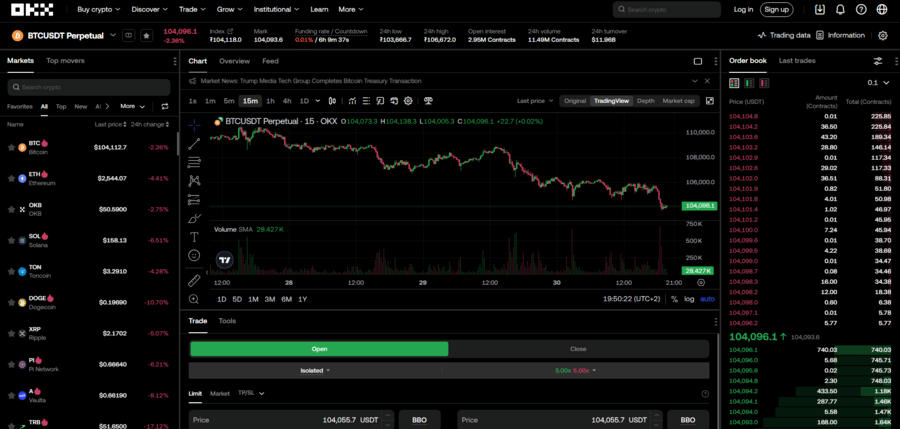
Often counted among the best peer-to-peer (P2P) crypto exchanges, OKX is another high-liquidity crypto exchange that offers a great diversity of futures trading opportunities. It excels with perpetual futures, which can be margined and settled in USDT or the underlying cryptocurrency.
Futures contracts offer up to 125x leverage on pairs such as BTC/USDT, ETH/USDT, and other major pairs. You can choose between at least 300 trading pairs.
Fees are fairly standard: 0.05% for takers and 0.02% for makers. However, the costs decrease progressively as your VIP level increases. VIP tiers are determined by the total assets you have or your 30-day trading volume in USD.
Pros:
- Over 300 futures trading pairs
- Up to 125x leverage on major pairs
- Trading bots and copy trading
- Demo account available for futures trading
Cons:
- KYC required for most features
- Customer support could be better
Best Features
- Large number of contract types
- Cross and isolated margin modes
- OKX Wallet integration
What Is Crypto Futures Trading and How Does It Work?
Cryptocurrency futures are a type of crypto derivatives contract where you effectively bet on a crypto asset’s future price without holding the asset itself. Consequently, you get higher exposure to the market without having to invest a significant sum of your own.
This makes them very similar to standard futures contracts, which track the prices of financial assets or commodities.
A crypto futures contract specifies that the platform must deliver the fiat value of a crypto to the trader on a specific future date, based on the predetermined value specified in the contract.
Moreover, the crypto futures contract not only allows you to bet on the price of one unit of the crypto, but also on more of it. This is called the leverage, and that number tells you by how much your position rises. If the leverage is 10x, your contract is 10x the capital. Leverage is effectively the money you borrow to keep the position open.
To help you fully understand how all of this works, we’ll need to use an example:
Example of a Futures Contract for Ethereum
Let’s say that Ethereum is, at the time of writing, priced at $2,400. Based on your experience and knowledge, you predict that the price will rise in the next month. ETH is expensive, and you don’t have the coins themselves, but you want to bet on its price reaching $2,500.
On a crypto trading platform, you decide to take up an Ethereum futures contract, stating that this will happen. The contract is for 10 ETH, and it will be settled within a month.
By committing to the contract, you only pay the required margin, which is the minimum amount needed to open the position. For instance, it’s 2% in our case, i.e., 2% of the contract’s value. Since the contract’s value is $24,000 (10 ETH worth $2,400 each), the margin is $480. That’s all you need to invest upfront, and you don’t pay for the whole 10 ETH in fiat, and you don’t hold any ETH.
You only need to hold a specific amount in your balance, a maintenance margin used to prove that you can settle your obligations to the platform if the contract doesn’t go in your favor. The maintenance margin is typically a specific percentage of the contract’s value, like 1%, for example. In this case, you’ll need to have 1% of $24,000, which is $240.
With all of that in mind, here are the two outcomes you can get on crypto futures trading platforms:
- Positive outcome: The price increases to $2,600 in one month. Your profit will be the market price of ETH minus the contract price times the amount of crypto covered. In other words, your profit is $26,000 – $24,000 = $2,000.
- Negative outcome: The price drops to $2,300 in one month. The calculation remains the same, but the result we get is negative. In other words, $23,000 – $24,000 = -$1,000. In reality, you wouldn’t lose this much because the maintenance margin is much lower, set to $240. You’ll get a margin call as soon as your initial equity, $480 in this case, drops below $240. You’ll need to deposit more, or the position will close.
Crypto Futures Trading vs. Spot Crypto Trading
The main difference between crypto futures trading and spot crypto trading is that the former doesn’t require you to own the crypto you’re trading, while the latter does. This also means that there is leverage with spot trading, which requires you to invest the crypto you have, rather than using borrowed funds.
Due to all of this, spot crypto trading is generally lower risk, but the profits are also lower as they come from price appreciation. At the same time, futures are the exact opposite; i.e., the risk is much higher, but the profits are much higher as well.
Crypto futures are more complex due to their intricate features, such as margins and leverage, whereas crypto spot trading is relatively simple.
However, you can use crypto futures to hedge against the price volatility of the crypto you’re actually holding. Moreover, you can short sell, which isn’t possible with spot crypto trading.
All in all, spot trading is more reserved for beginners, long-term investors who believe in the value of crypto, investors with low risk tolerance, and people who want to control the crypto they’re trading.
Altcoin and Bitcoin futures trading is better suited for advanced traders, short-term speculators, traders interested in leveraging their positions, and investors who want to hedge their cryptocurrency holdings.
Pros & Cons of Trading Crypto Futures
To understand if crypto futures trading is for you, here are its advantages and disadvantages, starting with the former:
- Leverage: This is the main advantage for many. It allows you to manage a large contract with minimal investment of your funds. The leverage can go up to 200x in some cases, which can lead to massive profit on your initial margin.
- Chance to go long and short: With futures, you can profit from the price of a crypto going up and down, depending on the type of contract you’ve invested in.
- Hedging against volatility: Since you can go both long and short, you can effectively hedge against the potential price decline of a cryptocurrency you actually hold by going short, effectively offsetting volatility-induced losses.
And here are the main disadvantages:
- High risk from leverage: The higher the leverage, the higher the potential profits; however, this also increases risk. Depending on what the maintenance margin is, you can potentially lose significant funds.
- Overly complex: As you’ve seen from our long explanations, crypto futures are very complex types of trades. We haven’t even explained everything as the topic requires a much, much longer guide. You need to understand every element before jumping into it.
- You don’t own the asset: If you’re a big believer in crypto, you won’t like the fact that you don’t own the assets you’re trading through futures contracts. That means you can’t use it in staking or anything else that crypto allows for.
How to Pick a Crypto Futures Trading Platform
When choosing a crypto futures trading platform, it’s essential to focus on reputable exchanges, like those mentioned in this article.
Evaluate each platform using consistent criteria. Start by examining their security protocols and whether they provide proof of reserves, which signals transparency and trustworthiness.
Consider the range of supported cryptocurrencies and trading pairs. The more options available, the better your trading flexibility. Also, assess the leverage offered. If you’re comfortable with the risks, a platform with higher maximum leverage might suit your strategy.
Review the types of contracts available, especially perpetual futures, which are among the most commonly traded.
Check the fee structure to ensure it’s competitive and not above the industry average. Also, pay attention to the trading tools and features provided. A quality platform should offer a user-friendly interface, multiple order types, a mobile app, and advanced charting capabilities.
How to Trade Crypto Futures
To start crypto trading with futures, here’s what you need to do using MEXC as an example:
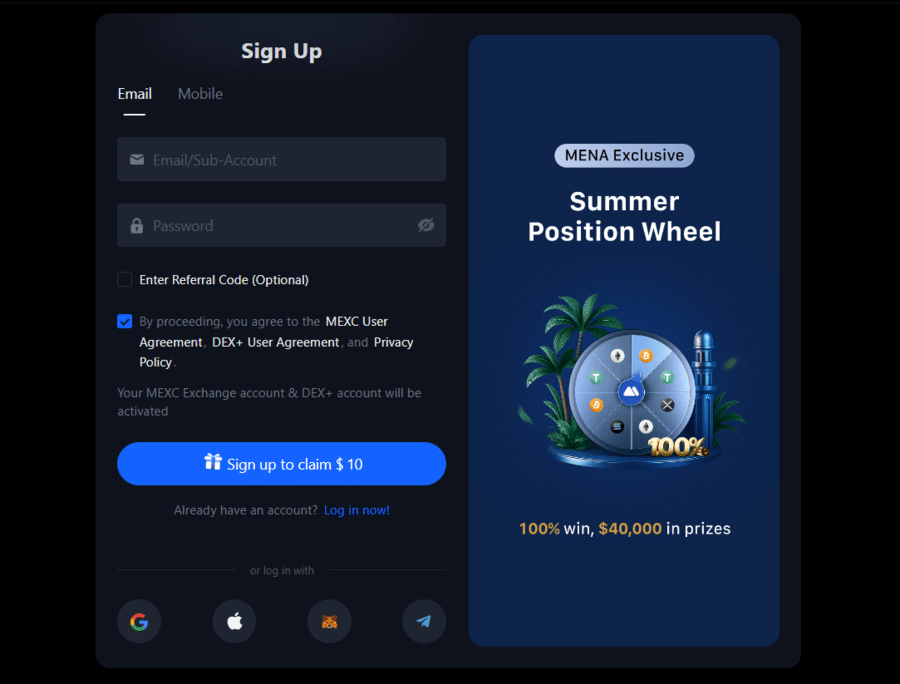
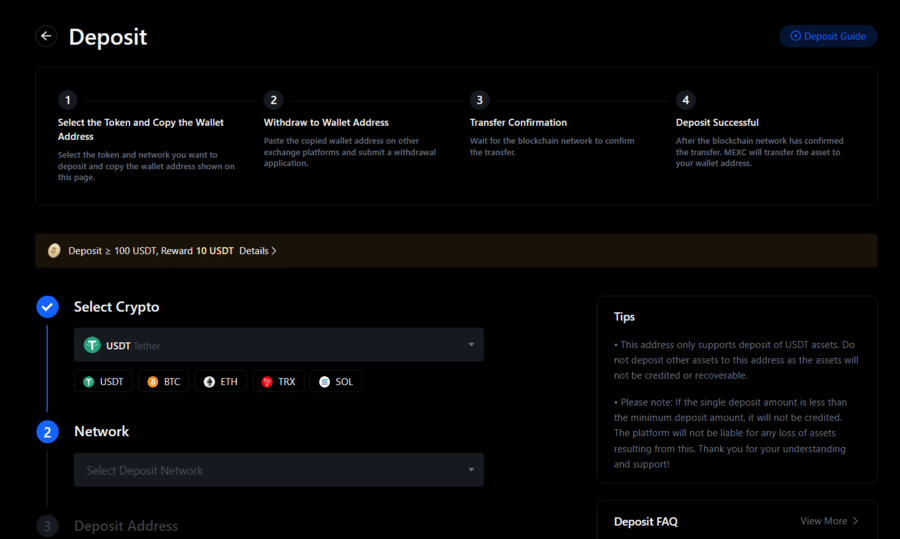
- Register an account. Visit the official MEXC website using our link and create an account. You can use only an email or a phone number. MEXC doesn’t require KYC upfront, so you can complete this step quickly with little to no personal information. You’ll need to finish KYC to get better limits and claim most of the bonuses, including the initial $10 bonus mentioned in the screenshot below.

- Deposit funds. Go to the Deposit window, where you can transfer crypto from your wallet. You can also buy crypto directly on MEXC if you don’t have any funds. You can also use the demo account to try trading without any risk or using your own funds. The demo account comes with 50,000 USDT in virtual funds.

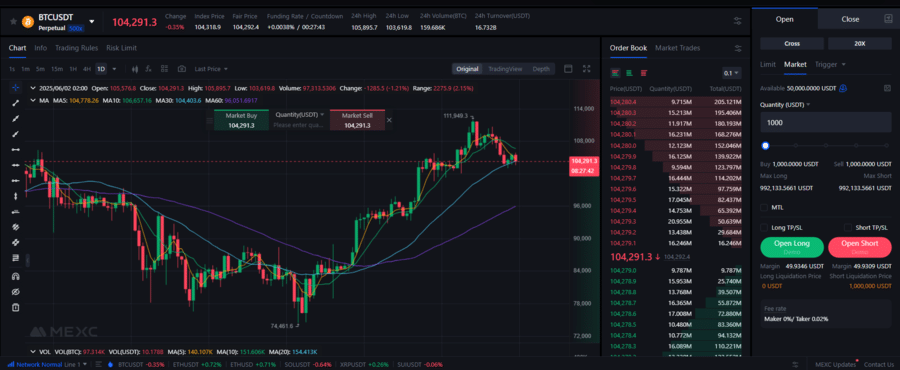
- Open a futures position. MEXC is excellent at guiding your hand while using its futures trading platform. To avoid going deep into the explanations, follow the embedded guide to place your initial trade.

Is Cryptocurrency Futures Trading Safe?
The type of trading itself is safe from a security standpoint as long as you’re using a verified and reputable trading platform.
The problem with crypto futures is that cryptocurrencies are generally very risky, and futures carry higher risk than traditional trading because they involve leverage and borrowed funds.
Conclusion
Crypto futures trading is a unique form of trading cryptocurrencies, where you effectively bet on the price of an asset without actually owning it. It uses leverage to increase market exposure, which can amplify both profits and losses.
BTCC is our top crypto futures trading platform overall, with more than 370 futures pairs, leverage of up to 250x, competitive futures fees, and optional KYC for crypto users. PrimeXBT and Kraken are also strong alternatives for traders who prioritize multi-asset access or a more established regulated trading environment.
Visit BTCCReferences
- Cryptocurrency Futures: Definition and How They Work on Exchanges (Investopedia)
- Cryptocurrency futures: A new way to ride the crypto wave, with some old-school trading twists (Britannica)
- Introduction to futures (Charles Schwab)
- What is spot trading in crypto and how does it work (Coinbase)
- How To Trade Futures With MEXC For Beginners (YouTube)
- 2025 Guide: Everything You Should Know to Invest in Crypto Safely (Security.org)