On this Page:
Most people think they missed the boat with crypto. Bitcoin’s already pushing six figures, Ethereum isn’t far behind, and the top altcoins all feel out of reach. But price doesn’t always reflect potential and some of the most promising crypto projects right now are still trading for less than a dollar.
In this guide, we’ll cover the best cryptos under $1, why they’re undervalued, and which ones could provide massive profits in August 2026. Right now, the top picks seem to be Bitcoin Hyper, Maxi Doge, and PEPENODE.
That doesn’t mean every cheap coin is worth buying. Some are low for a reason. But others are flying under the radar, building quietly while the market waits to catch up.
⚡ Highlighted

Top Gainers (24h)
 Pepe
PEPE
Pepe
PEPE
 Stellar
XLM
Stellar
XLM
 Cookie DAO
COOKIE
Cookie DAO
COOKIE
 Kaspa
KAS
Kaspa
KAS
 TRON
TRX
TRON
TRX
Top Losers (24h)
 Immutable
IMX
Immutable
IMX
 VeChain
VET
VeChain
VET
 Banana For Scale
BANANAS31
Banana For Scale
BANANAS31
 Shiba Inu
SHIB
Shiba Inu
SHIB
 Ethena
ENA
Ethena
ENA
Top Crypto Under $1 in August 2026
| # | Coin | Price | 24h % | Market Cap | Volume | 24h Range |
|---|---|---|---|---|---|---|
| 1 |

|
current price: $0.01 | raised: $33,015,422 | Learn more | ||
| 2 |
TRON
TRX
|
$0.33 | 0.41% | $30,999,300,681 | $268,661,297 |
$0.33
―
$0.33
|
| 3 |

|
current price: $0.0(3)28 | raised: $4,838,222 | Learn more | ||
| 4 |
Stellar
XLM
|
$0.19 | 1.55% | $6,477,806,161 | $111,092,058 |
$0.19
―
$0.19
|
| 5 |
 PepeNode 🎯presale stage
PEPENODE
⭐New
PepeNode 🎯presale stage
PEPENODE
⭐New
|
current price: $0.0012 | raised: $2,487,753 | Learn more | ||
| 6 |
Shiba Inu
SHIB
|
$0.0(5)41 | -0.48% | $2,428,216,710 | $38,481,764 |
$0.0(5)41
―
$0.0(5)41
|
| 7 |
Pepe
PEPE
|
$0.0(5)28 | 2.20% | $1,187,531,266 | $138,098,453 |
$0.0(5)27
―
$0.0(5)28
|
| 8 |
Kaspa
KAS
|
$0.03 | 1.33% | $767,188,778 | $8,424,606 |
$0.03
―
$0.03
|
| 9 |
Ethena
ENA
|
$0.08 | -0.34% | $766,967,127 | $69,717,737 |
$0.08
―
$0.08
|
| 10 |
 Algorand
ALGO
Algorand
ALGO
|
$0.08 | -0.06% | $740,800,027 | $16,558,078 |
$0.08
―
$0.08
|
| 11 |
VeChain
VET
|
$0.0046 | -1.36% | $399,295,735 | $5,397,708 |
$0.0046
―
$0.0048
|
| 12 |
 Bonk
BONK
Bonk
BONK
|
$0.0(5)28 | 0.09% | $248,174,120 | $50,352,036 |
$0.0(5)27
―
$0.0(5)29
|
| 13 |
Immutable
IMX
|
$0.12 | -1.39% | $105,228,025 | $5,339,988 |
$0.12
―
$0.13
|
| 14 |
Banana For Scale
BANANAS31
|
$0.0070 | -0.77% | $70,231,653 | $4,136,206 |
$0.0070
―
$0.0071
|
| 15 |
 Entangle
NTGL
Entangle
NTGL
|
$0.0(4)96 | - | $59,579,408 | - | - |
| 16 |
 Movement
MOVE
Movement
MOVE
|
$0.01 | 0.06% | $44,711,467 | $6,163,235 |
$0.01
―
$0.01
|
| 17 |
 VVS Finance
VVS
VVS Finance
VVS
|
$0.0(5)10 | -1.83% | $44,276,970 | $29,407 |
$0.0(5)10
―
$0.0(5)10
|
| 18 |
 CorgiAI
CORGIAI
CorgiAI
CORGIAI
|
$0.0(4)31 | -0.77% | $11,442,143 | $2,084 |
$0.0(4)31
―
$0.0(4)32
|
| 19 |
Cookie DAO
COOKIE
|
$0.0086 | 1.48% | $6,711,789 | $1,395,882 |
$0.0084
―
$0.0087
|
| 20 |
 MESSIER
M87
MESSIER
M87
|
$0.0(5)48 | 5.61% | $4,257,102 | $148,594 |
$0.0(5)45
―
$0.0(5)48
|
| 21 |
 Orbiter Finance
OBT
Orbiter Finance
OBT
|
$0.0(3)31 | 0.59% | $1,743,850 | $154,356 |
$0.0(3)30
―
$0.0(3)32
|
| 22 |
 Dione
DIONE
Dione
DIONE
|
$0.0(4)24 | 11.08% | $292,707 | $2,273 |
$0.0(4)21
―
$0.0(4)24
|
| 23 |
 Jupiter Project
JUP
Jupiter Project
JUP
|
$0.0(3)27 | 0.84% | $273,643 | $23,165 |
$0.0(3)23
―
$0.0(3)27
|
| 24 |
 STRIKE
STRIKE
STRIKE
|
$0.0(4)23 | 2.89% | $100,067 | - |
$0.0(4)22
―
$0.0(4)23
|
| 25 |
 Carlo Acutis
SAINT
Carlo Acutis
SAINT
|
$0.0(4)25 | 1.35% | $25,256 | - |
$0.0(4)24
―
$0.0(4)25
|
| 26 |
 Laïka
LAIKA
Laïka
LAIKA
|
$0.03 | 0.33% | - | $23,440 |
$0.03
―
$0.03
|
Bitcoin Hyper
HYPER 🎯presale stage
TRON
TRX
Maxi Doge
MAXI 🎯presale stage
Stellar
XLM
PepeNode
PEPENODE ⭐New 🎯presale stage
Shiba Inu
SHIB
Pepe
PEPE
Kaspa
KAS
Ethena
ENA
Algorand
ALGO
VeChain
VET
Bonk
BONK
Immutable
IMX
Banana For Scale
BANANAS31
Entangle
NTGL
Movement
MOVE
VVS Finance
VVS
CorgiAI
CORGIAI
Cookie DAO
COOKIE
MESSIER
M87
Orbiter Finance
OBT
Dione
DIONE
Jupiter Project
JUP
STRIKE
STRIKE
Carlo Acutis
SAINT
Laïka
LAIKABest Cryptocurrencies Under $1 to Watch
Let’s take a closer look at these nine crypto projects under $1 that actually look promising and could bring potential profits in the upcoming period:
1. Bitcoin Hyper ($HYPER) – Advanced L2 Network With Next-Gen Applications and Developer-Focused Utility
Bitcoin Hyper’s goals of redefining the entire Bitcoin ecosystem by combining its impregnable security and reliability with Solana’s speed and low costs are nothing if not ambitious. The network is built on top of Bitcoin using a custom implementation of the Solana Virtual Network (SVM). This makes it easy to port any dApp built on Solana to the chain while dramatically improving transaction speed and costs.
Even after years of exponential growth in crypto’s decentralized finance ecosystem, Bitcoin is still mostly used for basic payments and other simple transactions. Bitcoin Hyper wants to change that by supporting a wide range of DeFi features, from DEX trading and yield farming to NFT gaming and more.
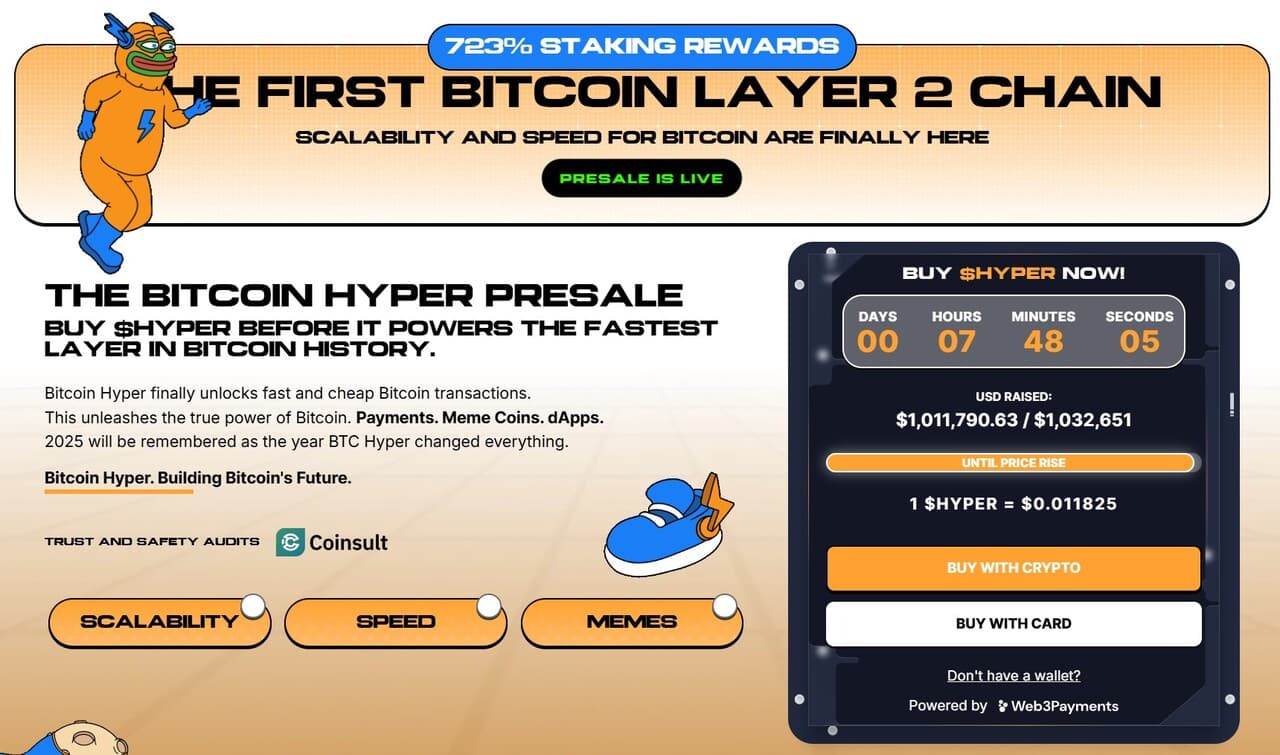
The entire Bitcoin Hyper platform is driven by its native token, $HYPER, which has already raised over $33.0M in its presale so far. The token is still below $1 and it has a total supply of just 21 billion tokens, indicating that it has incredible growth potential.
Find out more about Bitcoin Hyper:
2. Maxi Doge ($MAXI) – Bodybuilding-Themed Meme With Weekly Challenges & Community Rewards
Maxi Doge is a new meme coin that combines bodybuilding culture with crypto speculation. The token markets itself as a “240-lb canine juggernaut” that runs on Red Bull and determination, which sounds ridiculous but somehow fits the community they’ve built.
Unlike most meme coins that promise utility they never deliver, Maxi Doge actually has working features.
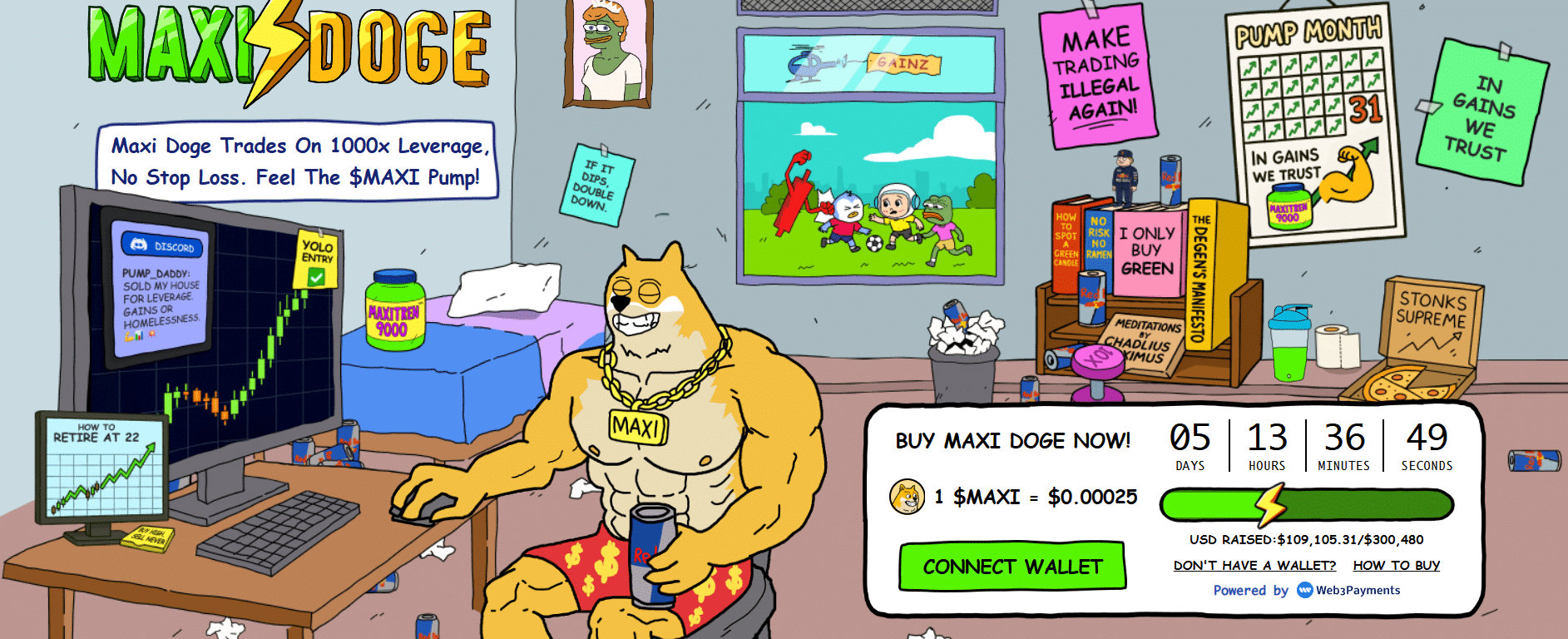
Holders can stake tokens for rewards, participate in weekly trading competitions, and join challenges that feel more like gym leaderboards than typical crypto activities. The “Leverage King Culture” encourages people to share trading strategies and amplify each other’s gains.
The project has audited smart contracts, treasury reserves, and partnership funding instead of just hoping things work out. The roadmap reads like someone’s daily workout routine, from “Red Bull and first 1000x leverage trade” to “Power through the final 6 hours of screentime.”
It’s authentically committed to the over-the-top fitness aesthetic and doesn’t pretend to solve world problems.
Find out more about Maxi Doge:
3. PEPENODE ($PEPENODE) – Trending Mine-to-Earn Meme Coin Offering Real Crypto Rewards
The next crypto on our list is PEPENODE, with a current token price of $0.001216. It’s the world’s first Mine-to-Earn meme coin, where token holders can build their own virtual token mining rigs and earn crypto rewards.
The project is still in its presale phase, which has already secured over $2.5M in crypto capital. $PEPENODE, the native utility token, is an attractive investment option for investors due to its mining-based utility and community-driven features.
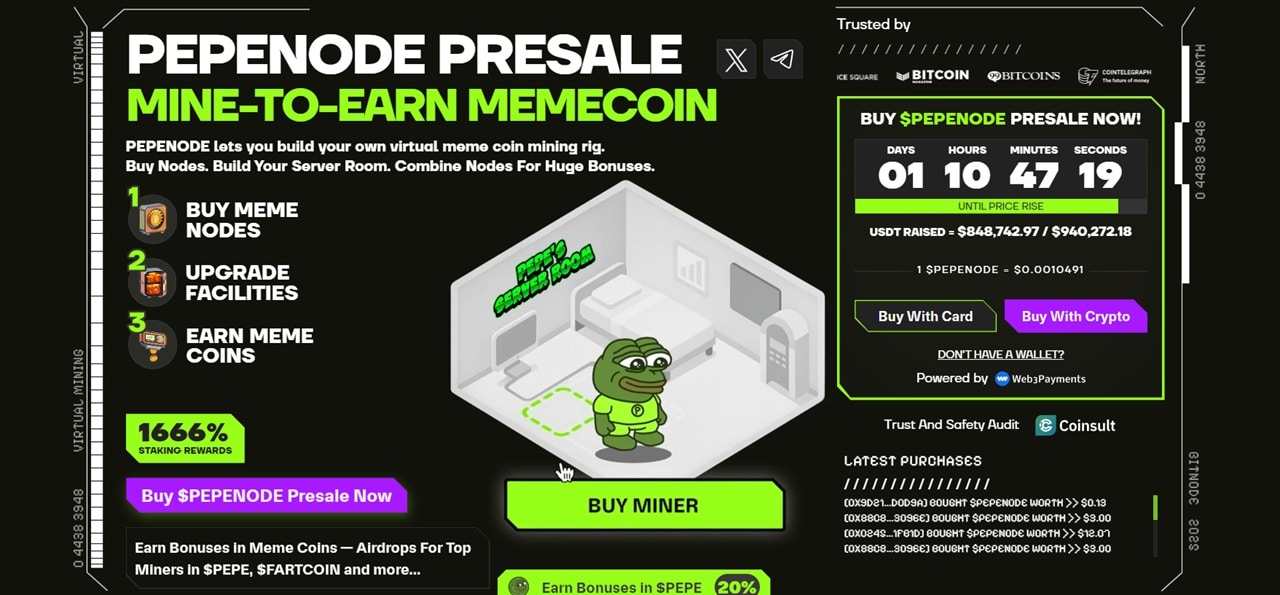
When the PEPENODE mining game launches, players will be able to purchase “Miner Nodes” using $PEPENODE tokens. Users install the nodes in their personal digital server rooms, and each node increases mining power for more token rewards.
$PEPENODE holders also benefit from the projects deflationary tokenomics, which help stabalize the meme coin’s price through strategic token burns. Specifically, 70% of all $PEPENODE tokens used to purchase nodes are permanently burned to increase the scarcity of the tokens.
Find out more about PEPENODE:
4. SUBBD ($SUBBD) – AI-Powered Content Platform That Lets Creators and Fans Monetize Together
Today’s creator platforms take a massive cut of revenue, offer little control to fans or creators, and rely on tools that limit growth. SUBBD aims to redefine how this works by providing AI tools, faster payments via crypto, and allowing fans to become more than just passive content consumers.
The $SUBBD token is what makes this system work. Holding it unlocks premium AI-enhanced and influencer-approved content, priority access to beta features and new launches, and discounts on content and subscription. Staking $SUBBD offers even more, including a 20% fixed APY, livestreams, behind-the-scenes content, credits to use on the platform, and more.
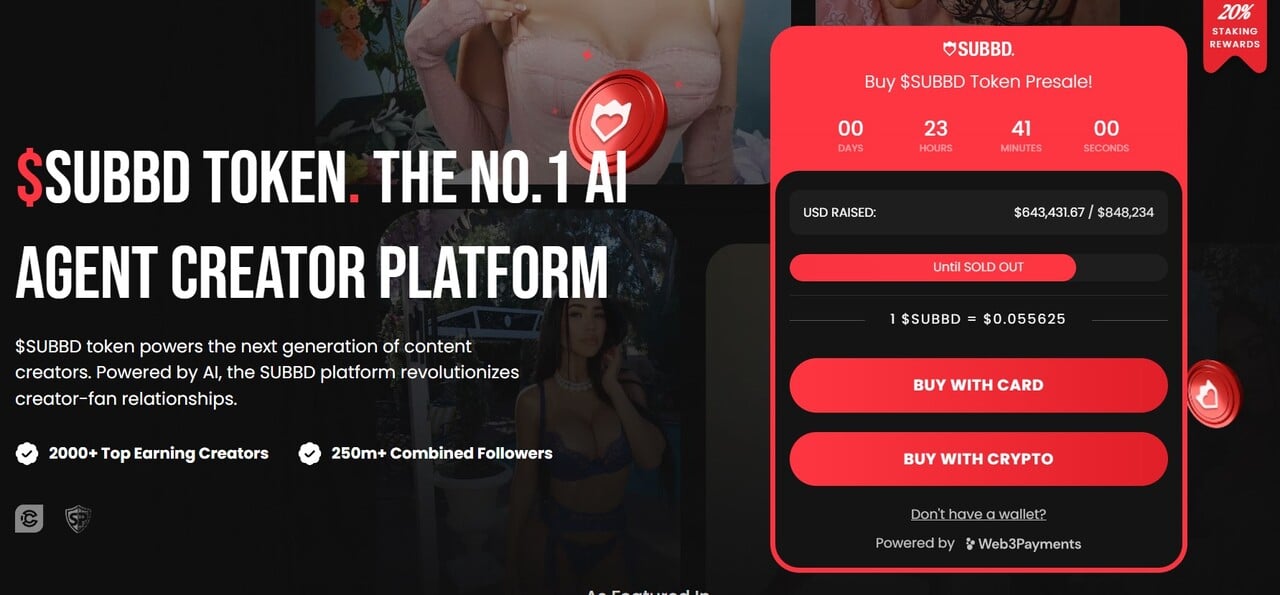
SUBBD aims to disrupt the $85 billion industry, and for a token that costs less than $1, this is an impressive task. The platform already boasts over 250 million combined followers across all its influencers and ambassadors. With over $1.6M raised in the current presale stage, this could be one of the best undervalued tokens worth considering.
Find out more about SUBBD:
5. Notcoin ($NOT) – Viral Telegram Tap-to-Earn Game That Became a Cultural Phenomenon
Notcoin is a pioneering tap-to-earn game project based in Telegram and a major part of The Open Network (TON) ecosystem. The idea is about as simple as it gets in crypto: you tap a virtual coin to earn Notcoin, a basic meme coin with no utility.
Notcoin’s team has done zero marketing for it and yet it has become one of the hottest coins on the market. The early community loved the concept and spread it to millions of other crypto users in under a week’s time. Unfortunately, the Notcoin tap-to-earn game is now over, so the best way to get $NOT is to buy it from a crypto exchange.
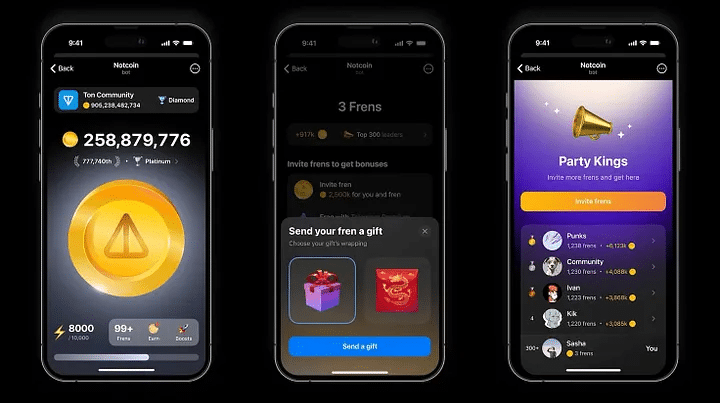
Even though the game was extremely simple, the team was able to make it fun and competitive. It was able to block auto-clickers and even introduced co-op multiplayer and a competitive leaderboard. Special boosts, power-ups, and quests helped keep players interested despite the simplicity of the base game.
Notcoin has never taken itself seriously and its humor has likely been a major driver of its success. For example, it released a ‘whitepaper’ that was comprised of a title, a date, and eight empty (white) pages, poking fun at the term.
Find out more about Notcoin:
6. Kaspa ($KAS) – Fair-Launch Layer 1 Network With Bitcoin-Style Distribution and Instant Transaction Finality
Kaspa ($KAS) is a Layer 1 blockchain project built on its unique blockDAG mechanism, a directed acyclic graph of blocks. Kaspa leverages the GHOSTDAG protocol to establish consensus and arrange blocks within the blockDAG, allowing the network to process multiple blocks in parallel rather than one by one, as is typically done in traditional blockchains.
As a result, Kaspa’s users experience unparalleled throughput and instantaneous transaction finality without compromising decentralization.
Having launched at the end of 2021 without an ICO or pre-mine, Kaspa emulated Bitcoin’s fair distribution and community-first model. By early 2025, it had become a top 50 cryptocurrency, with a market cap of around $2 billion.
Even investors who bought KAS in 2022 saw a massive return on investment (ROI) of over 44,000% from its all-time low.
Kaspa Price Chart
(KAS)Kaspa (KAS)
The project’s technical backbone has gained traction with passionate retail investors, which is evident in its growing community of over 247,000 X followers.
Moreover, Kaspa’s open-source development shows consistent activity with frequent GitHub commits. While KAS is available on KuCoin, Gate.io, and MEXC, its community believes KAS could soon be listed on Binance.
The KAS coin’s token supply is capped at just 28.7 billion tokens, adding an element of scarcity that’s unusual for cryptos under $1.
Find out more about Kaspa:
7. VeChain ($VET) – Enterprise Blockchain Platform That Tracks Supply Chains for Major Global Companies
VeChain ($VET) is a promising low-cap crypto under $1 to watch because it already has significant real-world use cases and high enterprise adoption. It’s the native cryptocurrency of a Layer 1 blockchain platform built to improve supply chain management using distributed ledger technology and IoT integration.
VET is a prime example of an established low-priced crypto with strong fundamentals. The coin’s long-standing utility as an infrastructure solution for multiple industries supports a strong reputation not commonly seen with many penny cryptos. VeChain has worked with Walmart China to track food products, and with firms like PricewaterhouseCoopers (PwC) to implement blockchain solutions for business auditing processes.
VeChain Price Chart
(VET)VeChain (VET)
The VeChain ecosystem uses a dual-token model. VET is the platform’s primary token used for staking and governance, and VTHO is generated from VET holdings to pay for transaction gas fees on the network.
VeChain runs with a proof-of-authority consensus mechanism, which is useful in enterprise ecosystems—and the blockchain has had no major outages since its launch, proving high network reliability and operational stability.
The “VeChain Renaissance” roadmap for 2025 includes new plans to help grow VET’s value. The roadmap includes tokenomics changes, EVM compatibility to onboard more developers, and improved governance through a DAO structure organized by VeChain developers.
Find out more about VeChain:
8. Laïka ($LAIKA) – Layer 2 Network That Brings DeFi and Programmability to DOGE
Laïka ($LAIKA) is a promising low-cap crypto under $1 to watch because it solves real scalability problems for Dogecoin and brings genuine utility to the world’s most popular meme coin.
It’s the native crypto of the first Layer 2 blockchain platform built specifically on Dogecoin to improve transaction speed, scalability, and programmability within the Dogecoin ecosystem.
LAIKA is a great example of an established low-priced crypto with strong fundamentals. The project makes smart contract support possible for Dogecoin, which previously only allowed simple value transfers, and brings DeFi features like liquidity pools, yield farming, and NFTs to the Doge network.
Laïka Price Chart
(LAIKA)Laïka (LAIKA)
Laïka has already launched liquid staking where users can stake $DOGE and get $mDOGE tokens to earn $LAIKA yield. The Laïka ecosystem also uses a dual-token model. LAIKA works as the proof-of-stake token for network security, while $DOGE can be used directly through account abstraction for transactions and fees on the Layer 2 network.
Laïka runs with a Proof-of-Stake consensus mechanism where Sequencers and Validators make sure data integrity between Layer 2 and Dogecoin’s Layer 1 blockchain, with all L2 actions checkable on the Dogecoin blockchain for transparency.
Find out more about Laïka:
Best Wallet - Diversify Your Crypto Portfolio

- Easy to Use, Feature-Driven Crypto Wallet
- Get Early Access to Upcoming Token ICOs
- Multi-Chain, Multi-Wallet, Non-Custodial
- Now On App Store, Google Play
- 250,000+ Monthly Active Users
Why Invest in Cheap Cryptos?
Buying crypto under $1 feels like getting in early, with the potential for big upside on a small budget. But a low price doesn’t always mean a good deal. What actually matters is market cap, not the number of decimal places. A coin trading at $0.004 with a tiny market cap has more room to grow than one at $0.50 that’s already fully diluted.
One of the main reasons cheap cryptos under $1 are appealing to investors is psychological bias. These low-cost coins enable investors to buy more units with a smaller budget, which creates a sense of greater potential wealth (for example, buying 1,000 tokens at $0.10 and imagining the crypto growing to $10 or more). Viral crypto success stories, like early Dogecoin ($DOGE) holders turning into millionaires, further support this psychological bias.
However, beginners should treat low-cost coins like any other investment, and thoroughly assess the crypto project’s fundamentals and risks. Evaluating the project’s real-world use cases, development activity, community sentiment, and trading liquidity can help you distinguish the real gems from average low-cost coins.
How to Evaluate Cryptocurrencies Under $1
Not all cryptos under $1 are inherently good investments. Some are cheap for a reason, like abandoned projects or meme tokens with little or no utility, while others are just early in their growth cycle and could hit $1 down the line, or have large supplies despite solid fundamentals. Here’s what to consider when looking at low-priced cryptocurrencies:
Market Capitalization
A token’s market cap (price per coin × circulating supply) is more important than the price, as it tells you how large a project really is. A coin that costs $0.50 and has a supply of 10 billion coins has a $5 billion market cap—but a coin that costs $5 and has a supply of 50 million coins has a $250 million market cap.
Why it matters: Market capitalization helps to indicate a coin’s potential for growth and significant price increases. Coins with a high market cap, such as Cardano or XRP (which are worth billions of dollars), are unlikely to increase by 100x easily. As a rule of thumb, a lower market cap means a higher potential reward—but also higher risk.
Real-World Utility
It’s important to know what real-world problems a project and its crypto token will solve, because coins with utility tend to have better longevity. Utility comes in many forms, such as powering blockchains (like ETH for Ethereum and ADA for Cardano), unlocking unique features (like VET for supply chain tracking), or even participating in DeFi protocols, games, and other decentralized applications.
Why it matters: There needs to be a reason to buy and hold cryptos beyond speculation. If a coin is required for transactions on a popular network or gaining access to services, it creates organic demand. For instance, Chainlink became valuable because its network participants use LINK to pay node operators for decentralized oracle network (DON) services.
It’s always better to choose coins with utility that have already been adopted, or at least have a documented roadmap that leads to adoption. The stronger and more unique the utility, the better the crypto’s long-term prospects—although delivery and execution quality still matter as well.
Development Activity
Active development is a positive sign that a project has room to grow. Investors can watch for consistent and frequent commits on GitHub, regular updates, transparent roadmaps, and active developer communities. A coin under $1 with no code updates in a year probably isn’t a good investment, as it’s likely an abandoned project. On the other hand, a cheap coin with an active development team may well be undervalued.
Why it matters: Blockchains and decentralized protocols are dependent on carefully coded and securely designed software—and if the underlying mechanisms don’t get upgraded over time, they risk becoming obsolete or even vulnerable to hacks. In that regard, development activity is essential as it signifies the rollout of new features on the blockchain, bug fixes, and network expansion to new use cases.
For example, the fact that the Kaspa team pushes periodic technology upgrades shows that the team is actively building the project. Likewise, Shiba Inu’s development of Shibarium shows efforts to increase utility beyond its meme origins.
You can visit any coin’s official channels to see how often they release updates, and what those updates consist of. Projects that hold AMAs with the community, and/or regularly publish reports on their progress, are more reliable. An active third-party developer community is also a positive sign of a project’s health and long-term potential.
Trading Volume
This is the amount of crypto transacted in a single day, and is often expressed in US dollars. Trading volume is an important metric to watch, as it indicates not just a coin’s liquidity but also investor interest, both of which contribute to price stability and consistent growth.
Why it matters: If a token doesn’t have liquidity, you may not be able to sell it when you want to. Large volume spikes generally happen ahead of price moves. Before investing, it’s also worth ensuring that volume hasn’t been artificially inflated via wash trading (fake volumes) on obscure exchanges.

What Kinds of Crypto Can You Buy Under $1?
The under $1 crypto space is quite diverse, ranging from the top 20 coins to lesser-known emerging tokens. In general, cryptos that cost less than $1 tend to fall into one of the following categories.
Established Low-Priced Cryptos With Strong Fundamentals
These cryptos have been around for a while, with relatively large market caps, solid technology, and real-world use cases—yet they still trade under $1. Their low price usually comes from a large token supply rather than low project value.
Examples include:
- Stellar ($XLM): Stellar is a payment network facilitating cross-border transactions, has been active since 2015, and has several partnerships with legacy fintech players (including the US Federal Reserve). XLM’s price is low due to its massive supply of 50 billion tokens.
- TRON ($TRX): TRON is a high-throughput blockchain known for entertainment dApps and DeFi. It primarily excels in stablecoin transfers and gambling dApps.
- Cardano ($ADA): Cardano is a Layer 1 smart contract platform that’s remained in the top 15 cryptos by market cap for several years. Although it has seen a recovery above $1 during previous bull runs, it generally trades below that level.
- VeChain ($VET): An enterprise blockchain leader with actual use cases in supply chains and sustainability.
Investing in these established coins is like buying blue-chip stocks instead of penny stocks. They’re less likely to go to zero because of their strong communities, continued development, actual use cases, and adoption. Because they already have relatively large valuations, a 100x return is unlikely—although a 5x over the course of a few market cycles could be feasible if they capture more market share.
Emerging Cryptos Under $1 With High Growth Potential
This category includes newer projects that are still developing their tech and ecosystems, and/or growing their communities. Their tokens usually have a mid-to-low market cap, and could offer exponential gains in the right market conditions. Some examples include:
- Entangle ($NTGL): This is a relatively new project that aims to offer core Web3 infrastructure. The NTGL token is both cheap and extremely volatile, and has a total supply of 843 billion.
- Mina Protocol ($MINA): Described by its creators as the world’s lightest blockchain, Mina Protocol uses zk-SNARKs (zero-knowledge proofs) to build a constant-sized blockchain (22KB). MINA is priced well below $1, but has a vibrant dev community and is advancing use cases around private DeFi and identity.
- Web3 Gaming Tokens (such as Yield Guild Games ($YGG) and Aavegotchi ($GHST)): These tokens often start below $1, and can appreciate quickly as their platforms attract more users. Depending on hype and broader market conditions, it’s not uncommon to see 10x or 15x gains in this category.
Regardless of which category of crypto you’re drawn to, it’s important to read every project’s whitepaper, learn about the team members, look for well-known investors backing the project, and observe the general community sentiment. A useful portfolio management strategy is to spread your bets among a few good projects that you find the most appealing.
Meme Coins and Speculative Low-Cost Tokens
Finally, there’s a whole class of cryptos under $1 that thrive purely on speculation and/or memes. These include well-known meme coins, as well as countless penny tokens with no serious projects behind them.
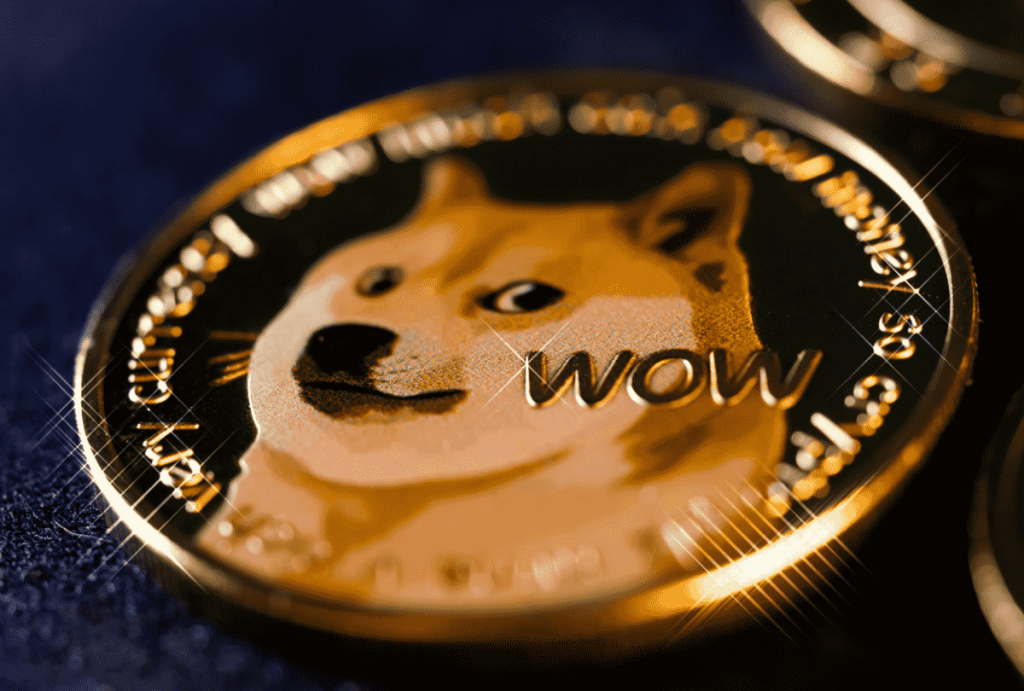
Dogecoin is still well below $1, and has proven its worth as the most legitimate meme coin on the market. A major reason behind this is DOGE’s growing utility in the real world, as it’s used for tipping, buying Tesla merchandise, and online microtransactions. Shiba Inu is another popular meme coin that’s witnessing high developer activity and attracting new users to its Layer 2 solution, Shibarium.
Similarly, Pepe and Floki Inu are other examples of animal-themed meme coins that have gone viral on social media.
The price of a meme coin is normally tied more to the size and enthusiasm of its community than the token’s utility. For instance, Dogecoin skyrocketed in 2021 to reach an all-time high, primarily driven by Elon Musk tweets.
Based on social media trends, meme coins can typically pump 10x in a week and dump 90% the following week. So, while meme coins can be fun and sometimes profitable if timed right, they carry the highest risk. Many are outright scams or pump-and-dump schemes.
It’s also important to remember that some decentralized crypto exchanges allow users to list multiple tokens with the same names, tickers, and even logos. This enables scammers to imitate popular coins and trick exchange users into buying a scam coin instead of the one they actually wanted. Before buying any crypto through a DEX, always double-check to make sure you’re buying the correct coin and not a fake.
Latest Market News


Where to Buy Cryptocurrencies Under $1
Once you spot promising cheap cryptos, you need to buy them without getting scammed or overpaying. Most projects below $1 mark trade on major exchanges, but the newest and smallest projects only exist on decentralized exchanges.
Here’s where to find these coins and how to buy them safely:
Exchanges
Many well-established cryptos under $1 (including well-known meme coins like SHIB or DOGE) can be bought on large exchanges like Binance, Coinbase, Kraken, and KuCoin. The advantages of purchasing cryptos on major cryptocurrency exchanges include high liquidity, regulatory oversight, and user-friendliness. Most platforms let you create an account, deposit funds (using a credit card, debit card, or wire transfer), and execute trades.
New and emerging coins usually list first on Gate.io, MEXC, OKX, or similar small- to mid-sized exchanges, often before larger platforms host them. For example, Kaspa was on MEXC and Gate.io before it reached bigger exchanges. If the coin you’re looking for isn’t on a major exchange, there’s a good chance you’ll find it on one of these platforms. It’s important to stick to trusted names like MEXC, Gate.io, and KuCoin, which have solid reputations for reliability.
Very new tokens often start trading on DEXes like Uniswap (for Ethereum tokens), PancakeSwap (for BSC tokens), or TraderJoe (for Avalanche). To buy cryptos from a DEX, you’ll need a Web3 wallet like MetaMask or Best Wallet, and some base crypto to swap. This is often the only way to buy many cryptos under $1 in their early days—although some (like PEPE) can go on to achieve major exchange listings and mainstream success.
Safety tip: Always verify official sources and token contract addresses to avoid impersonation scams on DEXes.

How to Buy Low-Priced Crypto
Choose an Exchange and Sign Up
Register with a centralized exchange and complete identity verification, or create a crypto wallet to start trading on a DEX.
Deposit Funds
Deposit fiat (like USD or EUR) or crypto into your exchange account. If you’re using a DEX, you’ll need the network’s native token in your wallet (such as ETH for Uniswap or BNB for PancakeSwap) to pay for transactions.
Find the Coin
Look for the trading pair you need. On DEXes, you can either paste in the token’s contract address or search for it on the list.
Place a Buy Order
You can place a market order to immediately buy the crypto at the current price. You could also place a limit order that executes only when the token hits a certain price (useful for avoiding slippage in volatile, low-cap coins). On DEXes, just enter how much you want to swap and set your slippage tolerance.
Store Your Coins
If you plan to hold coins long-term, it’s better to move them to a secure self-custody wallet, especially after the $1.5 billion Bybit hack which highlighted the vulnerabilities of centralized exchanges. If you bought your crypto from a DEX, the tokens are already stored in your wallet.
Stay Informed
Follow project updates and news that could affect your investment. Also, when buying very cheap tokens, make sure trading fees don’t eat up a large percentage of your funds.
Common Risks When Buying Cheap Cryptos
- Scams and Rugpulls: The low-cap crypto market is especially infamous for scams, “pump-and-dump” schemes, and even fake projects. Some red flags include a lack of a whitepaper, minimal GitHub activity, anonymous founders, and overly aggressive marketing promises.
- High Volatility: These cryptos are also prone to large price swings. This is why using limit orders and stop-losses can be helpful.
- Liquidity Risk: Lower trading volume means a higher chance of not being able to sell at your desired price.
- Regulatory Risk: Some smaller coins might get delisted if they’re seen as unregistered securities in certain jurisdictions.
- Security Risk: Be alert for phishing when using DEXes. Double-check that you’re on the correct site, and protect your private keys.
- FOMO: Don’t invest heavily in a coin just because it’s cheap, as most of these coins never reach $1. Only risk what you can afford to lose.
- Project Failure: Small crypto projects can fail easily due to a lack of funding, team issues, or tough competition.
Do Cryptos Under $1 Really Have Potential?
One of the most common questions newcomers ask is if penny cryptos can ever amount to anything significant. Let’s understand this by looking at history, key price catalysts, and portfolio strategy.
Historical Examples of Cheap Cryptos That Exploded in Value
History is full of examples of coins once priced below $1 that later reached valuations of 100x, 1000x, and more:
Bitcoin ($BTC) and Ethereum ($ETH)
Bitcoin traded for just a few cents in 2010, but by January 2025, it was valued at over $108,000. Ethereum also saw massive price increases, as it traded for under $1 during its 2015 crowd sale and eventually soared to nearly $5,000 in November 2021.
Dogecoin ($DOGE)
For most of its early days, DOGE was priced well below 1 cent. As the first-ever meme coin to get mainstream attention and recognition from popular figures like Elon Musk, it surged from about $0.005 in early 2021 to highs of $0.73 by May of the same year—an almost 15,000% return.
Shiba Inu ($SHIB)
SHIB launched in late 2020 at around $0.00000000005, but by October 2021 it had reached $0.00008, an almost 160,000,000% increase. Some early investors turned a few hundred dollars into millions.
Cardano ($ADA)
ADA debuted on exchanges at about $0.02 before shooting up to around $1.10 in January 2018. By 2021, it had reached a new ATH above $3.
Binance Coin ($BNB)
BNB started at around $0.10 during its ICO in 2017 and is currently trading well over $600, an approximately 6,000x return from its ICO price.
These examples show that cryptos under $1 can deliver outstanding returns, but such opportunities are quite rare. Most crypto launches fail or stagnate. Investors who buy price peaks (usually due to the fear of missing out) can incur significant losses, making purchase timing (and early buying) extremely important.
Factors That Could Influence Price Growth
For a cheap crypto to explode, the following factors should typically align:
- Bull Market Conditions: When overall sentiment is bullish, speculative money flows into lower-cap coins in search of the next big thing. On the other hand, even promising projects can stall if the market mood is bearish.
- Exchange Listings: Getting listed on major exchanges (like Coinbase or Binance) suddenly makes a coin available to millions of buyers. Coins often jump 20-50% on listing news alone.
- Community and Social Media Hype: If a coin trends on Twitter, Reddit, or Telegram, the buzz can fuel a self-fulfilling price rise. An enthusiastic army of supporters rising behind a coin can be a huge catalyst.
- Technical Breakthroughs: Hitting major development milestones (such as launching a working mainnet) or solving important industry problems can attract attention and justify higher valuations.
- Regulatory and Legislative Developments: Regulators like the US Securities and Exchange Commission (SEC), and lawmakers in every country, can impact crypto price movements with new announcements.
- Genuine Adoption and Partnerships: Real-world integrations and big-name collaborations provide a strong proof of concept and value.
- Scarcity Events: Token burns or halvings that cut supply can drive prices up if demand holds steady.
- Market Narrative Fit: Being in the right sector at the right time (for example DeFi, the metaverse, and/or AI) can help a token’s price to quickly pump.
It’s usually not one factor, but a confluence of them, that helps to create a new crypto rally. When everything is going right and euphoria peaks, it often signals a top, which is when savvy investors might begin taking profits.
Conclusion – Should You Invest in Multiple Low-Cost Cryptos?
Diversification is typically a good idea when it comes to cheap cryptos. By spreading your bets, you have a better chance of hitting a big winner. For example, if you invest $100 in 10 different coins, and nine go to zero while one does a 100x (turning $100 into $10,000), you still get a 10x overall return. Diversification also mitigates project-specific risks.
However, spreading yourself too thin can dilute your potential gains. It’s also harder to track developments across too many projects. Most importantly, diversification only within crypto (and not other assets like stocks and commodities) might not protect you from a market-wide downturn.
Therefore, it’s generally considered ideal to identify 3-10 low-priced projects from different niches that you really believe in. Allocate more toward established projects, and less toward ultra-speculative ones. Then, periodically review and rebalance your portfolio by realizing gains and selling coins showing low potential for growth.
Crypto Under $1 FAQs
What is the best cryptocurrency under $1?
If you're more interested in established cryptos, Cardano and Stellar are worth considering. If you want cryptos with more room for growth, newer projects like Kaspa could be better.
Can a cheap cryptocurrency reach $100 or more?
A few coins like BNB have gone from pennies to $100+ through massive adoption and relatively low supply. For most coins with large supplies, reaching even $1 is challenging.
Are cryptos under $1 a good investment?
They can be, but price alone doesn't determine potential. Under-$1 cryptos offer potential for large percentage gains, but include many risky ventures with higher failure rates. They’re ideal for a portion of a diversified portfolio if you've researched the fundamentals and understand the project's potential.
How do I know if a low-cost crypto is a scam?
Watch for red flags like anonymous developers, unrealistic promises of guaranteed returns, lack of working product/code, pressure tactics, negative community feedback, concentrated token distribution, and no security audits.
Where can I buy cryptos under $1?
Most established under-$1 cryptos are available on major exchanges like Binance, Coinbase, Kraken, and KuCoin. For newer tokens, check mid-tier exchanges like Gate.io or MEXC. Very new tokens might only be on decentralized exchanges like Uniswap or PancakeSwap.
Why are some cryptocurrencies priced so low?
This is usually due to the high token supply (billions or trillions of tokens), early project stage, low market demand, or intentional design for psychological appeal. A low price often reflects tokenomics rather than project quality.
Do low-priced cryptos have a higher risk of failure?
In general, yes. Cheap coins with a smaller market cap are typically small and new projects. They’re also vulnerable to security, regulatory, and technical risks.
What is the difference between price and market cap?
Price is how much one token costs. The market cap (price × circulating supply) is the total value of a project.
Should I buy meme coins under $1?
Meme coins can deliver exponential gains, but are highly volatile and risky—so it’s important not to give in to FOMO (fear of missing out) when making an investment decision.
How long should I hold cheap cryptocurrencies for potential gains?
This depends on your strategy, and a coin's current price performance. Short-term trades on fast-moving cryptos might last for weeks, days, or even hours—but long-term investments could require months or years of patience.
References
- Pepe Price (CoinGecko)
- Shiba Inu Price History and Prediction (CoinMarketCap Blog)
- Here’s Why Kaspa (KAS) Could Be Listed on Binance ‘Very Soon’ (CoinMarketCap Blog)
- VeChain: What It Is, How It Works, Examples, and History (Investopedia)
- “VeChain Renaissance” roadmap for 2025 (VeChain via X)
- Overview of Universal Interoperability Protocol (Entangle)
- What’s behind Dogecoin’s price surge—and why seemingly unrelated brands are capitalizing on its popularity (CNBC)
- Bybit Hit by Crypto’s Worst Hack With Almost $1.5 Billion Stolen (Bloomberg)