Everybody in crypto is always obsessing over Bitcoin hitting its next ATH, but what nobody will tell you is that real money is made by trading underappreciated projects valued under the $1 threshold.
Serious investors usually won’t touch tokens under $1, but once a project breaks that psychological barrier, institutional money floods in and early investors start making millions.
We’ve analyzed hundreds of tokens under $1 point, and found that the most likely candidates to cross it in August 2026 are Bitcoin Hyper, Maxi Doge, and PEPENODE. This is mostly thanks to their viral communities, strong use-cases and transparent roadmaps.
Below we’ll take a closer look at these projects and several others, what makes them special, and also show you our step-by-step guide on finding the next crypto to hit the $1 mark.
⚡ Highlighted




Top Gainers (24h)
 Siren
SIREN
Siren
SIREN
 Coq Inu
COQ
Coq Inu
COQ
 OriginTrail
TRAC
OriginTrail
TRAC
 KAITO
KAITO
KAITO
KAITO
 Ava AI
AVA
Ava AI
AVA
Top Losers (24h)
 Reef
REEF
Reef
REEF
 eCash
XEC
eCash
XEC
 Toshi
TOSHI
Toshi
TOSHI
 Yield Guild Games
YGG
Yield Guild Games
YGG
 OMG Network
OMG
OMG Network
OMG
Crypto That Could Hit $1 in 2026
Let’s dive straight into five tokens that could be the next cryptos to hit $1 this year.
1. Bitcoin Hyper ($HYPER) – The Missing Link Between Bitcoin and Modern DeFi
Bitcoin Hyper promises sub-second transaction finality, high throughput, and dramatically lower fees without sacrificing Bitcoin custody, thanks to a canonical bridge that locks $BTC and issues equivalent $HYPER tokens. With the bridge, users retain full control of their Bitcoin, but gain the performance and programmability of modern layer-1s like Solana or Avalanche.
Built on the Solana Virtual Machine, $HYPER, the native token, does the heavy lifting: powering transactions, enabling smart contracts, and unlocking access to a growing dApp ecosystem. Staking rewards, DAO governance, and early developer grants round out a utility-focused token model. The tokenomics are deliberately designed to echo Bitcoin’s 21 million supply cap, scaled to 21 billion.
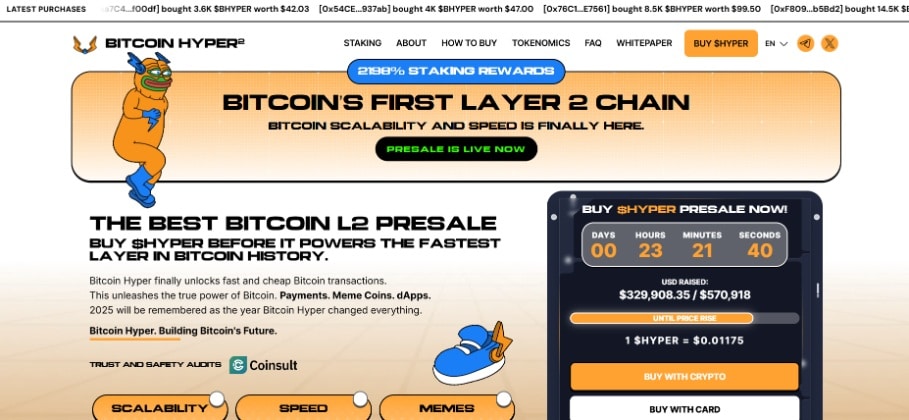
For all its ambition, Bitcoin Hyper is still early-stage. The mainnet isn’t live, exchange listings are penciled in for Q4 2025, and there’s minimal information about the DAO’s actual structure. Success hinges on building a developer ecosystem that wants to deploy on a Bitcoin layer-2 instead of Ethereum or Solana directly. And while the Solana VM is powerful, it comes with its own baggage, including outages, complexity, and a steep learning curve for some builders. That said, if Bitcoin Hyper delivers on its roadmap, it could be one of the most significant efforts to bring programmable utility to Bitcoin without asking users to give up their BTC keys.
Price analysis
Bitcoin Hyper has set its total supply at 21 billion $HYPER, intentionally mirroring Bitcoin’s 21 million, aiming to imply long-term scarcity with a scaled-up utility layer. 30% will be used for engineering and infrastructure, including the canonical bridge. 25% will be used for operations, partnerships, and exchange relations. Marketing eats up another 20% (4.2B) to promote user growth, presale outreach, and network adoption. 15% will be used for community rewards, including staking incentives, airdrops, and early liquidity programs. Exchange listings will round out the final 10%.
With listing expected by Q4 2025, speculative demand may ramp up post-mainnet launch in Q3, especially if early dApps and DeFi integrations prove functional. If successful, price appreciation will likely be driven by increased transaction volume (all requiring $HYPER for gas), staking lockups reducing circulating supply, developer adoption and DAO participation. However, price performance is speculative until there’s measurable demand on-chain.
Key strengths
- Maintains full $BTC custody while allowing access to faster layer-2 utility.
- High performance, sub-second settlement, scalable to thousands of TPS.
- Enables dApps, staking, perpetuals, swaps, and more for Bitcoin holders.
- Reviewed by Coinsult, removing early-stage technical risk.
- Democratic protocol changes expected Q4 2025.
Risks
- Everything is hypothetical until mainnet launches (planned for Q3 2025).
- Competing with dozens of other L2s and modular chains, including Ethereum rollups.
- Grant-funded growth is a gamble unless builders stay long-term.
- Solana VM is fast, but has a history of congestion and downtime.
Find out more about Bitcoin Hyper
2. PEPENODE ($PEPENODE) – Mine-to-Earn Meme Coin With Gamified Virtual Mining
PEPENODE Token ($PEPENODE) is a new meme coin that’s trying to fix the boring presale problem with a virtual mining game investors can play immediately after buying.
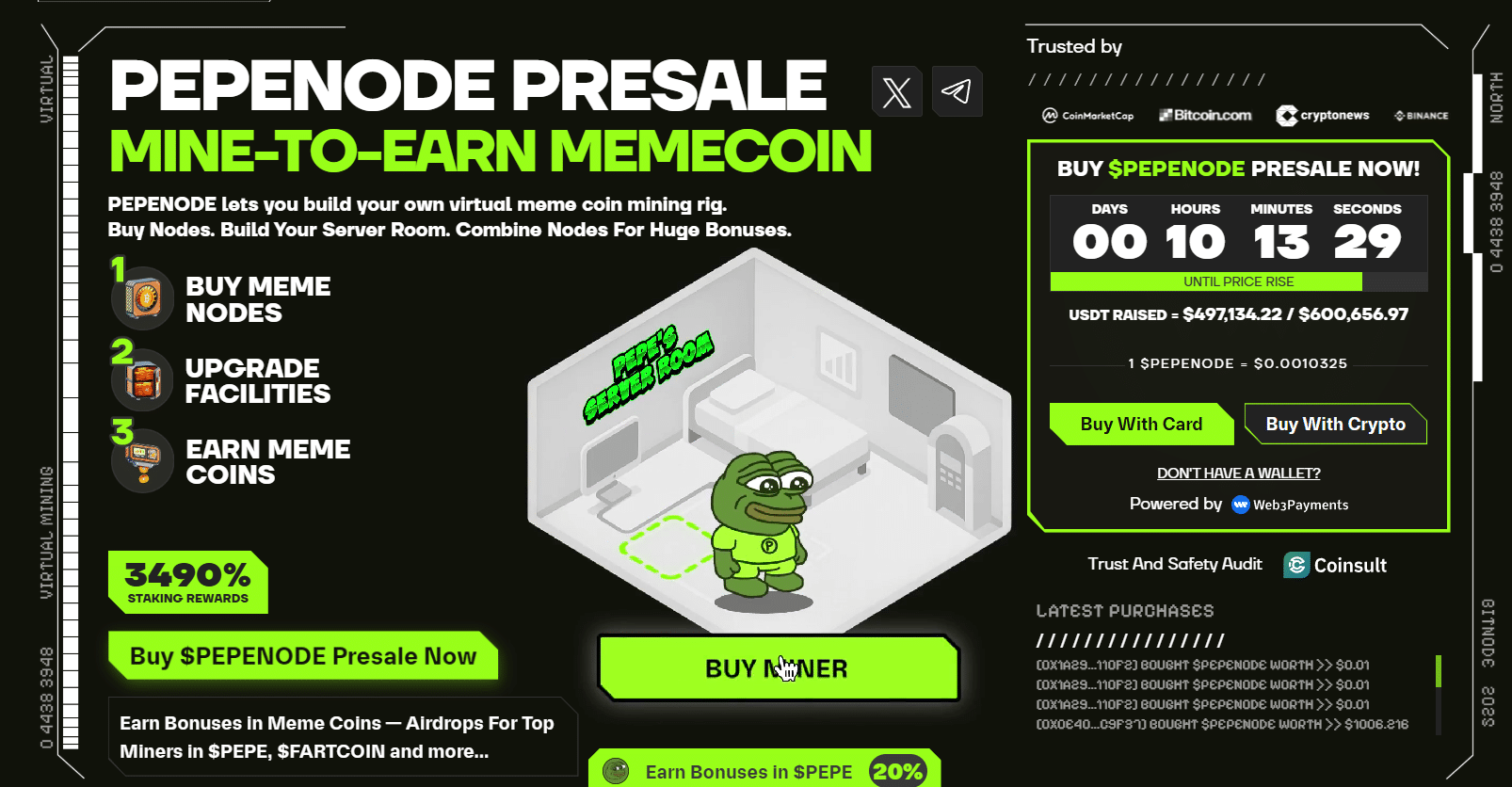
It powers a browser-based mining simulator where you build server rooms, deploy nodes, and compete on leaderboards. The platform burns 70% of tokens used for upgrades and promises to reward top miners with airdrops of other meme coins like $PEPE and $FARTCOIN.
Price analysis: Pepenode is still in its presale phase with over $554,000 raised. Its price is currently around $0.001 per token and increases progressively through presale stages. The team allocated 35% of tokens to protocol development and another 35% to economics/treasury, with no private sale or team allocation.
Key strengths
- Smart contract audited by Coinsult
- Deflationary mechanics through 70% burn rate
- No insider allocation or private rounds
Risks
- Registered in British Virgin Islands (limited accountability)
- Meme coin market is massively oversaturated
Find out more about PEPENODE
3. SUBBD ($SUBBD) – The Web3 Revolution for Content Creators and Fans
SUBBD is a subscription content creation platform that’s set to change the game for influencers and creators. It offers a suite of AI-powered tools that reduce the time creators spend on administrative work, freeing them up to focus on releasing new content. At the same time, SUBBD’s generative AI features make it easier than ever for influencers to release personalized content tailored for top subscribers.
For fans, that means deeper connections with their favorite creators and more content to enjoy. In addition, fans can use SUBBD’s AI tools to generate their own content in the style of their favorite influencer, with that influencer’s permission, and monetize it with other fans.

The entire ecosystem is driven by the $SUBBD token, which unlocks access to exclusive content, facilitates subscriptions, and offers community-only discounts and rewards. SUBBD is backed by prominent influencers with a combined social following of more than 250 million, reflected in the fast-moving $SUBBD token presale, which has raised nearly $900,000 already and could produce significant returns down the line.
Price analysis
The SUBBD presale kicked off in April 2025 with tokens priced at $0.055075, which puts it less than 20x away from hitting that magical $1 mark. You can still grab tokens in the ongoing presale for $0.056325 right now.
Once SUBBD actually launches and the platform features start rolling out, expect the token to blast past $0.10 pretty quickly. From there, if the momentum keeps building and users actually start using the platform, we could see a serious run toward $1 as more people the real value behind SUBBD’s use-cases.
Key strengths
- Subscription content creation platform incorporating generative AI
- Backed by major influencers with 250 million combined followers
- $SUBBD token is less than 20x gain from $1 at the start of the presale
- $SUBBD offers staking rewards, subscription discounts, exclusive content, and more
Risks
- Competes with other subscription content platforms and generative AI tools
- Presale is in its early stages, with the concept still just on paper
Find out more about SUBBD
Best Wallet - Diversify Your Crypto Portfolio

- Easy to Use, Feature-Driven Crypto Wallet
- Get Early Access to Upcoming Token ICOs
- Multi-Chain, Multi-Wallet, Non-Custodial
- Now On App Store, Google Play
- 250,000+ Monthly Active Users
Why the $1 Mark Matters to Crypto Investors
The $1 mark is an important psychological price point for crypto investors. While it doesn’t have any ‘real’ significance, it can have a big impact on how investors perceive tokens.
Tokens are no longer considered penny cryptos after they hit $1. For some investors, that’s a good thing because penny cryptos are often seen as risky, and tokens priced at over $1 could be viewed as less risky (although this is not necessarily the case). For other investors, the $1 mark could represent decreased affordability, with tokens above this threshold no longer seeming like a good deal.
Given these dynamics, the $1 price area often serves as an area of support and resistance when studying crypto token charts, and consequently bears importance for short-term traders as well.
Despite all of this, the $1 price level doesn’t actually reveal much about a token’s value, or even what a crypto project is worth intrinsically. A crypto’s overall value is determined by its market capitalization (market cap): the token price multiplied by the number of tokens. So, two tokens could be priced at $1, but one project could be worth a lot more than the other if it has more crypto coins in circulation.
In addition, $1 doesn’t signal that a token is a good buy at the moment it hits this threshold. To determine whether a token is worth the investment, investors need to look carefully at a token’s historical price action and its fundamentals to evaluate what it could be worth in the near future.
Looking for the next crypto to hit $1 can be a way to generate ideas for tokens to investigate further. But a token approaching or breaking through $1 shouldn’t be grounds on its own for buying a crypto coin.
Key Criteria for Identifying Potential $1 Coins
There are a number of factors to consider when analyzing whether a specific coin can become the next crypto to hit $1.
- Market cap potential: Look closely at a token’s current market cap and compare it to the market cap of leading tokens in the sector. Is it realistic for the token’s price to increase to $1 based on how similar tokens are valued? If a $1 price would make a token the most valued coin in its sector by a wide margin, it may not be feasible for the token to reach $1 in the near future.
- Community & developer activity: A strong community engagement is the basis for long-term price appreciation for most cryptocurrencies. It’s important to look at how many token holders a project has, whether the number of holders and developers is growing, and whether the project is keeping its community engaged.
- Exchange listings & liquidity: Crypto tokens can reach $1 while only trading on decentralized exchanges, or even during a presale. However, for most tokens, reaching $1 is only possible if they are widely available and easy to trade with significant liquidity, where bigger trading volumes are possible. That means upcoming exchange listings on top centralized exchanges, and ideally Tier-1 exchanges like Binance and Coinbase.
- Token supply & emission schedule: Tokenomics can play a big role in a token’s ability to reach $1. Look carefully at how many tokens a project plans to release and whether all of them are already in circulation. Watch for team tokens, which can dilute investors’ coins if they are sold. Tokens released through staking rewards can also dilute the existing supply and hold a token back from reaching $1.
- Backing, partnerships & roadmap: The team behind a crypto project matters a lot. Experienced teams that are dedicated to a project for the long term are more likely to shepherd it forward, helping drive price gains and bringing the token closer to $1. Be sure to closely study a project’s roadmap and see whether it has secured strategic partnerships with other major projects.
Cryptos That Broke $1
Looking back at some cryptos that broke the $1 threshold in the past can offer a guide into what this milestone means for tokens vying to become the next crypto to hit $1.
Polygon ($MATIC) – Ethereum’s Scaling Solution with Lightning-Fast Layer 2 Power
Polygon launched at a price around $0.00445, less than a cent, back in April 2019. It began its rise to $1 in 2021, during a massive crypto bull market, and broke through in May. That was hardly an endpoint for $MATIC’s rise, however – the token carried its momentum and rocketed to a high of $2.21 in the weeks that followed. Importantly, after the token price began to fall as traders sold for profits, $MATIC held $1 as a key support area.
MATIC (migrated to POL) Price Chart
(MATIC)
MATIC (migrated to POL) (MATIC)
Dogecoin ($DOGE) – Most Popular Meme In the Industry With Elon Musk’s Backing
Dogecoin began life in 2014 as a practical joke, and it wasn’t until 2021 that the token began to gain serious traction. It rocketed past $0.01 in January 2021, then quickly skyrocketed to $0.73 in April after receiving backing from Tesla founder Elon Musk. $DOGE never actually did break $1, its current price being $0.24, but the $1 level remains a symbolic goal for the Dogecoin community that many long-term token holders are waiting for.
Dogecoin Price Chart
(DOGE)
Dogecoin (DOGE)



Ripple ($XRP) – Blockchain-Powered Payment Solution That Big Banks Trust
Ripple was one of the first major cryptocurrencies of the 2017 ICO boom to break the $1 threshold. It was priced at less than a cent at the start of that year, but quickly exploded to an all-time high of $3.32 by the end of the year. The $1 benchmark never even slowed $XRP down. Conversely, the $1 threshold didn’t serve as support for $XRP when the token’s price fell due to a lawsuit with the SEC.
XRP Price Chart
(XRP)
XRP (XRP)
The most notable thing these tokens have in common is that they all crossed the $1 threshold (or, in $DOGE’s case, approached it) when the crypto market was in the middle of a historic bull run. Bullish conditions are key to tokens exploding higher in such a significant way, so it’s noteworthy that analysts think the market today could be on the cusp of another bull run.
What to Avoid When Chasing Low-Cost Tokens
Low-cost tokens can offer potential for huge returns, but they can also be risky. It’s important to make sure the tokens you’re considering are truly strong investments that can deliver the returns you’re aiming for.
Here are some red flags to watch for that can indicate a low-cost token might not live up to expectations:
- Large token supply: A very large token supply with no mechanism for burning tokens can lead to oversupply, making it hard for prices to rise even when demand grows.
- No working product or roadmap: Many projects have promised a new platform, only to fail to deliver. Watch out for projects that don’t have a product ready and don’t have a clear plan for building one.
- Anonymous teams: Projects should be transparent about who is behind them and their experience. Note that in the meme coin sector, keeping project teams anonymous remains common practice.
- Tokens with no utility: Hype-driven coins with zero real-world utility, meaning they’re not designed for solving real-world problems, present serious risks of rug pull scams, in which founders exit a project with investors’ funds without delivering anything in return. They’re also highly risky since the token price can fall suddenly if the hype disappears.
- Low liquidity: Tokens with low liquidity and trading volume can be difficult to sell. Watch out for tokens that aren’t available on major exchanges or only have questionable exchange listings.
Future Trends That Could Influence Price Movements
It’s also important to be aware of macro-factors that could impact the success of promising crypto tokens and their ability to become the next crypto to hit $1. We’ll cover some of the key factors and market trends that influence prices for the growth prospects of tokens.
Crypto Market Cycle
The crypto market goes through major bull and bear cycles, which can have a big impact on the prices of top low-cap cryptocurrencies. Bull market cycles helped push $MATIC and $XRP over $1, but they’ve also caused crashes in many tokens that looked like they were about to break through $1 and then never did. It’s crucial for investors to watch which way the market is headed and invest with the market rather than against it.
Layer-2 Growth and Altcoin Season
The growth of Layer-2 networks on Ethereum and other Layer-1 blockchains has a significant impact on token values. This represents a major growth market sentiment that can push the prices of related projects higher.
At the same time, investors should watch for ‘altcoin seasons,’ which typically see the value of altcoins grow relative to Bitcoin. For tokens looking to become the next crypto to hit $1, the effect of an altcoin season is similar to the impact of a crypto bull market.
Crypto Regulations
The crypto market has long been asking for more regulatory clarity, particularly in the US. It could soon get this thanks to crypto legislation working its way through Congress. This could encourage more investors, and especially financial institutions, to invest in cryptocurrencies for the long term and put their weight behind promising projects.
Institutional Investment
Institutional investors go through waves of interest and disinterest in buying cryptocurrencies, particularly cryptos with innovative solutions and strong utility. Institutional investment can bring huge amounts of money into a token and keep tokens off the market for years, which is important for helping the price rise. However, when institutions sell a project, it can also flood the market with coins and send a project back below key support levels.
Trending Sectors
Some sectors of the crypto market are simply hotter than others, making it more likely that tokens in these sectors will grow to $1 faster than their peers. For example, some of the hottest areas of the crypto market right now involve AI agents, play-to-earn games, and real-world asset tokenization platforms.
Conclusion: Is Chasing the $1 Crypto a Smart Strategy?
The next crypto to hit $1 in July 2025 include projects like Bitcoin Hyper ($HYPER), PEPENODE ($PEPENODE), and SUBBD.
These tokens have the essential in transparent teams behind them. From AI-powered content platforms and Bitcoin Layer 2 solutions to gaming rewards and trading automation, each project offers real value.
If you’re thinking about joining, there won’t be a better time than now.
Looking for more tokens to add to your crypto portfolio? Check out our full guide to the best altcoins to buy today for our top investment ideas.
Next Crypto to Hit $1 FAQs
What does it mean when a cryptocurrency “hits $1”?
Why is the $1 price level significant in crypto investing?
How can I identify low-priced coins with $1 potential?
Does a low token price mean a coin is undervalued?
What factors influence whether a token can realistically reach $1?
How does token supply impact the chances of hitting $1?
Which cryptocurrencies are currently under $1 but gaining traction?
What are the risks of investing in low-cap or sub-$1 cryptocurrencies?
Can meme coins ever sustainably reach or stay above $1?
Where can I track emerging altcoins that might break the $1 mark?
References
- Cathie Wood’s Firm Predicts Bitcoin Price Could Surge to $1.5Mn by 2030 (Newsweek)
- Dogecoin price surges after tweets from Elon Musk and Mark Cuban (CNBC)
- SEC Charges Ripple and Two Executives with Conducting $1.3 Billion Unregistered Securities Offering (SEC)
- Senate advances a major crypto regulation bill on a bipartisan vote (NBC)