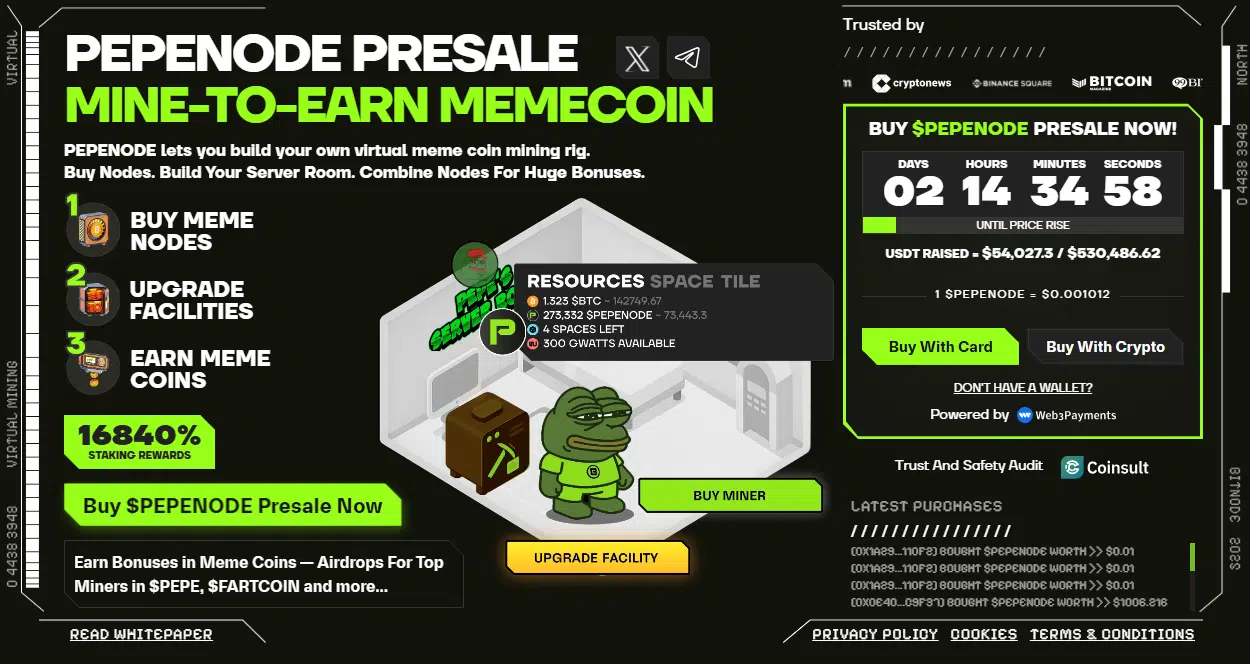
Pepe Node is an innovative gamified crypto mining project that lets users earn meme tokens by building and upgrading virtual mining nodes. As such, the project doesn’t require a massive amount of electricity or any physical hardware. The platform blends GameFi mechanics with tokenomics designed for scarcity, featuring a 70% token burn rate on in-game spending.
Right now, users can participate in the presale phase, stake tokens, and later move on to on-chain gameplay after the Token Generation Event (TGE) to start earning meme coins like $FART and $PEPE.
Pepe Node’s goal is to make mining-style rewards accessible to everyone through a fun and interactive system. The concept is already catching on with the meme coin community as its presale price ticks up over time. Right now, the next price bump is only hours away. If you buy it today, it will be cheaper compared to tomorrow, and so on.
Still, this rush and FOMO make many investors wonder – should I invest in Pepe Node?
Key Takeaways
- Presale urgency: Progressive pricing increases token cost at each stage, rewarding early participants.
- Mine-to-earn gameplay: Build and upgrade virtual nodes to passively earn $PEPENODE and other meme tokens.
- Multi-token rewards: Earnings include partnered meme tokens such as $FARTCOIN and $PEPE.
- Burn mechanics: 70% of tokens spent on upgrades are burned, which reduces supply over time (potentially increasing the price).
- Staking and referrals: Users can stake tokens and earn bonuses for bringing in new participants.
Verdict: Pepe Node is a playful mix of GameFi and meme culture, but it comes combined with real scarcity mechanics. Still, buyers should carefully review the presale terms and roadmap, proceeding with caution as with any early-stage crypto project. The project has completed a formal smart contract audit from Coinsult, which reduces the risk of exploits and scams.
What Is Pepe Node?
PepeNode is a new crypto project that mixes fun and interactivity with the passive world of token presales. It is described as a mine-to-earn memecoin platform where, instead of complex setups and hardware, you can build a virtual mining rig using digital nodes. From there, users can upgrade their facilities and mine meme coins, engaging in activities as a game rather than just waiting for the launch.
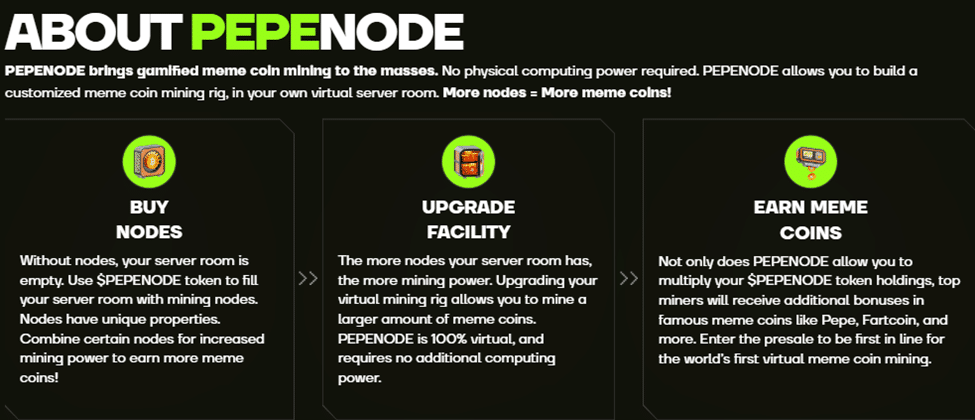
Unlike most other memecoins on the market, PepeNode aims to tackle the presale dullness by offering engagement and immediate utility. Users don’t just buy tokens here; they can instantly start playing and use them.
The project is issued by Neuriki LTD, registered in the British Virgin Islands (company number 2182463), with Fahim Rahman as its managing director, per the whitepaper. It’s a relatively new project. The whitepaper was released on July 22, 2025, with the roadmap extending into late 2025.
Technically speaking, $PEPENODE runs on Ethereum as an ERC-20 token, using Ethereum’s Proof-of-Stake (PoS) consensus to remain energy-efficient. This is an eco-friendly choice and aligns with rising sustainability concerns in crypto. According to FTSE Russell, Ethereum’s shift to PoS reduced energy use by over 99% compared to Proof-of-Work chains.
How Does Pepe Node Work?
Let’s now dig deeper into PepeNode’s mechanics:
Virtual mining, no hardware required
You purchase nodes using $PEPENODE tokens. Each node contributes virtual “hashpower.” Upgrading your setup boosts your mining performance. This avoids the technical complexity and the energy drain that comes with traditional mining rigs.
Presale engagement and off-chain gameplay
From day one of the presale, you can put your new coins to work for you. You can actively build and upgrade off-chain, earning early rewards before the Token Generation Event (TGE). It is faster and more cost-efficient, making the presale access dynamic from the very beginning.
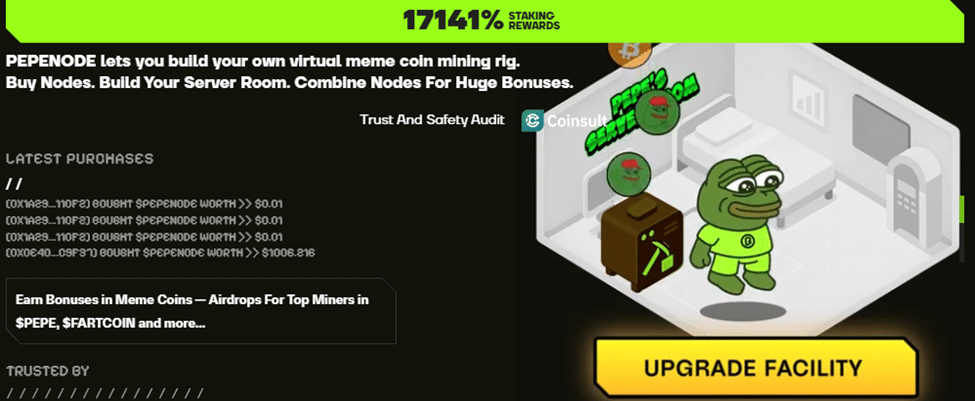
Tiered rewards for early buyers
Early participants receive more effective nodes and, with them, better virtual mining yield. This tiered system creates a high incentive to buy in sooner rather than later. There is also, of course, the rising price of the token. The more you wait, the higher it gets.
Deflationary tokenomics
Around 70% of tokens spent on buying and upgrading nodes are burned, which intentionally reduces the circulating supply. This could potentially boost scarcity over time and increase the token’s value.
Referral incentives and anti-bot measures
The platform rewards users who bring in others. They have allocated 2% of all mined rewards to the referring address. Plus, manual steps in facility purchases help deter bots from exploiting the system or mass-buying.
On-chain transition post-TGE
Once the $PEPENODE token is officially launched, everything will migrate on-chain, including mining, upgrades, burns, staking, leaderboards, and governance. This is all handled by transparent smart contracts.
Technical Overview of $PEPENODE
PepeNode ($PEPENODE) is an ERC-20 token on the Ethereum blockchain, following the 18-decimal standard. The token exists solely on Ethereum at launch, with no multi-chain bridge announced as of August 2025.
The project’s total token supply is not explicitly stated. Supply can decrease over time via the platform’s burn mechanics, which remove about 70% of tokens spent on in-game node purchases and upgrades from circulation.
The $PEPENODE token operates on Ethereum’s Proof of Stake consensus, which means significantly lower energy consumption compared to Proof-of-Work mining chains.
https://twitter.com/pepenode_io/status/1951349430629835188
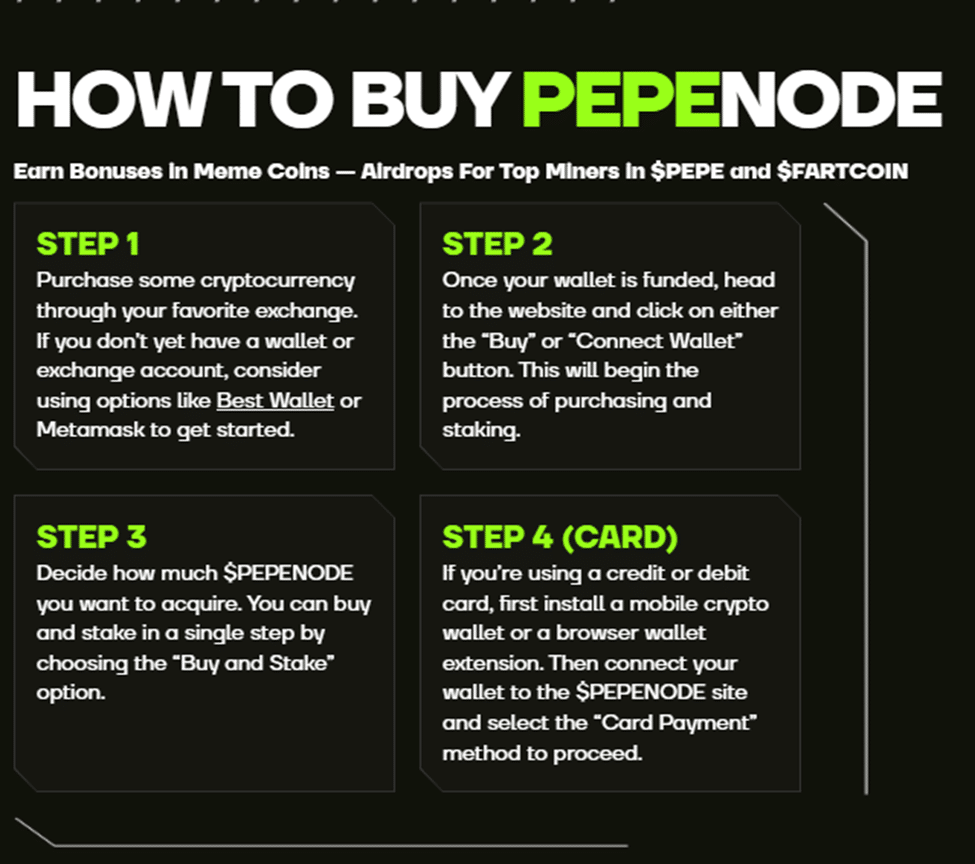
Buying $PEPENODE
During the presale phase, $PEPENODE can be purchased directly through the PepeNode presale portal using a crypto wallet or cards. The pricing follows a progressive stage model, where each new stage slightly increases the price per token. This creates a great incentive for early participation.
After the presale is completed and the TGE starts, $PEPENODE is planned for listing on decentralized exchanges (DEXs) such as Uniswap, with centralized exchange (CEX) listings targeted for late 2025.
Staking and Rewards
The PepeNode staking system will launch post-TGE, allowing holders to lock up $PEPENODE for fixed periods in exchange for mining boosts or other token rewards. The early-stage gameplay runs off-chain for lower gas fees and speed. There is a planned full migration to on-chain smart contracts for mining, upgrades, and governance after the token is officially launched.
Security and Audits
The PepeNode smart contract has been manually audited by Coinsult, which did not find any issues with the smart contract.
Presale and Token Sale Mechanics
Pepe Node’s presale works on a progressive pricing model. This means that the price of $PEPENODE tokens increases incrementally as more tokens are sold. This method creates urgency for early buyers, and many jump at the opportunity because of FOMO (fear of missing out). In this case, purchasing sooner means securing more tokens at a lower price before the next price bump kicks in.
Key features of the presale:
| Start price | The presale begins at $0.001 per $PEPENODE token. |
| Price increases | At set intervals, the token price rises, rewarding early participants. |
| No private rounds | The presale is open to all with no exclusive early access or insider allocations. |
| Accepted payments | Buyers can use popular cryptocurrencies like ETH, BNB, USDT, and even credit and debit cards via integrated Web3 payment solutions. |
| Wallet compatibility | Supported crypto wallets include MetaMask, WalletConnect, and others. |
| Buy and stake option | Users can purchase and immediately stake their tokens to start earning rewards. |
| Off-chain gameplay | During the presale, mining activity is simulated off-chain. |
| Token distribution | Purchased tokens become claimable only after the presale ends and the TGE is live. |
| Burn mechanism | About 70% of tokens used for buying nodes and upgrades are burned instantly. |
Is Pepe Node Legit?
The crypto space is full of projects promising big gains and big ideas, but how can you tell if Pepe Node is truly worth your trust, or if it is only hype? Below, we will break down the key factors to consider when evaluating the legitimacy of the project.
Does Pepe Node Solve a Major Problem?
Pepe Node tackles two main issues in crypto presales:
Problem 1: Boring, passive presales
Pepe Node addresses this by turning presale into an interactive mining game with top meme coins as rewards. By doing this, they increase user engagement during the token launch phase.
Problem 2: High barrier to mining
Pepe Node offers “virtual nodes” instead of physical rigs or complex setups, making mining fun, cheap, and easily accessible.
Why this matters:
Many presales simply ask users to buy and wait. Pepe Node’s unique gamified “mine-to-earn” model adds utility and involvement early on. This is a fresh take in the market.
Has Pepe Node Made Progress in Its Roadmap?
Pepe Node’s roadmap is available in their whitepaper and website, showing the following stages planned through late 2025:
| Roadmap Stage | Status | Details |
| Token Presale Launch | Underway | Progressive price stages live, early buyers are active. |
| Virtual Node Gameplay | Live (off-chain) | Users can mine and upgrade rigs before TGE. |
| Token Generation Event | Upcoming | Tokens to be claimable after presale completion. |
| On-Chain Mining Launch | Planned Q4 2025 | Full on-chain gaming for transparency. |
| Community and Referral | Ongoing development | Referral rewards active, anti-bot measures in place. |
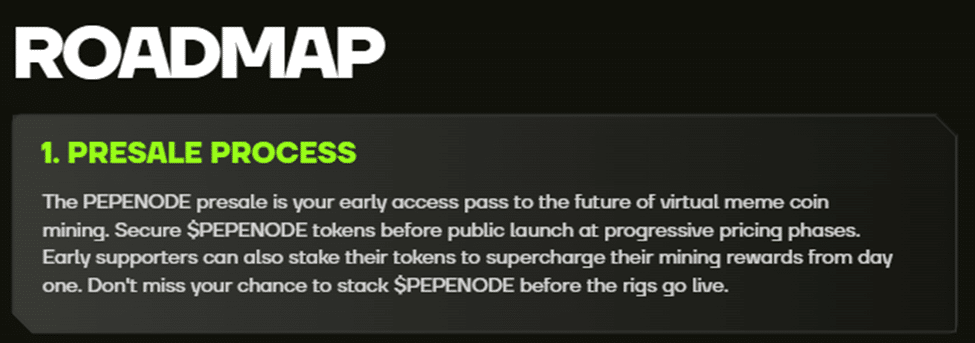
Right now, Pepe Node is in its “Presale Process” phase.
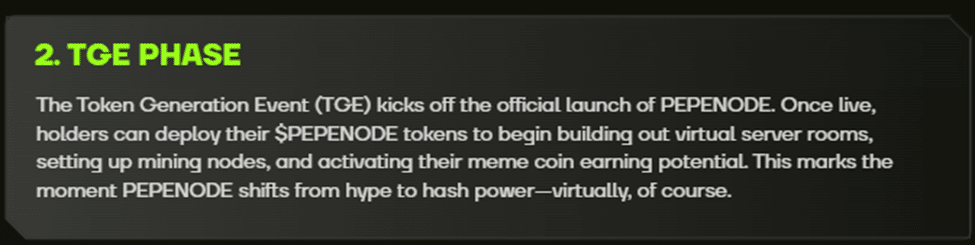
The TGE phase is upcoming, which is when you can deploy your $PEPENODE tokens, start building virtual server rooms, and set up mining nodes.
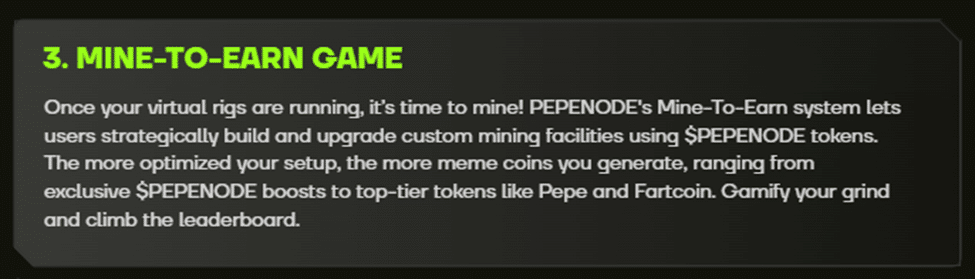
When you create virtual rigs and they are running, you can start mining in their mine-to-earn game.
What are Pepe Node’s Tokenomics?
Understanding the tokenomics of a project is crucial to evaluating its long-term viability. Based on the whitepaper and the project’s official website, here is what you should know about the tokenomics of this project:
- Token standard: ERC-20 on Ethereum
- Total supply: Presale phases limit supply dynamically.
- Deflationary mechanism: 70% of tokens spent on nodes and upgrades are burned.
- Utility: Used to buy and upgrade virtual mining nodes. Stackable for rewards.
- Staking rewards: Available, with tokens claimable 7 days after the staking period begins.
As for the token distribution, here is what Pepe Node promises:

Who are Pepe Node’s Competitors?
Pepe Node operates in a niche that combines token presales, GameFi, and meme coins. That being said, some notable competitors and similar projects include:
| Competitor | Focus | Differentiator |
| Gala Games | GameFi and NFT ecosystem | Established with multiple games |
| Illuvium | Blockchain-based RPG game | High-quality 3D graphics, on-chain gameplay |
| PEPE (Pepe Coin) | Pure meme coin without gamification | Meme-only token with community hype |
Why are these the brand’s competitors, you wonder?
Gala Games offers a broad GameFi ecosystem with multiple games and NFTs. It appeals to players who want a diverse gameplay experience and ownership, which is similar to Pepe Node’s focus on gamified earning.
Illuvium represents the high-end of blockchain gaming with immersive RPG mechanics and on-chain gameplay. This is similar to Pepe Node’s presale mining and meme coin rewards model.
PEPE (Pepe Coin) shares Pepe Node’s meme culture appeal, but remains purely a meme token. It is a notable memecoin connected to $PEPENODE because, among the meme coin rewards offered in the project, $PEPE is featured as one of the bonus tokens you can get.
Who is Behind Pepe Node?
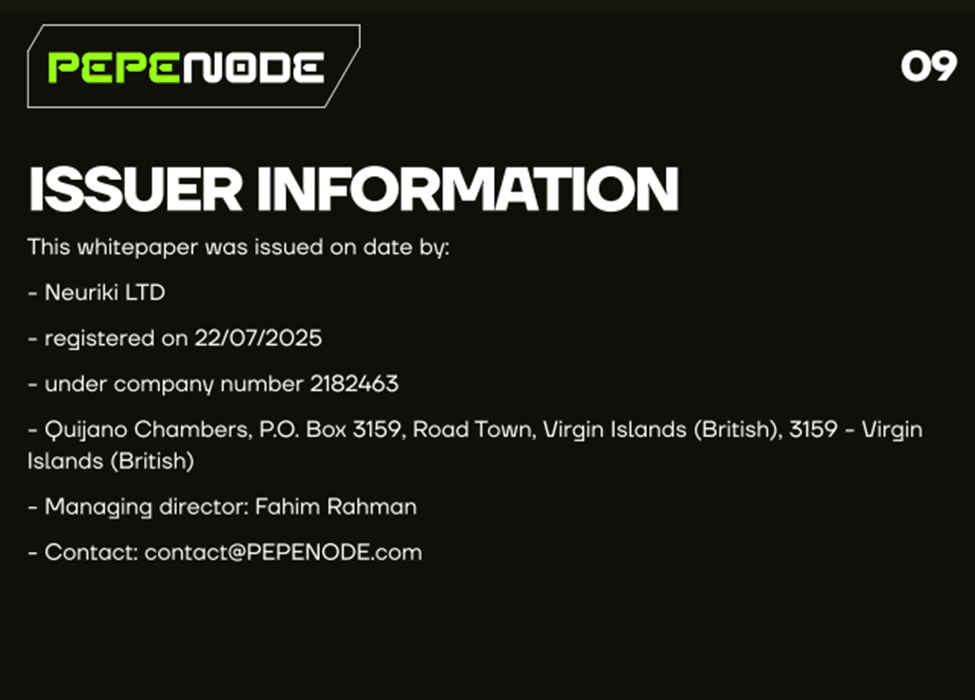
Pepe Node is officially issued by Neuriki LTD, a company registered in the British Virgin Islands on July 22, 2025. According to the whitepaper, the managing director is Fahim Rahman, but there are no detailed team bios publicly disclosed, nor is there independent verification of the team’s history and prior experience.
Transparency note:
Lack of publicly available team information is common in crypto, but carries risks. Projects with open teams like this one are generally safer, but in this case, we found no verifiable track records for the team.
Crypto Scam Red Flags to Watch Out For
When you’re picking a new crypto project to invest in, especially one that’s in its early phases like this one, it’s important to watch for common warning signs that have been linked to scams, such as:
Phishing/Fake URLs
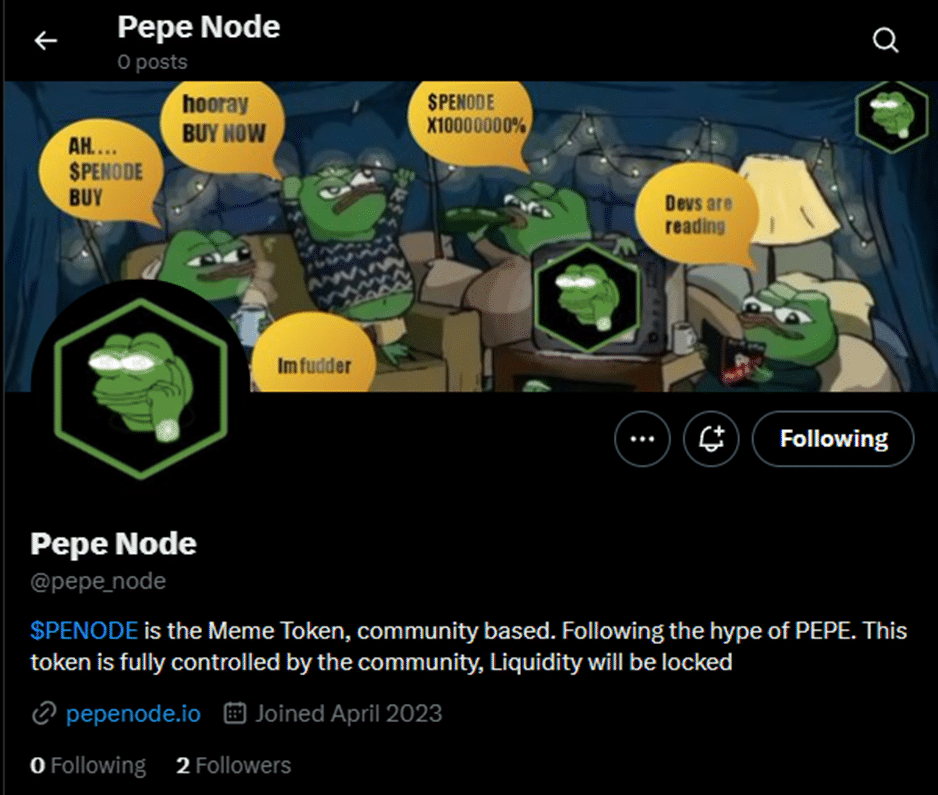
Make sure you are always using the official Pepe Node website and their official social media channels. Scammers often create fake sites or social media profiles to steal funds or personal data. For instance, this is their official profile on X (Twitter), as linked on the official website:

The image below shows an unofficial channel with a very similar name. If someone were to search for Pepe Node on X directly, they might think this is the project’s official channel:
Token Concentration
If a small number of wallets hold the majority of tokens, this increases the risk of price manipulation or sudden dumps (rug pulls). Transparency about token distribution is crucial for a project.
No Locked Liquidity
Locked liquidity helps ensure that funds supporting the token’s market are safe and can’t be rug-pulled. Lack of liquidity lock raises red flags about a project.
Fake Engagement and Bots
Watch out for fake community activity or bots in social channels, which can artificially inflate hype.
No Real Product
Projects that offer vague ideas and no working product, prototype, or verifiable roadmap might lack substance.
Conclusion – Is Pepe Node a Scam or Legit?
Pepe Node blends an innovative gaming approach with meme coin culture. This makes it stand out in a very crowded, often dull crypto presale space. Still, this is an early-stage project, so you should proceed with caution. Here’s a quick breakdown of the some of the main factors to consider:
| Signs of Legitimacy | Concerns and Risks |
| Registered company in BVI, completed audit | Early-stage project with limited track record |
| Detailed whitepaper and roadmap available | Potential risk of price volatility and hype |
| Clear tokenomics with deflationary mechanics | Token distribution details not fully transparent |
| Interactive mine-to-earn platform concept | Could face liquidity issues like many new projects |
As with all crypto investments, due diligence is essential here. Carefully read the official documents, research the tokenomics, and don’t invest more money than you can afford to lose.
FAQ
What is Pepe Node?
Pepe Node is a mine-to-earn memecoin platform where you can buy virtual nodes and mine meme coins like $PEPENODE, $PEPE, and $FARTCOIN.
How do I participate in the Pepe Node presale?
To participate, create an account on the official Pepe Node website and buy $PEPENODE tokens during the presale stages. Early buyers get better rewards as prices increase with each stage.
Is Pepe Node audited?
Yes, it has completed a third-party audit with Coinsult, which found no problems with its smart contract.
What blockchain is Pepe Node built on?
$PEPENODE is an ERC-20 token on the Ethereum blockchain, using Ethereum's Proof-of-Stake consensus.
Can I earn rewards before the token launches?
Yes. The presale lets early participants build and upgrade virtual mining rigs off-chain, earning rewards before the Token Generation Event.
Is Pepe Node different from Pepe Coin ($PEPE)?
Yes. Pepe Node is a gamified presale token with mining and upgrade features. Pepe Coin is a separate memecoin, though some Pepe Node rewards include $PEPE tokens.
References
- Proof-of-Stake: A Crypto Path to Lower Energy Consumption and Yield – FTSE Russell
- What Is a Token Generation Event – CoinMarketCap
- What are ERC-20 Tokens on the Ethereum Network – Investopedia
- What are Gas Fees – CoinBase
- What Is FOMO and How to Deal With It – CoinSpeaker
- Top 10 Smart Contract Audit Companies – Binance
- What Is Tokenomics? A Beginner’s Guide – CoinTelegraph
- Illuvium Official Project Website – Illuvium
- PepeCoin Official Project Website – The Pepe Coin