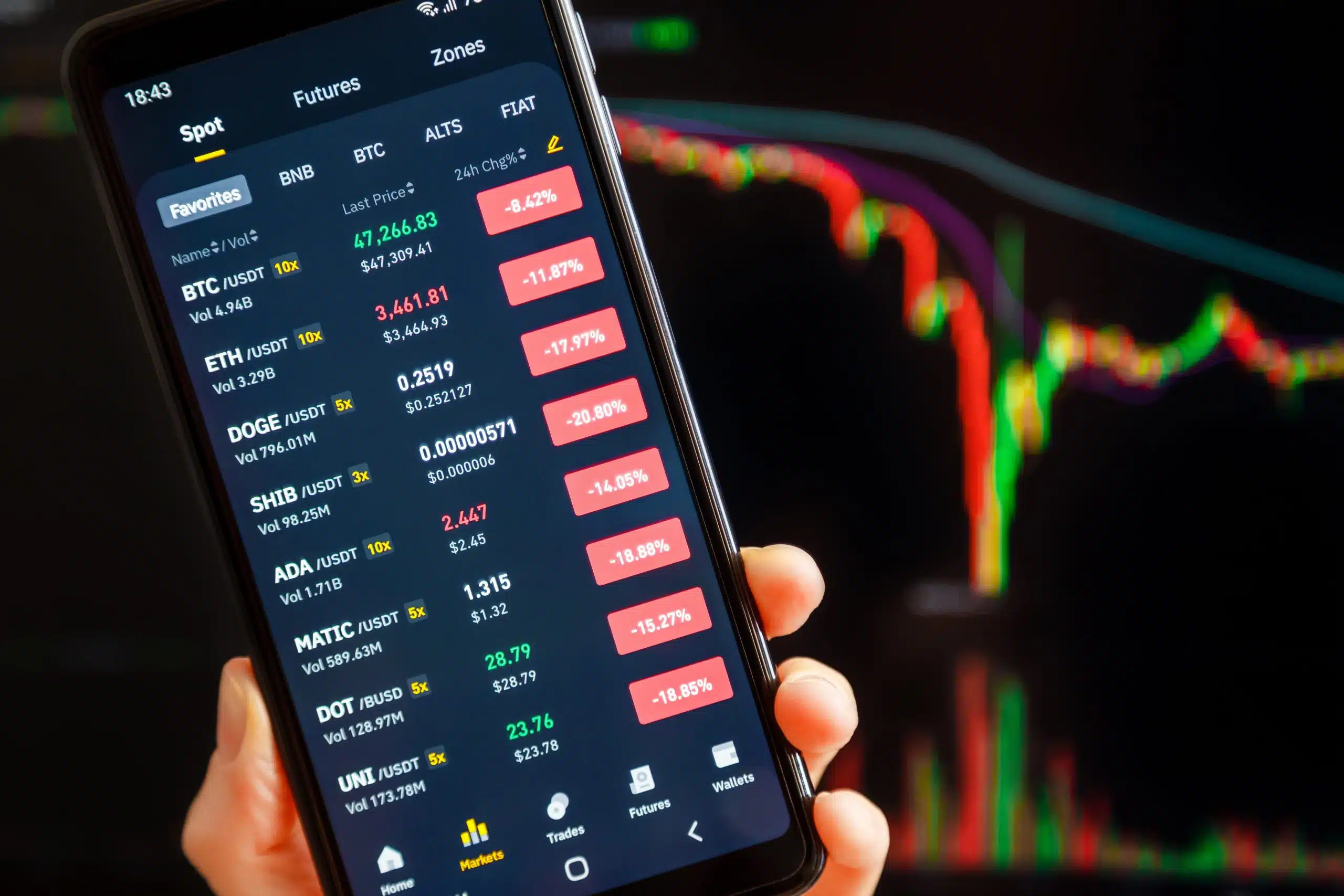
If you want to trade crypto options in 2026, it’s important to know that the landscape has evolved dramatically. Just a few years ago, only a small handful of exchanges offered options trading, and the selections were extremely limited and difficult to navigate. Today, the space has matured with top exchanges like Binance, ByBit, and OKX offering professional-grade options markets, and there are more choices than ever.
But what makes a platform the best choice for you? Is it the platform with the lowest fees or the most liquidity? Is it a teaching tool that helps you with your first trade? Or maybe it is the option to trade anonymously and settle contracts in USDC instead of volatile cryptocurrencies?
In this article, we will explore the best crypto options trading platforms and highlight each exchange’s top pros and cons to help you pick the best one for you.
Best Crypto Options Trading Platforms in 2025 Ranked
Here is a list of the top 6 crypto options trading platforms in 2025:
- Binance: Offers options for BTC, ETH, BNB, XRP, DOGE, as well as high liquidity and low fees
- OKX: Provides European-style options on BTC and ETH with “Simple” and “Pro” modes
- Bybit: Versatile platform offering BTC, ETH, and SOL options margined with USDC
- KuCoin: Offers non-US users access to BTC and ETH options in addition to its strong altcoin exposure and trading bot tools
- BingX: User-friendly platform that supports BTC and ETH options trading with copy trading features and flexible margin settings
- Crypto.com: Offers CFTC-regulated “UpDown” American-style options for BTC and ETH
- Deribit: The most liquid crypto options exchange
Reviewing the Best Crypto Options Trading Platforms
Below is a more detailed look at each platform known for its crypto options (not just futures). Let’s see what these platforms have to offer to traders.
1. Binance
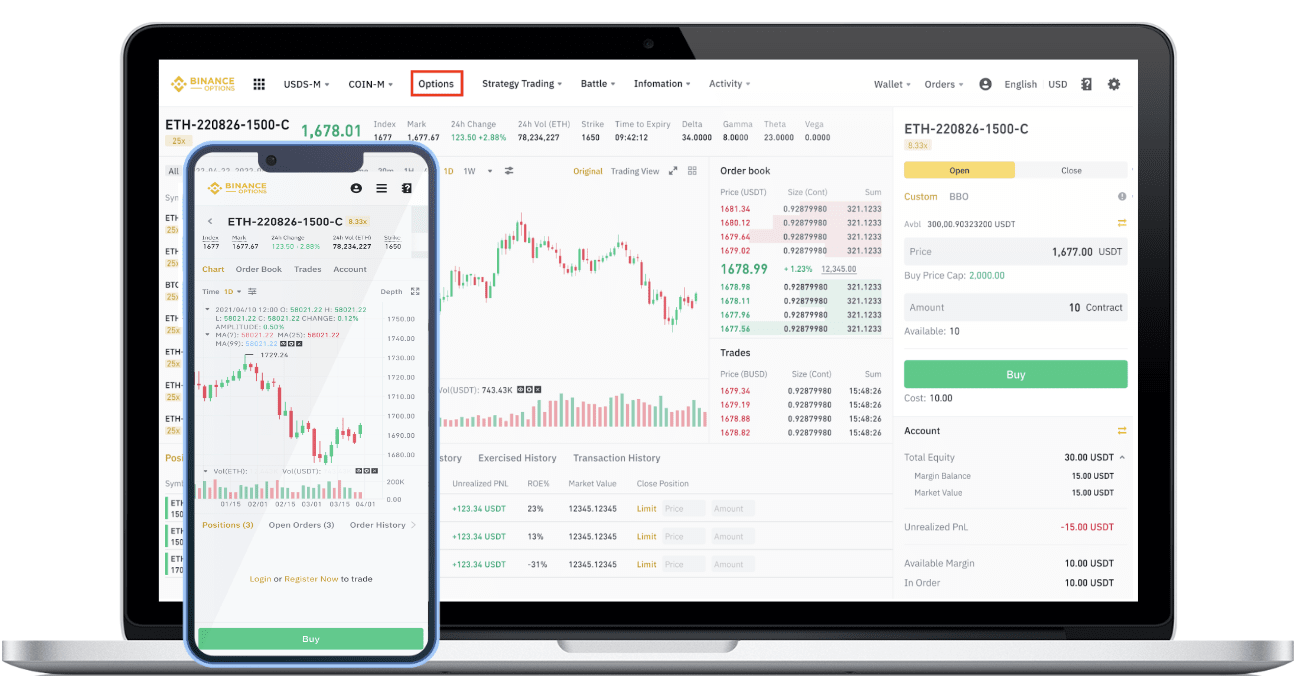
Binance is the world’s largest cryptocurrency exchange. Its Binance Options platform brings European-style call and put contracts on top tokens like BTC, ETH, BNB, XRP, DOGE, and SOL, all priced and settled in USDT.
Binance launched its revamped options desk in September 2022, with a focus on high liquidity, low fees, and options tailored for both retail and advanced traders.
Binance’s trading fees are among the most competitive in the industry: 0.03% per transaction (capped at 10% of the option value), along with an exercise fee of 0.015%, also capped at 10%.
In April 2024, Binance rolled out its “Options Enhanced Program.” Eligible users trading $100 million or more in notional volume over 30 days may apply for substantial fee discounts and maker rebates.
Best Features
- Diverse token options
- Tight spreads and liquidity
- Integration with the Binance ecosystem
Pros
- Integrated platform with options, spot, and futures trading
- High liquidity, especially for BTC options
- Robust security protocols and SAFU insurance fund
Cons
- Faces regulatory scrutiny in regions such as the Philippines
- Short expiries only
2. OKX
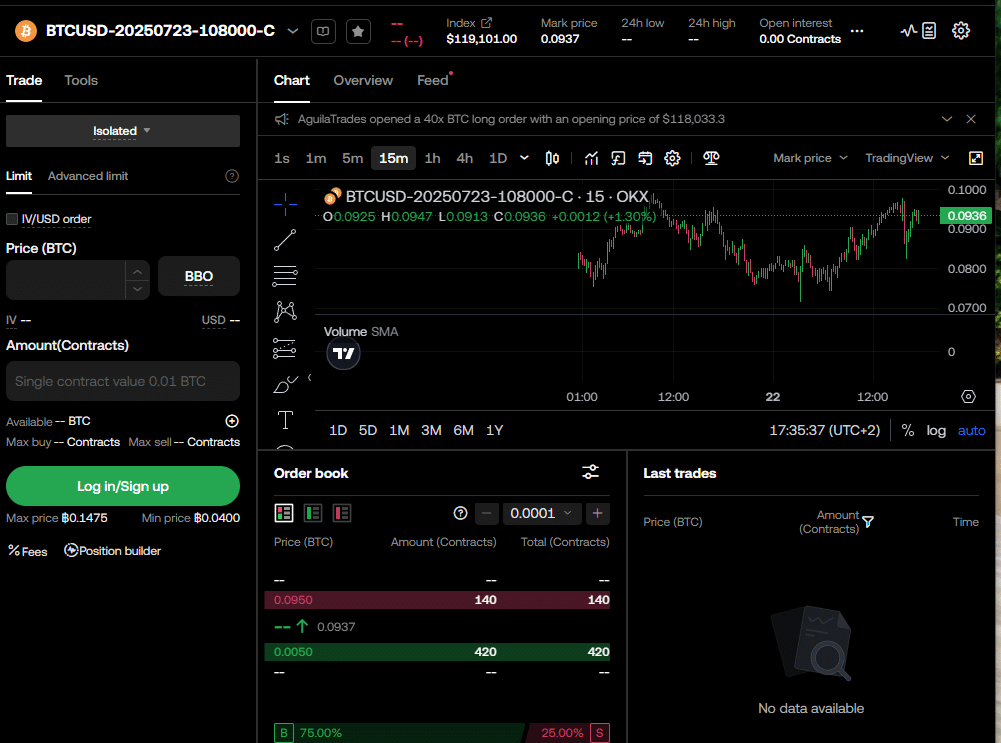
OKX was born as OKEx in 2017 and rebranded in 2022. The platform has since evolved into a global Tier-1 crypto platform, now offering everything from spot trading to futures and crypto options. OKX now commands deep liquidity across derivatives and serves over 20 million users, supporting 400+ coins and 500+ trading pairs.
OKX has made significant regulatory gains in recent years. It secured MiCA compliance in the EU in January 2025, a Virtual Asset Service Provider license in Dubai, and relaunched in the United States in April 2025.
OKX’s security is top-tier: over 95% of user funds in cold storage, 2FA available, withdrawal whitelists, and regular Proof-of-Reserves audits.
Best Features:
- All-in-one derivatives and options platform
- Copy trading and trading bots for experienced traders
- Full Proof-of-Reserve transparency and many regional licenses
Pros
- Options available alongside spot, margin, perpetuals, futures, and DeFi integrations
- Low and scalable fees ranging from 0.02% and 0.03% for options
- Discounts available for OKB token holders and high-volume traders
- Massive asset support and liquidity
Cons
- The pricing structure is a bit complex
- Steep learning curve with many features like bots, copy-trading, and advanced order types
- Regulatory restrictions persist in China, certain EU countries, etc.
3. ByBit
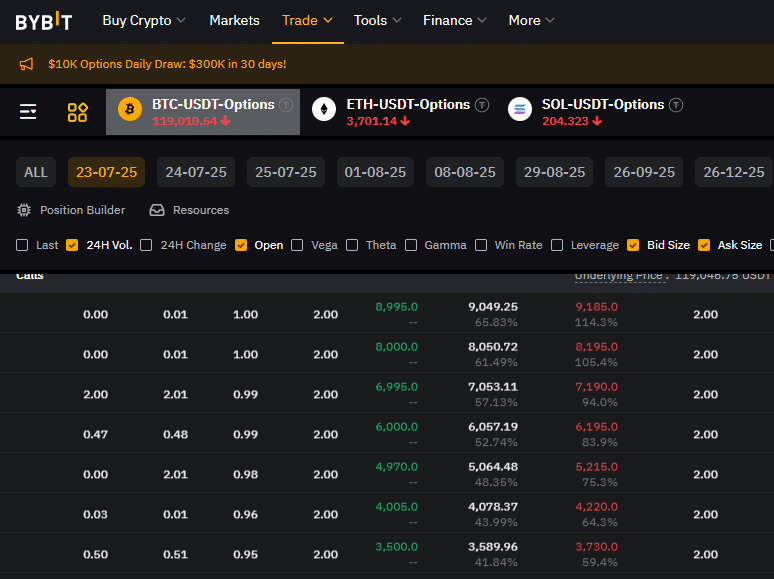
ByBit offers USDC-settled European-style options on BTC, ETH, SOL, and other cryptocurrencies, with expirations ranging from daily up to quarterly. Its trading fees are considered some of the lowest on the market. Traders pay as little as 0.01% maker and taker fee, plus portfolio margining to reduce capital requirements.
The platform introduced its USDC-collateralized options to stand out from competitors. The contracts settle only in USDC, offering greater capital efficiency.
The platform also separates its trading models into Options Explore, which is designed for beginners, and Options Pro, which offers full options chains, delta hedging tools, multi-leg orders, and more for advanced traders.
ByBit also offers a demo environment seeded with virtual USDC to let traders practice without real risk, which can be an incredibly useful tool for beginners. Its wider platform includes spot trading, perpetual and futures contracts, copy trading, automated bots, staking, and even an NFT marketplace and Web3 wallet.
Best Features:
- USDC-based options with wide expiries and flexible settlement
- Rapid-expiry options for active traders
- Efficient margining for multi-position portfolios
Pros
- USDC settlement and European contracts to reduce collateral lock-up
- Ultra-low fees
- Portfolio margin support for hedged positions
- Powerful UI with TradingView, multi-leg order support, and demo mode
Cons
- Newer and less battle-tested compared to Deribit
- Liquidity can be thinner on altcoin options compared to BTC and ETH
- Options are only available on BTC, ETH, and SOL
4. KuCoin
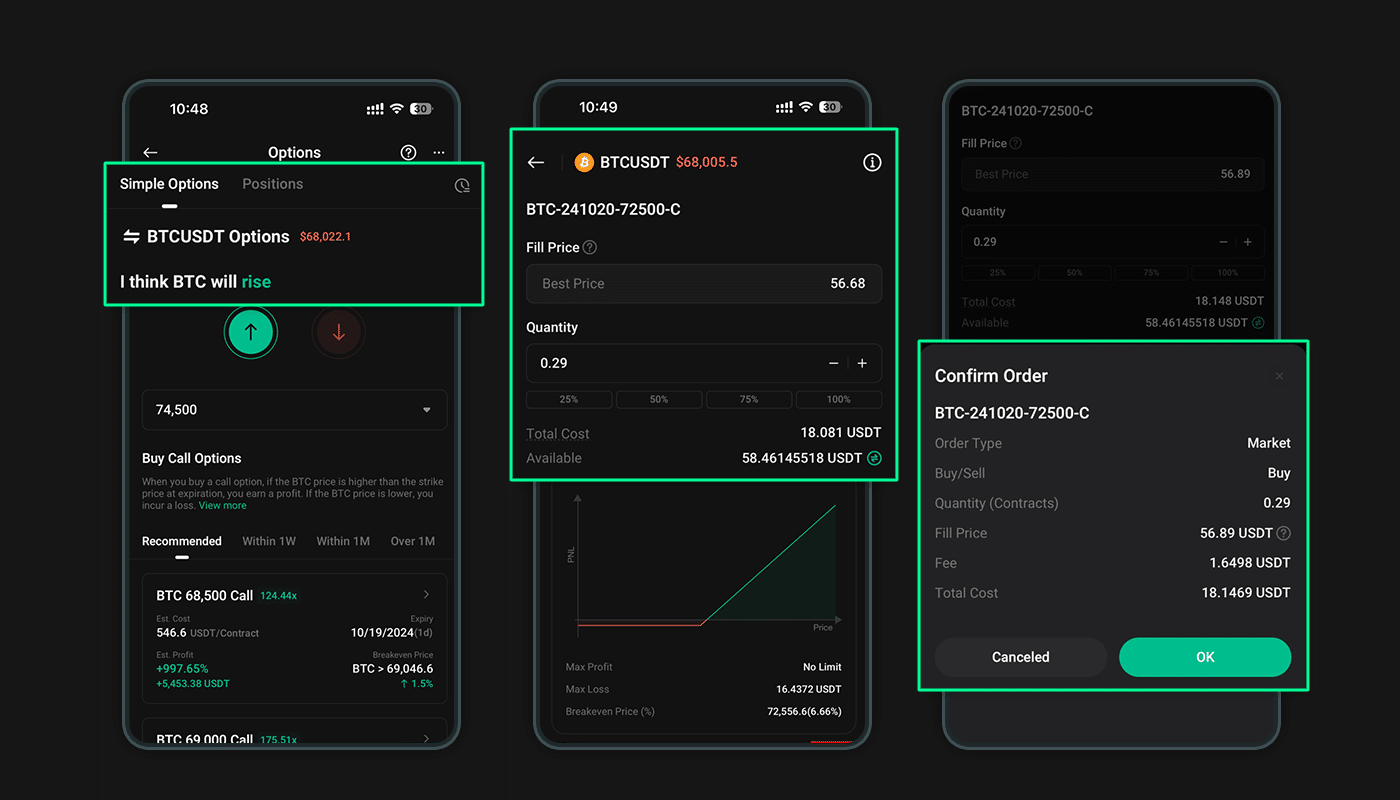
KuCoin is another popular crypto options trading platform, providing users with all the tools they need to profit from cryptocurrency and market movements. Introduced in late 2024, KuCoin’s options platform offers European-style options, where contracts can only be exercised at expiration.
The platform was founded in 2017 and is now a major global cryptocurrency exchange that offers spot trading, futures, margin trading, staking, and most recently, options trading.
KuCoin currently supports options on popular cryptocurrencies like BTC and ETH, which are accessible primarily through its mobile app.
Best Features:
- Accessible European-style options
- Low minimum trading amounts
- Strong educational content and user support
Pros
- Wide selection of cryptocurrencies available on the main exchange
- No liquidation risk – maximum loss limited to the premium paid
- Robust ecosystem with spot, futures, margin, staking, and lending
Cons
- Options trading is currently limited to a few cryptocurrencies
- Trading access restricted to the mobile app
- Limited options contract types compared to specialized platforms like Deribit
5. BingX
BingX launched in 2018 and has since grown into a popular global crypto exchange with over 10 million users. It offers a combination of spot, futures, margin trading, as well as an emphasis on copy-trading and social trading.
Since 2019, users on the platform can follow expert traders with just one click. The fees are transparent, too: a flat 0.045% platform fee per copied trade, plus standard trading fees, and optional profit-sharing of up to 80%.
BingX offers spot, coin/USDM perpetuals, standard futures, and a “Futures Kickoff” beginner mode. It holds Proof-of-Reserves, 2FA, KYC via Sumsub, and insurance with a bug bounty program.
Best Features:
- One-click copy trading with clear profit-sharing and transparent stats
- Beginner-friendly “Futures Kickoff” mode, ideal for new traders
- Intuitive apps rated highly on iOS and Android
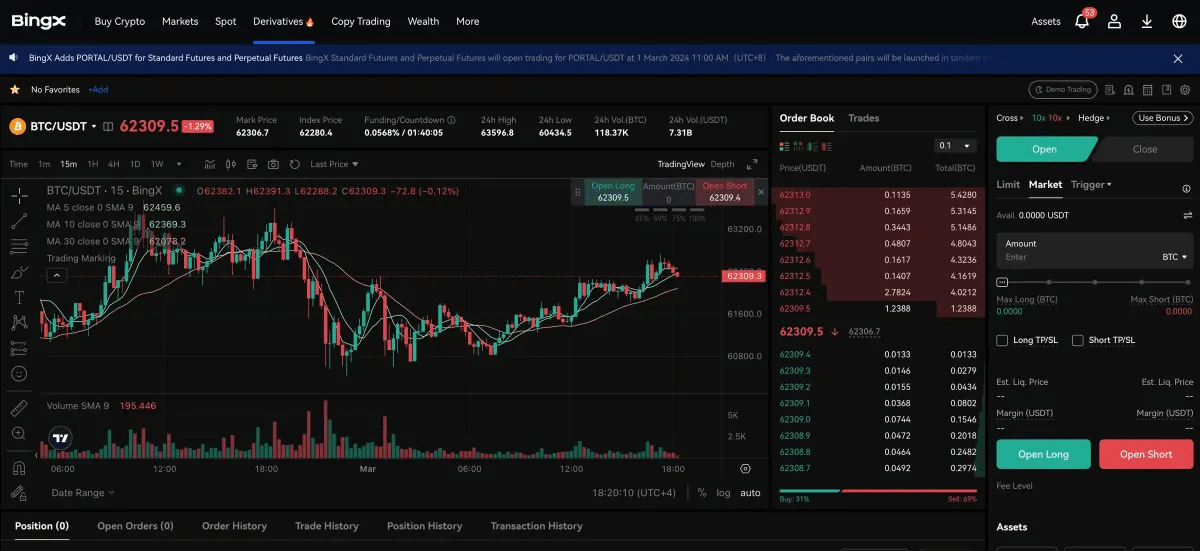
- Multi-mode derivatives trading: access to spot, perpetuals, options, and standard futures
Pros:
- Beginner-friendly platform with demo mode and Futures Kickoff
- Strong social trading
- Competitive fees and transparent structure
- Robust security with PoR, KYC, and 2FA
Cons:
- Geographic restrictions: Blocked in the U.S, UK, Canada, Singapore, and other countries
- Past security breach: A hot-wallet exploit in September 2024 resulted in a $43 million loss. Funds were since restored and protection was improved.
- Support speed issues: Some users report slow customer service at times
6. Crypto.com
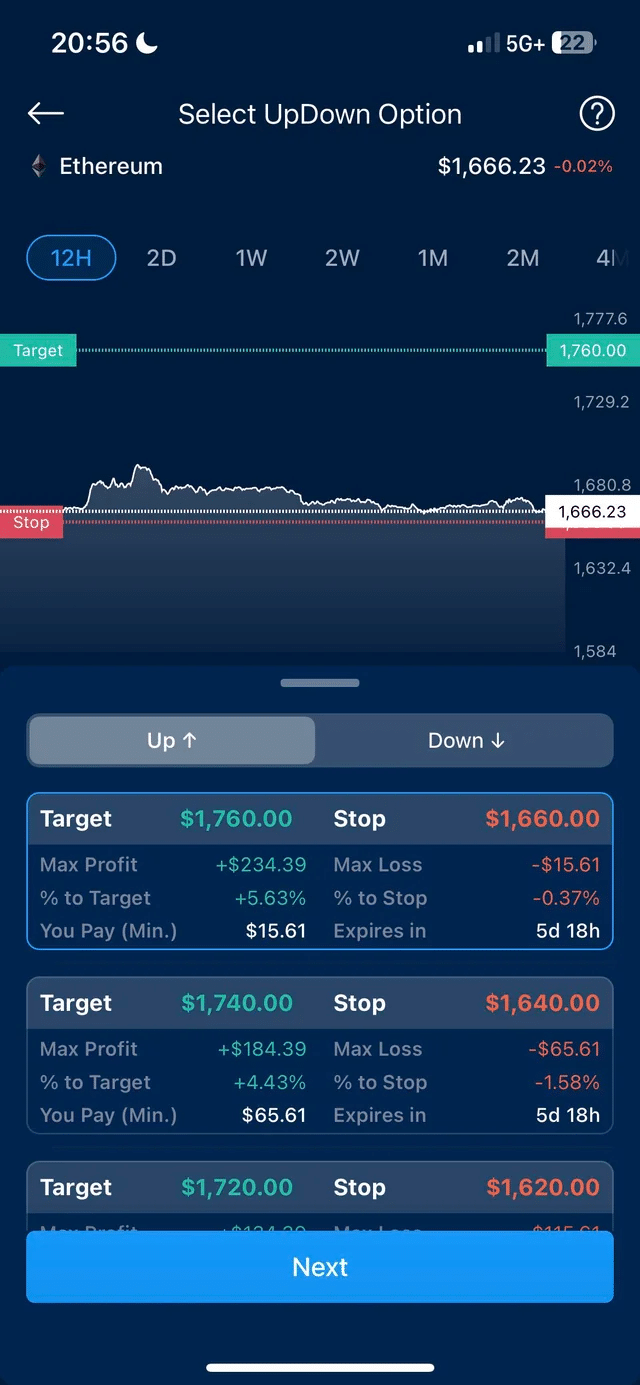
Crypto.com delivers crypto options trading via its UpDown Options, a CFTC-regulated U.S.-only derivative product, through CDNA. Unlike conventional call and put options, UpDown contracts let users select a target (ceiling) and stop (floor) price. If the barrier is reached, the contract will close automatically. If not, it will expire at the end of the week.
The platform initially offered options on BTC and ETH, but has since expanded selections to include assets like CRO, DOGE, BCH, LTC, ADA, SOL, AVAX, and others. Users pay a straightforward, flat fee: $1.00 exchange fee + $0.99 technology fee per contract, on both opening and closing trades.
Crypto offers up to four active barrier levels per asset weekly, with tracking up to 10 positions per asset, both long and short.
Best Features:
- Straightforward risk model and simple, flat-fee pricing
- U.S. regulatory credentials
- Wide token support
Pros
- Regulated transparency (a fully U.S.-licensed options product under CFTC oversight)
- Predictable flat fees and no surprise costs upon settlement
- Expanded asset coverage, many tokens supported
- Predictable weekly expiry
Cons
- Not exactly a traditional options market
- App interface issues such as lagging
- Limited trading hours, no weekend contracts due to CFTC-regulated schedule
7. Deribit
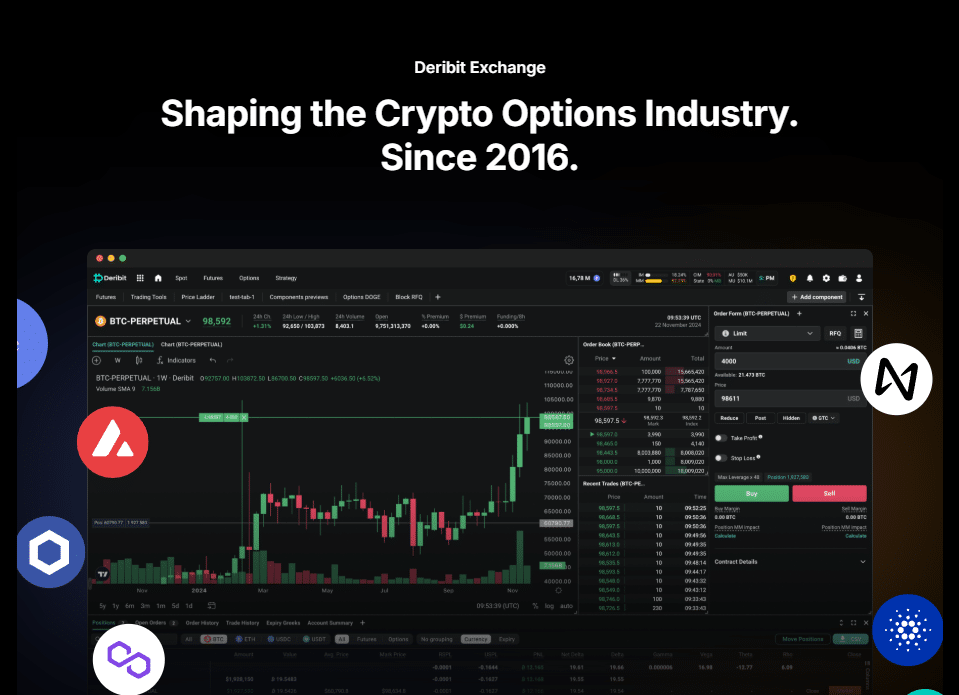
Deribit is a market-leading platform for Bitcoin and Ether options and futures. It commands over $1 trillion in annual trading volume, combined with around $30 billion in open interest.
Deribit is based in Dubai and has long excluded U.S. users. However, Coinbase is set to acquire the platform for $2.9 billion in a deal that is expected to close by the end of 2025. The acquisition could mark a massive shift in the U.S. crypto options market, with Coinbase taking a lead over its competition.
Going into Q2 2025, Bitcoin options open interest on Deribit jumped to over $40 billion, clearing around 139,000 BTC contracts in a single quarterly expiry event. With this number, Deribit alone accounted for nearly 90% of BTC open interest.
Deribit employs a maker-taker fee model. Options trades incur 0.03% maker or taker fees, capped at 12.5% of the option cost. Delivery fees for options are 0.015%, and liquidation fees are 0.19% of the underlying contract. There is also a fee discount on option combos. If a trade combines buying and selling legs, all fees on the cheaper side are zeroed out.
Best Features:
- Dominant liquidity enabling large trades with minimal slippage
- Wide variety of European-style expirations
- Highly competitive spreads and professional API access
Pros
- Great liquidity in BTC/ETH options
- Tight spreads and institutional-grade order execution
- Wide expiry cycles (daily/weekly/monthly/quarterly)
- Advanced combo-trade fee discounts
Cons
- Currently not available to traders in the United States
- Post-acquisition integration may change fees
- Limited access to fiat; only crypto or third-party swap deposit options available
What Is Crypto Options Trading and How Does It Work?
Crypto options trading is exactly what it sounds like – buying and selling options contracts based on underlying cryptocurrencies like Bitcoin and Ethereum. This is a type of crypto derivative, right alongside futures and spot contracts.
The most important aspect of crypto options that you need to know is that you aren’t buying the actual coins. You are buying the right to buy or sell a cryptocurrency at a specific price (called the strike price) on or before a certain date (called the expiration date).
There are two main types of options: calls and puts.
- A call option gives you the right to buy crypto at a certain price (strike price) before the contract expires.
- A put option gives you the right to sell crypto at the strike price.
Most crypto options are European-style, which means that they can only be exercised at the expiration date, not before. American-style options, on the other hand, can be exercised at any time before expiration. Unfortunately for traders used to U.S. stock options, the European format is standard on most crypto options platforms.
If the market moves in your favor, your contract may become profitable, but only if the price moves enough to exceed the cost you paid for the option, known as the premium. If it doesn’t, the most you can lose is the premium.
This makes options a very useful tool for hedging risk and making speculative bets with limited downside.
Whether you want to trade Bitcoin, Ethereum, XRP, or other crypto options, this can be an effective way to maximize profits and hedge risks. Unlike futures or spot trading, crypto options allow you to define your risk upfront, which can be incredibly useful in such a volatile market. Still, crypto options are complex and risky, making them best suited for advanced traders.
How to Trade Crypto Options
If you are new to this and want to learn how to start trading crypto options, here is a short guide to get you started:
- Choose a platform and create an account: Start with a reliable provider like Binance or Bybit. You will need to create an account on their website or app before you can get started.
- Verify your identity: Most exchanges and options platforms require identity verification.
- Deposit funds: Depending on the platform, you can deposit fiat currency or cryptos like USDT, USDC, Bitcoin, and Ethereum.
- Devise your trading strategy: Now it’s time to strategize. Call or put? Choose your strike price and expiry.
- Purchase the option(s): Open a limit or market order to purchase the option and pay the premium.
- Monitor the market: Use charts, volatility indicators, and the Greeks, and always be ready to close your position.
- Close, exercise, or let the option expire: If it is in profit, sell or exercise it. If not, you can let it expire worthless.
If you are a beginner, tools like paper trading and copy trading can be essential resources to get you started with much lower risk. Mistakes in options trading can be extremely costly, so make sure you are prepared.
Pros and Cons of Trading Crypto Options
Before you start developing your trading strategy for options, it is important to get familiar with the pros and cons of crypto options.
| Pros | Cons |
| Limited risk exposure: You can only lose the premium. | Complexity: Strategies like straddles, strangles, and iron condors are not beginner-friendly. |
| Leverage without liquidation: Big exposure without margin calls like futures. | Lower liquidity: Fewer participants compared to futures or spot markets, especially for altcoins. |
| Hedging tool: Ideal for protecting portfolios against sharp drops and rallies. | Premium costs: If the market doesn’t move much, your premium can be a total loss. |
| Flexible strategies: You can trade volatility, not just direction. | Limited platform support: Only a few platforms offer reliable crypto options trading. |
How to Pick the Best Crypto Options Trading Platform
Choosing the right platform isn’t just about picking the biggest name or the one that looks most appealing to you. There are several criteria a platform should follow to be a good fit for you. These include:
- Regulation and reputation: Look for platforms with a clean compliance record and user trust.
- Options variety: Can you only trade BTC and ETH, or are altcoin options available too? What do you wish to trade?
- Liquidity and volume: Higher volume generally means tighter spreads and better execution.
- Fees: Check trading fees, withdrawal and funding costs, and more. Does this fit your budget?
- Leverage and risk tools: Some platforms offer portfolio margining and Greeks analytics to help you manage risks.
- User experience: Is the website easy to navigate? Is the platform intuitive? Can you trade on your phone?
- Security: Look for platforms with 2FA, cold storage, and insurance funds.
The Best Crypto Options Trading Platforms – Our Verdict
Crypto options are a niche corner of the market, trailing behind futures and other derivatives in popularity. Still, they are growing quickly. Not long ago, options were limited to a single platform, but today the are vastly more accessible and versatile. You can even trade options on a variety of altcoins, not just Bitcoin and Ethereum.
If you are looking to hedge your long-term positions or simply speculate on short-term price moves, crypto options can be a great tool with relatively limited upfront risk. However, the flexibility they offer also comes with added complexity and responsibility.
Crypto options can be powerful tools, but it’s essential to do your own extensive research and understand the risks before diving in headfirst. Take time to choose the best options platform for you and consider using a paper trading feature to test out your strategies without risking real money. A thoughtful, informed approach can help give you the best chance of success.
FAQ
What is the difference between crypto options and futures?
Crypto options give you the right without the obligation to buy or sell at a set price by a certain date. Futures are contracts that must be settled at expiration.
Is KYC required to trade crypto options?
On most centralized platforms like Binance and OKX, KYC is mandatory. Some decentralized platforms may let you trade options without KYC, but this depends on the jurisdiction.
Are crypto options suitable for beginners?
Not usually. Options trading involves advanced concepts like implied volatility, strike prices, and expiration dates. Beginners might consider this a complex form of trading.
What wallet do I need to trade crypto options?
For centralized exchanges, no special wallet is necessary. But for decentralized platforms, you'll need a Web3 wallet like MetaMask or Trust Wallet.
Are profits from crypto options taxable?
In most countries, crypto options are subject to income tax and capital gains tax, depending on your trading activity.
References
- Coinbase Agrees to Acquire Crypto Derivatives Exchange Deribit – TheBlock
- Deribit Tops $40B in Bitcoin Options Open Interest – TheBlock
- ByBit Crypto Options Trading Guide – ByBit
- Binance Introduces the New Options Trading Platform – Binance
- Binance Introduces Binance Options Enhanced Program – Binance
- Crypto Exchange OKX Relaunches in U.S. – Fortune
- Introducing UpDown Options for U.S. Users – Crypto.com
- Introducing Options Trading – KuCoin
- Managing Risks with the Greeks in Crypto – Crypto.com