After testing dozens of crypto exchanges available to Australians in 2026, we found that Binance, KCEX, and MEXC provide the best combination of liquidity, low fees, and broad market access.
When choosing an exchange for you, keep a close eye on its security features, compliance, and fees. All of these can impact your trading experience and your profits, for better or for worse.
In this piece, we’ll break down the top crypto exchanges in Australia, how they compare side-by-side for different trader types, what makes each platform stand out, and how to choose the right one based on your specific needs and trading goals.
Top Crypto Exchanges Australia
- Binance – Best for Global Liquidity and Low Fees
- KCEX – Best for Low-Fee Derivatives Trading
- MEXC – Best for Altcoin Variety
- Kraken – Best for Security and Transparency
- Margex – Best for Risk Management Tools
- Independent Reserve – Best for Institutional and High-Volume Traders
- Bitcoin.com.au – Best for Beginners
- PrimeXBT – Best Multi-Asset Trading Platform
- OKX – Best for Advanced Trading Tools and Web3 Access
- BloFin – Best for AI-Driven Trading
Reviews of Australia’s Best Crypto Exchanges
1. Binance – Best for Global Liquidity and Low Fees
Binance handles over $200 billion in daily trading volume globally. The Australian arm has been AUSTRAC-registered since 2020, which means local traders have access to that massive liquidity pool under proper regulation.
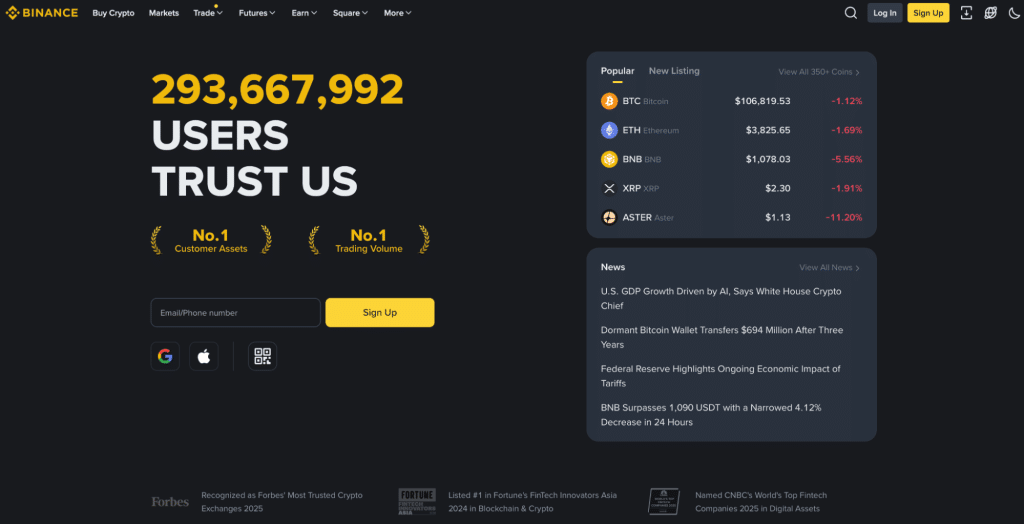
You can trade over 400 cryptocurrencies across 600+ trading pairs. The selection beats almost every other platform available to Australians. Whether you want Bitcoin or some obscure token that launched last week, chances are Binance lists it.
The platform packs in margin trading, futures, staking, an NFT marketplace, and automated bots. Beginners can use Lite mode to keep things simple, and experienced traders can switch to Pro mode for the full toolkit.
Binance runs the SAFU fund with over $1 billion set aside for security incidents. They keep 90% of user assets in cold storage and run regular security audits.
Pros:
- Largest selection of cryptocurrencies (400+)
- Exceptional liquidity on all major pairs
- Excellent mobile app with Lite and Pro modes
- Strong security with $1B insurance fund
Cons:
- Complex interface can overwhelm beginners
- No direct AUD trading pairs
- Past regulatory scrutiny in multiple countries
- Customer support response times vary
Fees:
- Spot trading: 0.1% maker/taker (0.075% with BNB)
- Futures: 0.02% maker, 0.05% taker
- Deposits: Free for crypto
- Credit card: ~3-5%
2. KCEX – Best for Low-Fee Derivatives Trading
KCEX launched in 2021 with zero-fee spot trading and low-cost derivatives as its main draw. The platform is perfect for traders who make frequent transactions and want to minimize costs.
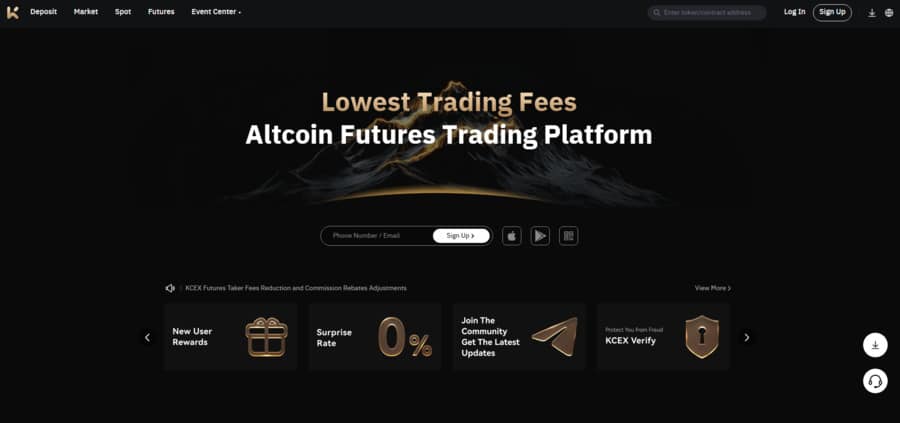
Spot trades cost nothing. Futures carry a 0.02% taker fee. If you trade regularly, the fee structure becomes relevant over months of activity. The platform stores 100% of user funds in cold storage and holds FinCEN registration in the US and Canada.
KCEX mentions PoS staking services, though details remain limited compared to their trading offerings. The platform prioritizes active trading over passive income features.
KCEX lists PoS staking among its services, but details are limited. You won’t find much information about rates or supported coins.
Pros:
- Zero fees on spot trading
- Minimal futures fees (0% maker, 0.02% taker)
- 100% cold storage for security
- FinCEN registered for compliance
- No KYC required for basic trading
Cons:
- Very limited staking information
- No fiat deposit support
- Smaller cryptocurrency selection
- Limited educational resources
Fees:
- Spot: 0%
- Futures: 0% maker, 0.02% taker
- Deposits: Free
- Withdrawals: Network fees only
3. MEXC – Best for Altcoin Variety
MEXC earned its reputation as the early-listing exchange. Over 2,600 trading pairs live on the platform, most of them altcoins you won’t find elsewhere.
The platform moves fast on new token listings. When a project starts trending, MEXC typically lists it before Binance or other major exchanges announce anything. Traders come here specifically for that early access to potential winners.

Spot trading comes with 0% maker fees, which saves money if you trade frequently. The platform processes 1.4 million transactions per second, so your orders go through even when the market goes crazy. Futures trading offers leverage up to 200x, though that level of risk isn’t for everyone.
MEXC holds an AUSTRAC license and covers the basics – 2FA, cold storage, and regular security audits. They also maintain a $100 million Guardian Fund for additional user protection.
Pros:
- Massive selection of 2,600+ trading pairs
- Early access to new and trending tokens
- Zero maker fees on spot trading
- No mandatory KYC for basic trading
- High-performance engine with fast execution
- Copy trading features are available
Cons:
- Limited direct AUD support (third-party processors)
- The interface can be complex for beginners
- Higher risk due to many low-cap tokens
- Some complaints about customer support responsiveness
Fees:
- Spot trading: 0% maker fees, minimal taker fees
- Futures: 0% maker, 0.01% taker
- Deposits: Free for crypto
- Fiat via third-party: 3-5%
4. Kraken – Best for Security and Transparency
Kraken has been around since 2011 with a clean security record. No major breaches in over a decade. Australians can use the global platform, which operates under proper regulations.

Security includes encryption layers, cold storage for the bulk of assets, and optional extra authentication steps. They run third-party audits regularly and show proof of reserves four times a year.
You get access to 200+ cryptocurrencies. Spot, margin, and futures trading are all available, with leverage reaching 50x on some pairs.
Direct AUD support exists through bank transfers, but it feels basic compared to local Australian platforms. The payoff is global liquidity and security that’s been tested for years.
Pros:
- Industry-leading security track record
- Transparent proof of reserves
- Wide range of 200+ cryptocurrencies
- Professional trading tools and API
- Margin and futures trading are available
- Strong regulatory compliance globally
Cons:
- Limited direct AUD deposit options
- The interface is less intuitive for beginners
- The verification process can take time
- Higher fees for small-volume traders
Fees:
- Spot trading: 0.25% maker, 0.40% taker (base level)
- Futures: 0.02% maker, 0.05% taker
- Deposits: Free for crypto
- Withdrawals: Variable by crypto (e.g., 0.0002 BTC for Bitcoin)
5. Margex – Best for Risk Management Tools
Margex uses the MP Shield system to protect traders from price manipulation. When prices spike or drop unnaturally, the system prevents forced liquidations that would otherwise wipe out positions. The platform launched in 2019 with leverage up to 100x.

Liquid staking lets you earn yield on Bitcoin, Ethereum, USDT, USDC, and LINK without locking them up. Your staked assets stay available for margin trading. You collect staking rewards and can still open leveraged positions with those same funds.
Risk management tools include the MP Shield protection, customizable liquidation parameters, and position monitoring. Withdrawals are processed once daily between 12-2 PM UTC. The platform keeps most funds in cold storage between withdrawal windows.
Pros:
- Unique MP Shield protection system
- Liquid staking while trading
- Leverage up to 100x
- No KYC required for trading
- Cold storage security
Cons:
- Limited coin selection (5 stakeable assets)
- No fiat withdrawal support
- No regulatory oversight
Fees:
- Perpetual futures: 0.019% maker, 0.060% taker
- Funding: ~0.12% every 8 hours
- Deposits: Free (crypto)
- Withdrawals: Variable (e.g., 0.0005 BTC)
- Staking: Up to 5-7% APY
6. Independent Reserve – Best for Institutional and High-Volume Traders
Independent Reserve has operated as Australia’s institutional-grade exchange since 2013. The platform is built for serious traders who prioritize security, transparent pricing, and professional-grade tools.

Their OTC desk handles trades from $50,000 to over $50 million – useful when you don’t want to affect market prices. SMSF support lets you hold crypto in your super fund. Tax reporting connects with KPMG’s tools. Customer support operates 24/7 with dedicated account managers for VIP clients.
On the security side, they hold full 1:1 reserves – every dollar and coin is backed. Crypto stays in Australian custody, and they’ve never been hacked. They hold licenses in both Australia and Singapore.
Pros:
- Industry-leading security with no history of hacks
- Ultra-low fees for high-volume traders (down to 0.02%)
- Professional OTC desk for large trades
- SMSF support with compliant reporting
- Multiple fiat currency support (AUD, USD, SGD, NZD)
- 24/7 customer support with dedicated managers
Cons:
- Limited cryptocurrency selection (30+ coins)
- Higher fees for casual traders
- Less beginner-friendly interface
- Deposit fees apply for amounts under $100
Fees:
- Trading: 0.5% base, scales down to 0.02% for high-volume
- Deposits: Free over $100 AUD, $0.99 under $100
- AUD withdrawals: Free
- Crypto withdrawals: Network fees only (e.g., 0.0001 BTC for Bitcoin)
7. Bitcoin.com.au – Best for Beginners
Bitcoin.com.au is one of the most accessible exchanges for Australians who are new to crypto. The platform started in Sydney back in 2013. Over the years, it earned a reputation as easy enough for beginners, with security you can rely on.

The exchange supports direct AUD deposits through PayID, bank transfers, and even credit cards. You can buy Bitcoin in under 10 minutes after account verification, which typically completes the same day.
Users love how easy it is to navigate. First-time buyers say the buy-sell process is straightforward and easy to navigate. The platform holds full AUSTRAC registration and ISO 27001 certification for security.
Pros:
- Ultra-simple interface perfect for first-time buyers
- Instant AUD deposits via PayID
- Fast verification process
- Strong security with cold storage and 2FA
- New user bonus offer available
Cons:
- Limited selection of cryptocurrencies compared to global exchanges
- Higher trading fees than some competitors
- Lacks advanced trading features
- No margin or derivatives trading
Fees:
- Deposits: Free for bank transfer, PayID, Australian debit/credit cards, and PayPal. International cards: 3.5%
- Withdrawals: Free for bank transfer, $1.50 for PayID/NPP instant
- Trading fees: Not explicitly disclosed on their fee page (uses spread-based pricing model)
8. PrimeXBT – Best Multi-Asset Trading Platform
PrimeXBT trades crypto, forex, commodities, and stock indices all from one account. Traders who want exposure to both traditional markets and digital assets can handle everything in one place.
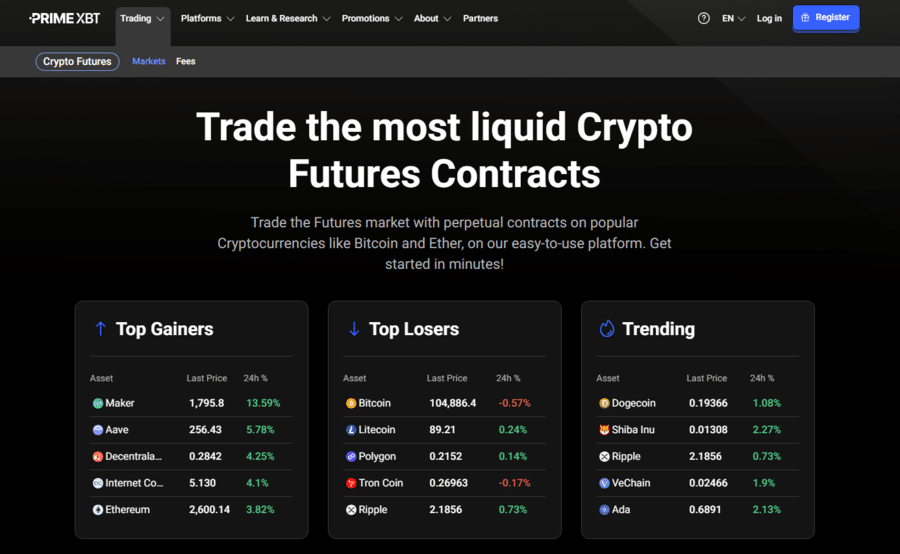
Leverage reaches up to 1000x on crypto positions, though that level of risk can wipe out your portfolio quickly. TradingView is in charge of the charting tools built into the platform. With the “Copy Trading” feature, you can replicate the trades of whale wallets if you don’t want to build your own strategy.
The platform runs trading competitions and hosts communities where people share strategies. Educational content helps newer traders learn the markets. Stop losses, take profits, and trailing stops work across every asset class for managing risk.
Pros:
- Trade crypto, forex, commodities, and indices
- Advanced charting with TradingView
- Copy trading features
- High leverage options available
- Active trading community
Cons:
- Complex platform for beginners
- Limited regulatory oversight
- Customer support inconsistencies reported
Fees:
- Crypto futures: 0.01% maker, 0.02% taker
- CFDs: 0.05% flat, often 0% commission
- Overnight fees: From 0.0017%
- Deposits: Free
- Withdrawals: 0.0005 BTC or up to 1%
- Copy trading: 25-40% success fee on profits
9. OKX – Best for Advanced Trading Tools and Web3 Access
OKX ranks among the biggest crypto exchanges in the world and is a strong option for Australians who want more than just a basic spot trading platform. The exchange combines low trading fees with a polished interface and a broad product suite, making it attractive to both active traders and users who want access to a wider crypto ecosystem.

OKX supports more than 350 cryptocurrencies and over 500 trading pairs, covering major coins, stablecoins, and a wide range of altcoins. In addition to spot trading, the platform offers futures, options, margin trading, copy trading, and P2P markets..
Users can also access OKX Earn products, explore token launches through Jumpstart, manage assets through the OKX Web3 Wallet, and interact with dApps, cross-chain tools, and NFT features – so there’s a fully fledged crypto hub going on here.
Pros:
- Wide range of trading products, including spot, futures, margin, options, and P2P
- Competitive fees for active traders
- Strong Web3 ecosystem with wallet, dApps, and DeFi access
- Trading bots, copy trading, and demo features available
- Large selection of cryptocurrencies and trading pairs
Cons:
- The full feature set can feel overwhelming for beginners
- Some services and payment options vary by region
- Customer support can be inconsistent at times
Fees:
- Spot trading: From 0.08% maker, 0.10% taker
- Futures: From 0.02% maker, 0.05% taker
- Deposits: Free for crypto
- Fiat via third-party: Varies by payment provider
10. BloFin – Best for AI-Driven Trading
BloFin uses AI-powered tools to analyze markets and identify potential trading setups. The system examines technical indicators, price patterns, and market data to generate insights for traders. The platform launched in 2019 with a focus on quantitative trading approaches.

The platform uses Fireblocks for institutional-grade custody and has never experienced a security breach. Most assets are stored in cold storage with multi-signature requirements for withdrawals.
Staking is only available for Bitcoin, Ethereum, and USDT, and APY rates are lower than those of staking-focused platforms.
Pros:
- AI-powered trading tools and insights
- Institutional Fireblocks custody
- No security breaches since 2019
- Clean interface for modern traders
- 24/7 customer support
Cons:
- Very limited staking options (3 coins)
- Low APY rates on staking
- No fiat withdrawal support
- Limited coin selection overall
Fees:
- Trading: 0.10% maker and taker
- Staking service fee: 10% on rewards
- Deposits: Free
- Withdrawals: Network fees
Comparing Australia’s Top Crypto Exchanges
| Exchange | Best For | Coin Selection | Trading Fees | AUD Support | Key Feature |
| Binance | All traders | 400+ | 0.1% | Via card | Global liquidity |
| KCEX | Fee-conscious | Moderate | 0% spot | None | Zero fees |
| MEXC | Altcoin hunters | 2,600+ | 0% maker | Third-party | Early listings |
| Kraken | Security-focused | 200+ | 0.16% | Limited | Proven track record |
| Margex | Risk management | Limited | 0.019% | None | MP Shield |
| Independent Reserve | Institutions | 30+ | 0.5%-0.02% | Excellent | OTC desk |
| Bitcoin.com.au | Beginners | Limited | 1% | Excellent | Simplicity |
| PrimeXBT | Multi-asset | Extensive | Variable | Limited | Forex & crypto |
| OKX | Advanced traders | 350+ | 0.08% | Limited | Web3 ecosystem |
| BloFin | Tech traders | Limited | 0.10% | None | AI tools |
Is Buying Crypto Legal in Australia?
Yes, buying and trading cryptocurrency is completely legal in Australia. The Australian government recognizes cryptocurrencies as legal property and has established clear regulatory frameworks.
The Australian Securities and Investments Commission (ASIC) oversees crypto-related financial products. The Australian Transaction Reports and Analysis Centre (AUSTRAC) requires all exchanges to register as Digital Currency Exchange providers.
Legitimate crypto exchanges operating in Australia must implement Anti-Money Laundering (AML) and Know Your Customer (KYC) procedures. These requirements protect users and help prevent illegal activities.
A recent draft legislation proposed in September 2025 wants to bring crypto exchanges under the same regulatory framework as traditional financial services businesses. This move would strengthen consumer protections and industry standards.
Do I Have to Pay Taxes on Crypto in Australia?
Yes, cryptocurrency is subject to taxation in Australia. The Australian Taxation Office (ATO) treats crypto as property, not currency, which has specific tax implications.
Capital Gains Tax (CGT) applies when you sell, trade, or dispose of cryptocurrency. If you hold crypto for more than 12 months before selling, you may qualify for a 50% CGT discount.
Every crypto-to-crypto trade is a taxable event. Swapping Bitcoin for Ethereum counts as disposing of one asset and acquiring another, both of which must be reported.
Mining rewards, staking rewards, and airdrops count as ordinary income and must be declared at their AUD value when received. Keep detailed records of all transactions, including dates, amounts, and AUD values.
Many exchanges now integrate with crypto tax software to simplify reporting. Independent Reserve offers KPMG-powered tax estimation tools, while platforms like Koinly can import transaction data from most exchanges.
Which Crypto Exchanges Accept AUD?
Several exchanges support direct AUD deposits and withdrawals:
Full AUD Support:
- Bitcoin.com.au – PayID, bank transfer, credit card
- Independent Reserve – Bank transfer, PayID, SWIFT
- CoinSpot – PayID, BPAY, bank transfer, credit card
- Swyftx – Bank transfer, PayID, card payments
- BTC Markets – PayID, Osko, bank transfer
- Digital Surge – PayID, bank transfer, POLi
Limited/Indirect AUD Support:
- Binance – Credit/debit card purchases only
- MEXC – Third-party processors (Banxa, MoonPay)
- Kraken – Bank transfer deposits available
- OKX – Via partner services (Banxa, MoonPay)
PayID has become the preferred deposit method for most Australian exchanges. It enables instant transfers that appear in your exchange account within minutes, often 24/7.
Traditional bank transfers work but usually take 1-2 business days to process. Credit and debit cards offer instant purchases but come with higher fees, typically 3-5%.
How to Choose the Best Crypto Exchange in Australia
We’ve put together a comprehensive list of things to check when you’re choosing which crypto exchange to use in Australia:
Regulation and Security
Check AUSTRAC registration first. Every legitimate exchange operating in Australia must be registered as a Digital Currency Exchange provider. This registration means they follow AML and CTF laws.
Security measures should include cold storage for most funds, two-factor authentication, withdrawal whitelisting, and regular security audits. Exchanges that have operated for years without security breaches demonstrate better track records.
Look for proof of reserves or regular audits by reputable firms. Exchanges that publish these reports show commitment to transparency and financial stability.
Fees and Spreads
Trading fees vary dramatically between exchanges. Binance charges 0.1% per trade, while MEXC offers 0% maker fees. Calculate what you’ll pay based on your trading frequency and volume.
Spreads matter just as much as stated fees. Some exchanges with “zero fees” make money through wider spreads between buy and sell prices. Check actual buy and sell prices to calculate the real cost.
Deposit and withdrawal fees add up. Platforms like Independent Reserve charge nothing for AUD deposits over $100, while others hit you with percentage-based fees or fixed charges.
Supported Assets and Liquidity
Match the exchange’s coin selection to your trading goals. Bitcoin.com.au offers limited coins perfect for beginners, while MEXC lists thousands of altcoins for experienced traders.
Liquidity determines how quickly your orders fill at desired prices. Major exchanges like Binance provide deep liquidity on popular pairs. Smaller exchanges may have wider spreads and slower fills on less common tokens.
User Experience and Mobile Support
Test the interface before committing large amounts. Some exchanges prioritize simplicity (Bitcoin.com.au, CoinSpot), while others offer professional tools (Binance, Kraken).
Mobile apps are important for traders who need to monitor positions on the go. Binance, Swyftx, and most major exchanges offer full-featured mobile apps with price alerts and trading capabilities.
Deposit and Withdrawal Options in AUD
Direct AUD support eliminates foreign exchange fees and complications. Local exchanges like Bitcoin.com.au and Independent Reserve excel here with PayID and instant bank transfers.
International exchanges may require converting AUD to USD or using credit cards with higher fees. Factor these extra costs into your decision.
Are All Exchanges in Australia AUSTRAC-Registered?
No, not all exchanges operating in Australia hold AUSTRAC registration. While Australian law requires Digital Currency Exchange providers to register with AUSTRAC, enforcement varies, and some platforms operate without proper licenses.
AUSTRAC reports approximately 400 registered crypto exchanges, though many are inactive or shell companies. Only a fraction actively serve Australian customers with full compliance.
International exchanges like Binance, Kraken, and OKX operate globally and serve Australian users, but they don’t always hold AUSTRAC-specific licenses. They may instead register through Australian subsidiaries or partner entities.
Local exchanges like Bitcoin.com.au, Independent Reserve, CoinSpot, and Swyftx maintain AUSTRAC registration as core parts of their operations. These platforms prioritize Australian regulatory compliance.
Some offshore exchanges with limited regulation continue serving Australian customers despite lacking AUSTRAC registration. Using these platforms carries higher risks, as they fall outside Australian consumer protections.
Check AUSTRAC’s public register to verify an exchange’s registration status. Legitimate exchanges display their AUSTRAC registration number on their websites, usually in the footer or regulatory information section.
Conclusion
Exchanges that are best for you will mainly depend on your experience level and the type of assets that you want to trade.
Binance leads the pack for overall liquidity and product depth. KCEX and MEXC stand out for traders who want low fees and access to a broad range of markets.
Independent Reserve and Bitcoin.com.au remain strong choices for Australians who want local support and direct AUD access, while PrimeXBT, OKX, and BloFin offer more specialized tools for advanced users.
Test each platform with small amounts first. Check how deposits work, how trades execute, and whether withdrawals process smoothly. Take time to understand the features you’ll use most.
FAQ
What is the best crypto exchange in Australia for beginners?
Are crypto exchanges in Australia regulated?
Which Australian crypto exchange has the lowest trading fees?
Can I trade altcoins on Australian exchanges?
How do I choose the right crypto exchange in Australia?
Can I deposit and withdraw in Australian dollars (AUD)?
Are crypto exchanges in Australia safe?
Can I trade derivatives or use margin in Australia?
References
- AUSTRAC Digital Currency Exchange Register – AUSTRAC
- Copy Trading – PrimeXBT