On this Page:
Staking has become essential to DeFi. It lets you earn yield while you help secure blockchain networks and validate transactions.
The best coins to stake require careful research. You need to evaluate network performance, reward rates, tokenomics, and community activity before you commit your funds.
This month, Bitcoin Hyper, Maxi Doge, and PEPENODE are some of the top staking opportunities. Bitcoin Hyper speeds up Bitcoin and adds staking, Maxi Doge harnesses degen trading culture with impressive staking APYs, and PEPENODE lets you deploy mining nodes, build server rooms, and compete on leaderboards.
Today, we’ll look at the best staking options for August, explain what makes each project worth your time, and help you pick the right ones for your portfolio.
Best Staking Crypto August 2026
| # | Coin (Ticker) | Approx. APY | Lock-up/Unbonding | Key Notes |
|---|---|---|---|---|
| 1 | Bitcoin Hyper ($HYPER) | 19.0% | Presale staking; likely 2‑year program | Layer‑2 on Bitcoin via Solana VM; high early rewards, audited contracts |
| 2 | Maxi Doge ($MAXI) | 13.2% | Presale; lock until claim | Ultra-high APY staking meme coin with no utility; high risk, high speculation |
| 3 | PEPENODE ($PEPENODE) | 0.0% | Presale; lock until launch | Virtual mining simulator with competitive leaderboards |
| 4 | Ethereum ($ETH) | 4–6% | ≈ 6 days unbonding | Largest PoS network; highly liquid and secure |
| 5 | Cardano ($ADA) | 3–5% | None (flexible) | Low-risk delegation, no lock-up |
| 6 | Polkadot ($DOT) | 10–14% | ≈ 10–28 days unbonding | Higher yield, parachain ecosystem |
| 7 | Solana ($SOL) | 6–8% | ≈ 2 days unbonding | Fast network; relies on validators |
| 8 | BNB Chain ($BNB) | 4–6% | ≈ 7 days unbonding | Native to Binance ecosystem |
| 9 | Cosmos ($ATOM) | 9–13% | ≈ 21 days unbonding | Hub-and-zone architecture, high staking rate |
| 10 | Algorand ($ALGO) | 5–7% | Instant (no lock-up) | Pure PoS with flexible rewards |
Best Coins to Stake in August 2026
In this section, we review the top coins for staking in August 2026, based on InsideBitcoins research as well as general industry consensus.
1. Bitcoin Hyper ($HYPER)
Bitcoin Hyper sets out to bring full DeFi functionality as well as low fees and lightning-fast transactions to Bitcoin. It sets itself apart with its custom implementation of the Solana Virtual Machine (SVM), which is what powers its DeFi capabilities and scalability.
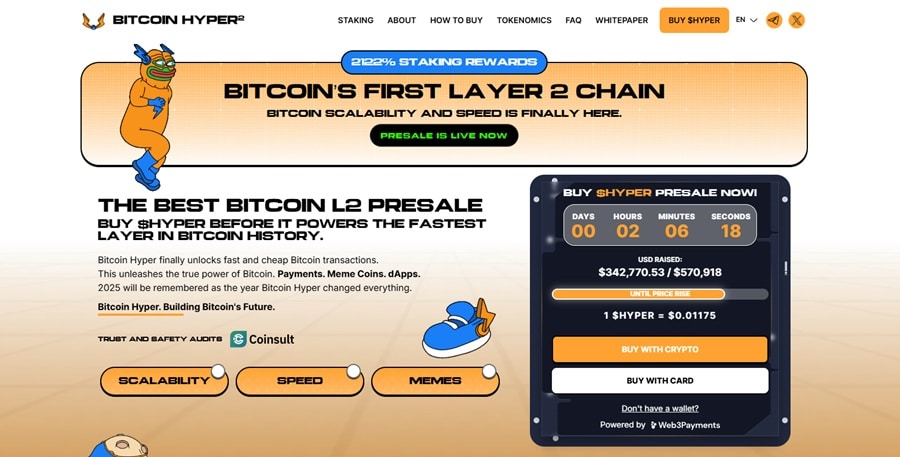
The project wants to combine the incredible functionality of DeFi from Ethereum and Solana, such as lending, borrowing, and yield farming, with Bitcoin’s unmatched security and immutability. The network will be powered by its native token, $HYPER. The community seems to love the project, as it is about to reach its presale number of $14M. Presale buyers can stake their tokens immediately to start earning rewards. Over 650 million $HYPER tokens have already been staked.
Find out more about Bitcoin Hyper
2. Maxi Doge ($MAXI)
Maxi Doge ($MAXI) is a new Ethereum meme coin that has already started to make waves in the shitcoin community. The idea of the project is to evoke the spirit of degen meme coin trading at the highest level. It’s trying to be the ultimate evolution of Dogecoin and it’s perfectly represented by its jacked Shiba Inu mascot, who chugs energy drinks and trades meme coins with 1000x leverage all day.
Maxi’s goal is to form a community around shared goals and mindsets, bringing all shapes and sizes of meme coin fanatics from around the world together to share their experiences in the trading trenches and just have a good time. While its main mission isn’t to build out some kind of massive DeFi app or ecosystem of interconnected tokens, it seems like it really wants to reward its community.
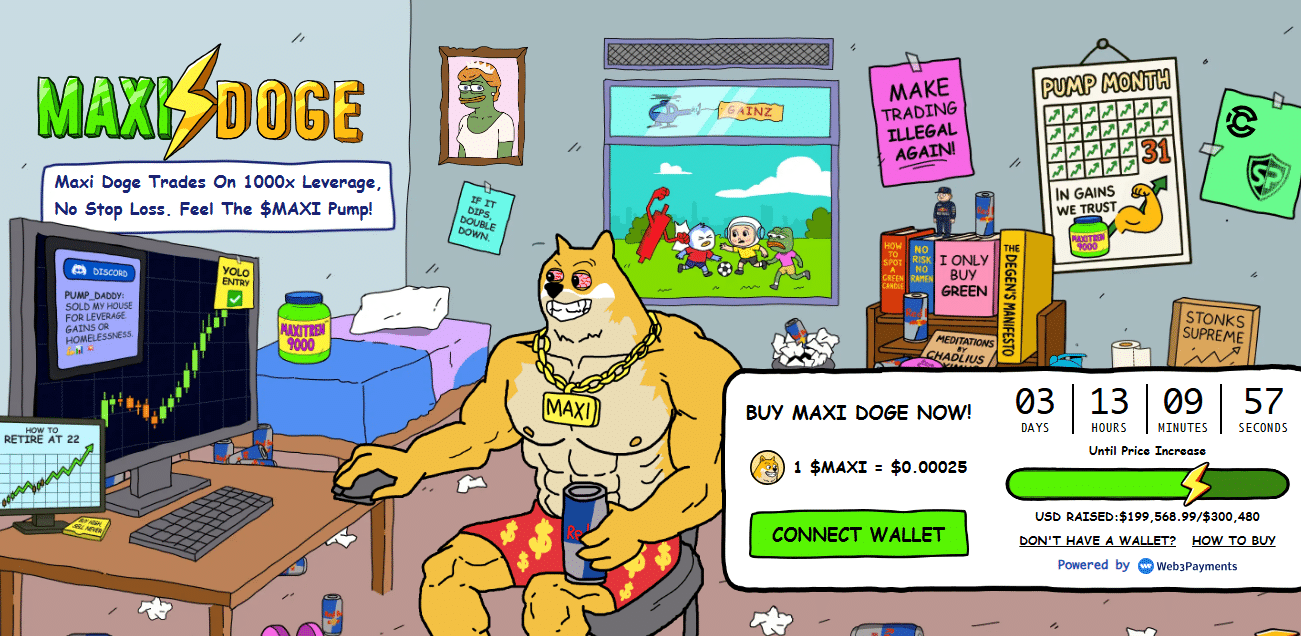
Even though Maxi Doge is in its presale phase, investors can stake their tokens for up to 175% staking rewards. The team is also planning special contests to reward the top degen traders in its community with more $MAXI tokens. So far, the project has been remarkably successful, with $1,600,000 raised in its presale, likely driven by its perfect narrative and community rewards.
Find out more about Maxi Doge:
3. Pepenode ($PEPENODE)
Pepenode ($PEPENODE) is a new Ethereum meme coin that launched with a virtual mining simulator built into its presale. It features a browser-based game where you deploy mining nodes, build server rooms, and compete on leaderboards.
Pepenode rewards players who upgrade their virtual rigs (burning 70% of those tokens permanently) and promises airdrops of other meme coins like $PEPE and $FARTCOIN to top miners.
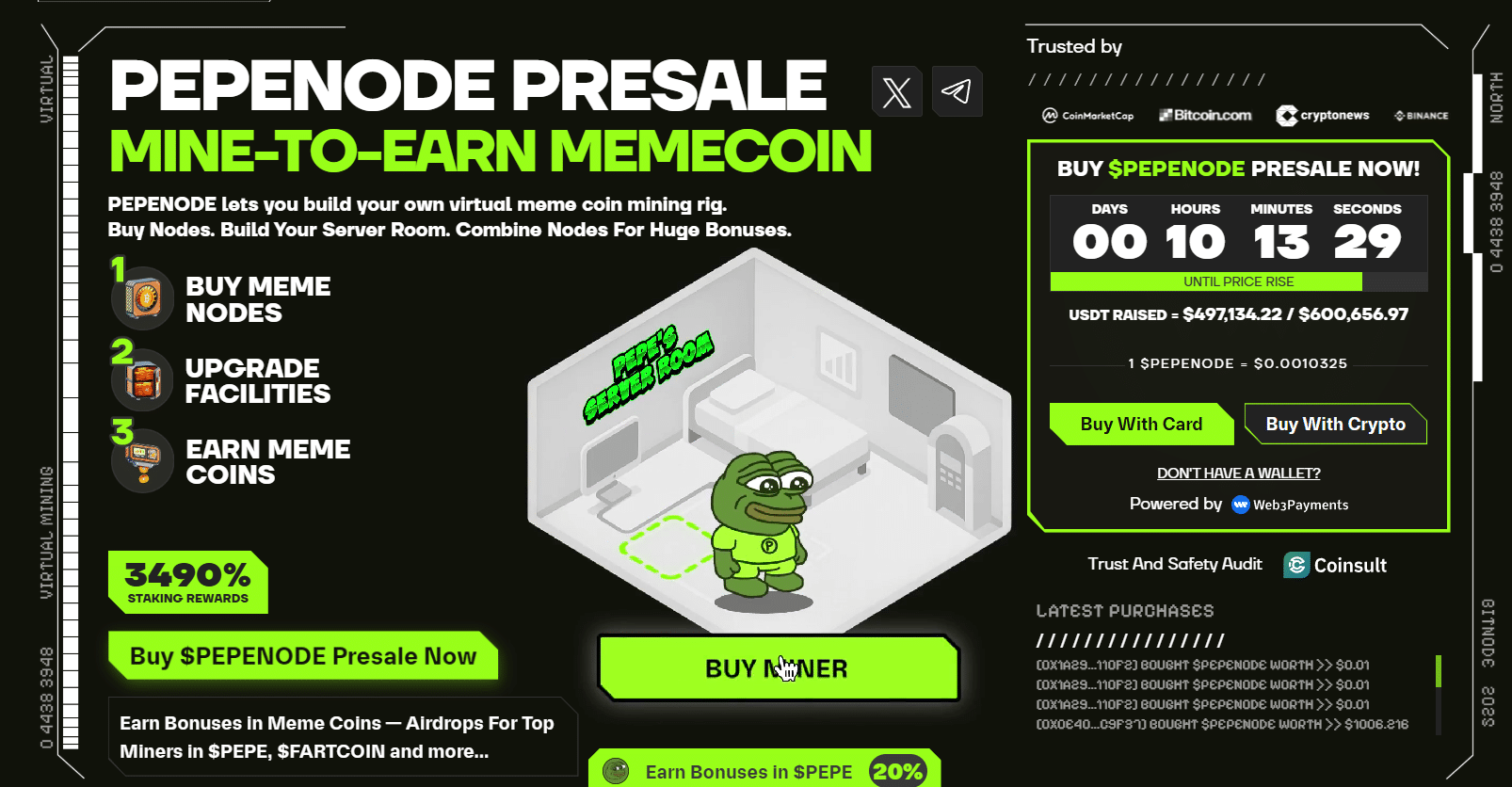
Even though Pepenode is in its presale phase, investors can stake their tokens for up to 3,495% APY rewards. The team also plans leaderboard competitions and referral bonuses that give 2% of mining rewards to whoever brought you in.
So far, the project has raised over $500,000 in its presale, which looks modest compared to other meme launches but could mean more room for growth if the virtual mining concept catches on.
Find out more about Pepenode:
4. Ethereum ($ETH)
Ethereum (ETH) remains the second-largest cryptocurrency by market capitalization behind Bitcoin and the most prominent altcoin in the digital currency ecosystem. Since completing “The Merge” in September 2022, Ethereum has fully transitioned from an energy-intensive Proof-of-Work model to a more sustainable Proof-of-Stake consensus mechanism, making ETH a premier stakeable asset.
Approximately 28.13% of all available ETH is now staked, representing 34 million ETH tokens with a staking market cap of around $60.3 billion. This massive pool of staked assets shows us investors’ strong confidence in Ethereum’s long-term viability and the appeal of earning passive income through staking.
Ethereum Price Chart
(ETH)
Ethereum (ETH)
While retail stakers on their platform are estimated to receive an estimated reward rate of about 2.04% APY, other staking options can yield higher returns. The Ethereum staking pool available through the ETH LaunchPad offers yields averaging around 4.1% APY, depending on the total amount of ETH staked network-wide. These rewards fluctuate based on network participation, as more ETH gets staked, the relative rewards decrease per validator.
The entry requirement for validators is 32 ETH, which represents a significant investment. However, staking pools and liquid staking derivatives like Lido’s stETH or Rocket Pool’s rETH allow investors to participate with much smaller amounts while maintaining some liquidity.
Unlike Ethereum, Bitcoin continues to operate on the original Proof-of-Work consensus mechanism, which means BTC cannot be directly staked. Instead, Bitcoin miners secure the network using specialized hardware and electricity. However, investors seeking yield on their Bitcoin holdings can stake wrapped Bitcoin (WBTC), an ERC-20 version of Bitcoin that runs on the Ethereum blockchain, through various DeFi protocols such as Aave and Compound, typically earning between 0.5-3% APY depending on market conditions.
Find out more about Ethereum:
5. Cardano ($ADA)
Cardano (ADA) stands strong in the proof-of-stake ecosystem, with its native token designed specifically for staking functionality. Approximately 59.99% of all circulating ADA tokens are actively staked, representing 21.2 billion tokens with a staking market cap of $15.3 billion. This high participation rate highlights strong community commitment to the network’s security and governance.
While Coinbase reports a conservative estimated reward rate of 1.68% APY for their platform, staking directly through native Cardano wallets like Daedalus or Yoroi can yield higher returns, with an average network-wide return of approximately 3.5-4.6%, depending on the stake pool selected. These rewards are distributed every five days at the end of each epoch, providing regular passive income to ADA holders.
Cardano Price Chart
(ADA)
Cardano (ADA)
Cardano’s staking process is notably user-friendly compared to other proof-of-stake blockchains. There is no minimum staking requirement, allowing even small investors to participate, and staked ADA remains liquid—tokens aren’t locked and can be spent at any time without a waiting period. However, only the ADA that remains in your wallet at each epoch snapshot will earn staking rewards.
The network’s design balances decentralization with efficiency through its delegation mechanism. While users could run their own stake pools, most choose to delegate their ADA to professional stake pool operators. The protocol has built-in safeguards against pool centralization, with diminishing returns for pools that grow too large, encouraging a more distributed validator network.
Cardano has expanded its utility beyond simple transactions since implementing smart contract functionality through the Alonzo hard fork. Smart contracts require ADA for transaction fees and as collateral in specific DeFi applications, creating additional demand for the token. This expanded utility enhances the value proposition for stakers, as their rewards potentially gain value both from accumulating additional tokens and from the increased utility of ADA within the Cardano ecosystem.
Find out more about Cardano:
6. Polkadot ($DOT)
Polkadot (DOT) has emerged as one of the highest-yielding major cryptocurrencies for staking, offering an impressive average annual yield of 9.91%. As the backbone of a “layer 0” blockchain ecosystem, Polkadot was created to address the interoperability limitations that plague many other blockchain networks, allowing different blockchains to communicate and share information securely.
Currently, 54.38% of all DOT tokens are actively staked on the network, representing over 854 million tokens with a staking market cap of approximately $3.7 billion. This substantial participation rate demonstrates strong investor confidence in Polkadot’s technological model and future potential.
Polkadot Price Chart
(DOT)
Polkadot (DOT)
Polkadot’s staking mechanism, known as Nominated Proof of Stake (NPoS), differs from standard PoS systems in several important ways. Rather than requiring users to run validator nodes directly, you can participate as a “nominator” by selecting up to 16 validators to back with your DOT tokens. When these validators perform their duties correctly, you’ll share in the rewards proportionally to your stake. This approach makes staking more accessible while maintaining network security.
For those looking to maximize DOT staking rewards, it’s worth considering the following factors:
- The 28-day unbonding period locks your tokens when you decide to unstake, during which time you won’t earn rewards but still can’t access your DOT
- You’ll need a minimum of approximately 120-160 DOT to receive rewards as a nominator due to the network’s minimum active nomination requirement
- Validator selection significantly impacts your returns—choosing validators with lower commission rates and consistent performance will optimize your earnings
When staking directly through the Polkadot.js wallet or Ledger hardware wallet, you retain full control of your DOT while earning some of the highest yields available in crypto staking. This combination of impressive returns and Polkadot’s vision for a multi-chain future continues to attract both long-term investors and those seeking substantial passive income from their cryptocurrency holdings.
Find out more about Polkadot:
7. Solana ($SOL)
Solana (SOL) has established itself as one of the most compelling cryptocurrencies for staking in 2025, offering an attractive 5.83% APY. It maintains its position as a leading “Ethereum alternative.” With nearly 65% of all SOL tokens currently staked, representing 336.3 million tokens with a staking market cap of approximately $52.1 billion. The network enjoys strong security and high participation from token holders.
What makes Solana particularly appealing for stakers is its unique approach to blockchain scaling. Unlike many competitors, Solana’s Proof-of-History (PoH) consensus mechanism works alongside its Proof-of-Stake system, enabling the network to process transactions at speeds exceeding 50,000 per second with minimal fees. This technical advantage has attracted substantial developer activity, creating a thriving ecosystem that enhances SOL’s utility and value proposition.
Solana Price Chart
(SOL)
Solana (SOL)
When you stake SOL, you’re not just earning passive income—you’re also supporting one of the fastest-growing blockchain ecosystems in the market. The network has seen its staking rewards trending upward, with an 8.05% increase in APY over the past month, suggesting improving economics for stakers as the platform continues to mature.
For those interested in staking SOL, you have several options to consider:
- Non-custodial wallets like Phantom, Solflare, and Sollet provide the most direct staking experience, allowing you to select validators personally while maintaining control of your private keys
- Liquid staking solutions such as Marinade Finance and Lido for Solana issue tokenized representations of staked SOL (mSOL or stSOL), enabling you to maintain liquidity while earning staking rewards
- Hardware wallet integration with Ledger devices offers enhanced security for those staking larger amounts
The unbonding period for Solana is much shorter than many competing networks at just 2-3 days, providing greater flexibility when you need to access your funds. However, be aware that while Solana has shown impressive technical capabilities, the network has experienced occasional outages in the past—a risk factor to consider when determining your allocation to SOL staking.
Find out more about Solana:
8. BNB Chain ($BNB)
BNB (formerly Binance Coin) has evolved from a simple exchange token into one of the cryptocurrency market’s heavyweights, currently maintaining a market cap of approximately $85.6 billion. While only about 20.79% of BNB is staked, significantly lower than many other major proof-of-stake cryptocurrencies, this still represents 29.3 million tokens with a staking market cap of nearly $17.8 billion.
BNB Price Chart
(BNB)
BNB (BNB)
What makes BNB particularly interesting as a staking option is its dual utility. Beyond earning the current 3.83% APY through staking, BNB provides significant advantages within the Binance ecosystem. When you hold BNB, you’ll benefit from:
- Trading fee discounts of up to 25% on the Binance exchange
- Priority access to new token launches through Binance Launchpad
- Reduced fees when using BNB to pay for transactions on BNB Chain
- Eligibility for Binance Earn products with enhanced rates
The staking mechanism for BNB differs from many competitors as it uses a Delegated Proof of Stake system with only 21 active validators. While this raises some centralization concerns, it enables the network to process transactions more efficiently and maintain consistently low fees. If you’re considering staking BNB, you have several options:
Staking directly on Binance Exchange offers simplicity and variable lockup periods, with higher APYs for longer commitments. BNB Vault on Binance combines multiple yield strategies to optimize returns. DeFi protocols like PancakeSwap and Venus allow you to stake BNB while maintaining more control over your assets. Third-party staking platforms such as Trust Wallet provide a middle ground between security and ease of use.
It’s worth noting that BNB’s staking rewards have seen substantial volatility in recent months, with a dramatic 97.97% decrease in yield.
Find out more about BNB:
9. Cosmos ($ATOM)
Cosmos (ATOM) delivers one of the highest staking yields among established cryptocurrencies, currently offering an impressive 14.31% APY according to recent data. This remarkably high return rate exists in part due to the token’s essential role in securing the broader Cosmos ecosystem, often called the “Internet of Blockchains.” Unlike single-blockchain networks, Cosmos provides the infrastructure for different blockchains to communicate with each other while maintaining their independence.
Cosmos Hub Price Chart
(ATOM)
Cosmos Hub (ATOM)
The Cosmos Hub, secured by staked ATOM tokens, is the central connecting point in this interoperable network. When you stake ATOM, you’re not just earning passive income—you’re helping secure a critical infrastructure that supports dozens of major blockchain projects built using the Cosmos SDK, including Binance Chain, Crypto.org Chain, and Osmosis. This utility drives real demand for the token beyond speculation.
Currently, 57.57% of all ATOM tokens are staked, representing 225 million tokens worth approximately $1 billion. This high participation rate demonstrates strong confidence in the network’s security model and future potential. The staking ratio has remained relatively stable despite market fluctuations, indicating a committed long-term holder base.
For those considering staking ATOM, it’s worth understanding the specific mechanics involved. When you stake tokens, you’ll need to select a validator from the active set. Your selection matters significantly—validators charge different commission rates (typically 1-10%) and have varying uptime records that can affect your rewards. Poor validator performance can also lead to “slashing,” where a portion of staked tokens is lost if the validator misbehaves or fails to maintain proper operation.
One important consideration when staking ATOM is the 21-day unbonding period. During this time after initiating an unstake, your tokens are neither earning rewards nor available for transfer or trading. This extended lockup period helps secure the network, but requires careful planning if you might need quick access to your funds. Some investors prefer to stagger their ATOM stakes so that not all tokens are locked in the same unbonding cycle.
Find out more about Cosmos:
How to Stake Crypto – Quick Guide
- Choose an exchange that offers staking.
- Create and verify a free account.
- Deposit funds via bank transfer, PayPal, debit card, or other payment methods.
- Buy coins such as Ethereum, Cardano, or Tron.
- Select staking services via the exchange.
- Receive the staking rewards that are distributed automatically each month.
How to Stake Crypto – Best Methods
There are several ways how to stake crypto assets – DeFi staking, using staking-as-a-service platforms, staking on an exchange, and even on hardware wallets.
DeFi Staking
Decentralized finance advocates for users being in control of their funds, eliminating the role of a third party or an intermediary. This is the concept behind DeFi staking, such that users act as validators and help secure the network just like miners do on PoW-enabled blockchains.
More often than not, running a node as a validator often comes with steep requirements. For instance, the minimum stake of 32 ETH required to run a node on ETH is relatively high. Alternatively, you can opt for pools on decentralized exchanges such as PancakeSwap or Uniswap.
In most cases, there is no minimum stake stipulated in these pools. This creates an opportunity for free entry and exit such that users can stake and unstake at any time.
In DeFi staking, you can earn passive income on your tokens via two means, namely liquidity mining and yield farming. With liquidity mining, stakers provide liquidity on a pool and are rewarded with transaction fees spent by other pool users.
Tokens are often paired with liquidity pools (LPs). For example, you could have a pool with Binance Coin (BNB) and Axie Infinity Shards (AXS) paired together. Users who prefer to stake in this pool have to use equal amounts of BNB and AXS tokens.
Staking-as-a-Service Platforms
Staking-as-a-Service platforms are focused on providing crypto staking. Using these platforms, you are delegating your assets while they maintain a node as a validator on your behalf. Delegating your assets to them is not handing over custody – you are still in control of your assets and allowed to ‘undelegate’ them whenever you wish.
While they run the nodes and handle other technicalities involved, they charge commissions on your rewards. This is like their reward for the service rendered. Staking with SaaS platforms is also known as soft staking.
Several platforms offer staking services and they do so across different pools. Only a few have been able to resonate with staking enthusiasts.
Staking on Exchanges
Many leading crypto exchanges make things simple for their customers and offer automatic staking rewards on their platforms. There’s no need to set up your a node or purchase any special equipment.
Rewards are automatically paid out to users monthly, with the platform reserving a small percentage of yields as the fee for operational costs and other incurred costs. Users should note that staking via exchange is not available in all countries.
Staking Stablecoins
Stablecoins are considered by more conservative investors to be the best coins to stake as they are less volatile, meaning they are not subject to sudden market fluctuations, unlike other crypto assets. One reason for this is that they are pegged to fiat currencies which give them adequate backing provided there is a reserve.
Your principal is more guaranteed, and the returns are more predictable. Below are some stablecoins you could stake, as well as platforms that enable stablecoin staking and yield rates:
- USDC – issued by Circle and is pegged to fiat dollars on a 1:1 basis. Binance offers 3.49%, Coinbase 0.15% and OKX 3.23%.
- BUSD – issued by leading crypto exchange Binance. Users earn 3.59% annually for staking BUSD on Binance.
- DAI – another stablecoin pegged to the US dollar and issued by the decentralized protocol and autonomous organization MakerDAO. DAI has a circulating supply of 6.4 billion. However, the token’s supply is not known.
The disadvantage of staking stablecoins is, of course, that they don’t rise in value; they remain stable. When you buy Ethereum and stake it, you can earn income in two ways: from the rise in the price of ETH and from crypto passive income.
How to Stake Crypto – Step-by-Step
Let’s break down the staking steps in detail:
Step 1 – Create an Account
The first step to staking crypto is to find a preferred crypto exchange. There are different platforms, and each has its own strengths and weaknesses, unique features, and fees – find one that you’re comfortable holding your funds.
Most are available as free mobile apps on iOS or Android, or via their websites. Create an account with basic information and then verify that account. This will involve confirming an email address and phone number, and providing a photo ID such as a passport or driver’s license. Some platforms also require proof of address and may ask customers to complete a questionnaire.
As mentioned, staking services are unavailable on major crypto exchanges in some countries.
Step 2 – Buy Staking Coins
Once an account has been created, search for the cryptocurrency you wish to stake using the search bar available on most platforms. Then, purchase the token.
Different exchanges have different minimum purchase amounts and fees, but most will allow users to buy major cryptos such as ETH, ADA, and SOL, with fiat currency. Follow the instructions on-screen to complete the transaction.
Keep in mind that the coins you purchase should be supported for staking on your chosen platform. Most major exchanges clearly indicate which cryptocurrencies are available for staking, along with their respective reward rates.
Step 3 – Stake Your Coins
Navigate to the app’s staking section—on Binance, for example, this is called ‘Earn’. Find the token you wish to stake and select the relevant staking product.
Binance allows users to stake tokens for a set period of 30, 60, 90, or 120 days. The rewards percentage increases the longer a token is locked. Users select the locking period and the amount to stake.
On other platforms like Coinbase or Kraken, the staking process may be slightly different, but the general concept remains the same – you’ll need to navigate to their staking or earn section, select your asset, and follow the instructions to commit your tokens to staking.
Note that you can redeem tokens early if you decide to sell a token, but all potential rewards will be lost, and some platforms may charge early redemption fees.
Step 4 – Receive Crypto Staking Rewards
Crypto exchanges will automatically distribute staking rewards, although the timescale for rewards varies. Some platforms distribute rewards daily, while others may pay out weekly or monthly.
The rewards will not automatically be added to the staking pool, but there is nothing to stop users from manually adding rewards to create compounding interest. Some platforms do offer auto-compounding options that reinvest your rewards automatically.
You can typically track your staking rewards through the platform’s dashboard or earnings reports. This allows you to monitor your passive income and decide whether to continue staking a particular asset or possibly stake additional tokens.
Latest Market News


Is Staking Crypto Safe?
While crypto staking may hold many benefits for those who engage in it, some risks must be considered as well. Let’s discuss them below:
Possible Exploits or Hacks
Security breaches represent one of the most serious risks to staked assets, particularly on centralized platforms. Over the last few years, several major incidents have demonstrated this vulnerability, with Huobi exchange losing more than $100 million to hackers in November 2023.
Non-custodial staking options, where you maintain control of your private keys, can significantly reduce the risk of losing funds in a centralized platform hack. Hardware wallets that support staking, such as Ledger or Trezor, provide an additional security layer by keeping your private keys offline while still allowing you to participate in staking activities.
Unstaking Limitations and Lock-up Periods
Most staking protocols implement mandatory lock-up periods during which you cannot access your staked assets. These periods vary widely between cryptocurrencies, from a few hours to several weeks or months. For example, Ethereum requires a minimum waiting period before unstaked tokens become available, while Cardano has a shorter unstaking cycle.
During this unstaking period, you remain exposed to market volatility without the ability to sell. As the reference material notes, “The balance you stake will be unavailable to sell or send until you unstake it,” and the process completion time isn’t guaranteed. This illiquidity can be particularly problematic during market downturns, when you might want to exit positions quickly but cannot.
Liquid staking derivatives (LSDs) like stETH for Ethereum have emerged as a solution to this problem, allowing you to maintain some liquidity while continuing to earn staking rewards. However, these derivatives come with their own risks, including potential depegging from their underlying assets.
Protocol Penalties and Slashing Risks
Many proof-of-stake networks implement “slashing” penalties for validators who violate protocol rules, either intentionally or through technical errors. These penalties can result in the partial or complete loss of staked assets.
While slashing is relatively rare, the consequences can be severe. Common causes of slashing include:
- Double-signing (validating conflicting blocks)
- Extended validator downtime
- Malicious network behavior
- Technical failures in validator setup or maintenance
When staking through third-party providers, it’s crucial to understand their slashing protection policies. Some providers commit to reimbursing slashing penalties resulting from their mistakes, but not those caused by external factors like protocol bugs or network-wide attacks.
Value Fluctuation and Impermanent Loss
Cryptocurrency volatility poses a significant risk to stakers. When the value of your staked asset decreases during the lock-up period, you experience what’s sometimes called impermanent loss, though unlike in liquidity pools, this loss becomes permanent if you’re forced to sell at lower prices.
During the market downturn of late 2023, many investors who had locked their assets in longer-term staking contracts watched helplessly as their staked assets lost significant value while being unable to sell. To mitigate this risk, consider diversifying your staked assets across different cryptocurrencies and staggering your staking positions to avoid having all your assets locked for the same period.
Validator and Third-Party Risks
When delegating your assets to a validator or staking service, you inherently trust their technical competence and ethical behavior.
Different staking options carry different risks:
- Crypto exchanges may offer convenient staking but present centralized security risks
- DeFi platforms introduce smart contract vulnerabilities and less regulatory protection
- Staking pools depend heavily on the reliability of pool operators
- Running your own validator node requires technical expertise and constant maintenance
To minimize third-party risk, thoroughly research validator performance metrics before delegating, including their historical uptime, commission rates, and community reputation. Distributing your stake across multiple validators can also help reduce your exposure to any single point of failure.
Reward Variability and Inflation Risks
Staking rewards are not guaranteed and can fluctuate significantly based on network conditions, validator performance, and protocol changes. As more participants stake their assets, individual rewards typically decrease. Additionally, some cryptocurrencies with high inflation rates may dilute the value of your staking rewards over time.
What is the Future of Crypto Staking?
Staking has become a lucrative venture for investors wanting to earn crypto passive income as an alternative to day trading or choosing to sell cryptocurrency and realize profits. It provides a way to hedge against downside risk and compound gains.
The rise of liquid staking derivatives (LSDs) continues to transform staking, allowing users to maintain liquidity while still earning staking rewards. Protocols like Lido and Rocket Pool have seen tremendous growth, with these liquid staking tokens increasingly being integrated into DeFi applications.
The environmental benefits of crypto staking continue to be a strong selling point as sustainability concerns remain at the forefront of technological adoption. The energy efficiency of PoS compared to PoW has made staking more attractive to environmentally conscious investors and organizations.
Cross-chain staking solutions are emerging, allowing users to stake assets across multiple blockchains from a single interface. This interoperability is making staking more accessible and efficient for the average user.
Security measures have improved following several high-profile exploits in previous years. Auditing standards for staking protocols have become more rigorous, and insurance products designed explicitly for staking risks are now available.
Conclusion
As the crypto market continues to mature, staking is increasingly viewed as an essential component of a diversified crypto investment strategy. Regulatory clarity has improved in many jurisdictions, though challenges remain. Several countries have now established frameworks that recognize staking as a legitimate investment activity, providing more certainty for participants.
Institutional involvement in staking has significantly increased, with major financial institutions now offering staking services to their clients. This mainstream adoption has brought greater liquidity and stability to the staking ecosystem.
If you are looking to enter the space, established exchanges and staking platforms like Binance, Coinbase, Best Wallet, OKX, Nexo, and Kraken offer secure, user-friendly options to start earning passive income through staking.
Crypto Staking FAQs
What does staking mean in crypto?
Crypto staking involves locking up your cryptocurrency assets for an extended period of time to unlock rewards or earn interest on your coins. Crypto staking rewards come in the form of more coins, making staking one of the simplest ways to earn crypto passive income.
What is the best crypto staking platform?
We recommend Binance or Coinbase as two globally popular and secure crypto exchanges that offer staking services.
Any risks in crypto staking?
There can be risk attached to staking coins that are relatively new to the cryptocurrency markets and may end up as failed projects - earning crypto staking rewards on a token that crashes and doesn't recover won't be profitable long term. This is unlikely to happen with crypto majors such as ETH and ADA, although the price can vary wildly during a locked staking period.
Is crypto passive income a safe investment?
The cryptocurrency markets have outperformed all other financial assets over the last decade, including Gold, and bank savings accounts. The crypto marketcap still has room to grow, currently at around a quarter of the size of Gold. Staking coins in order to earn more of that coin is safer than attempting to daytrade the volatile swings in the market.