
ChatGPT is everywhere right now. People are using it to write code, plan their vacations, pick the best watermelon, and just about everything you can think of. Naturally, crypto investors are wondering: Can ChatGPT predict prices, too? AI is far from perfect but the sheer volume of information it harnesses could give investors an edge in one of the most unpredictable markets on the planet.
Bitcoin crashes, meme coins pump 300% overnight, and some guy on Reddit turns $1,000 into a Lamborghini with Fartcoin. On the other side of the world, someone loses his entire fortune overnight.
So, we asked ChatGPT: What do you think crypto prices will look like this year? The idea wasn’t just to have fun, which was the main reason, but also because I wanted to see how it compares with what analysts and actual market data are saying.
Let’s be real: nobody is expecting ChatGPT to be a perfect fortune teller. However, since it can give informed guesses based on news, macro shifts, and even market sentiment, let’s see what it predicts.
Can ChatGPT Really Predict Crypto Prices?
ChatGPT is not a crystal ball and should not be seen as a sure way to predict the price of anything. This is an AI-powered tool that cannot see the future, and it isn’t secretly plugged into some top-secret financial database (though conspiracy theories do exist on this).
ChatGPT is a large language model trained on a massive amount of online text, including news articles, blog posts, forum threads, books, research papers, and much more. It has become really good at spotting patterns and can summarize information within seconds.
But can it really predict prices? This is an entirely different game. In fact, ChatGPT and every other AI chatbot all have the same documented problem called ‘AI hallucinations.’ This is essentially when it makes a wild guess or just invents something.
So, if you just go and ask it, “What will Bitcoin be worth in December 2025?”, it will probably throw a number at you. But, where is that number coming from? It’s not pulling from up-to-the-minute trading volume, the latest ETF approval rumors, or geopolitical shifts. It’s just a wild guess based on past patterns and some publicly available info.
That being said, ChatGPT can be useful when it comes to crypto, but the trick is how you use it. You can get much more out of it if you treat it less like a fortune teller and more like your assistant in researching the crypto market.
For example, you can provide it with a bunch of current data and analysis and ask it to summarize it or help break down the most likely scenarios. You can also use it to break down and analyze a whitepaper, a price pattern, or a coin’s tokenomics.
ChatGPT Bitcoin Price Prediction
When we asked ChatGPT about Bitcoin‘s price in the future, here is what its forecast was:
1 year (mid-2026): “If current trends continue—ETF inflows, macro shifts, halving effects—Bitcoin could stabilize around $150k, with a range between $120–$180k.”
Assuming continued ETF inflows and steady macro conditions, ChatGPT predicts that Bitcoin will stabilize around $150,000, which would likely “push its market capitalization well past the $3 trillion mark.” Still, the AI tool cautions about major black swan events, which could happen at any time.
5 years (2030): “Assuming growing institutional adoption and digital-gold narrative, BTC could reach $250–$300k.”
For this estimate, ChatGPT argues that this price would grow if Bitcoin keeps its role as the preeminent digital store of value. It also shares that the price will most likely grow as long as regulatory environments remain favorable, showing us once again how much of a “wild guess” these estimates are.
10 years (2035): “If Bitcoin maintains bullish momentum, it might hit $400k–$600k—but it could just as easily stagnate or crash.”
ChatGPT pointed out that much of Bitcoin’s price in the future would depend on psychological triggers. If the bullish outlooks dominate the headlines, the price surges “could snowball.” Also, if fear grows in the crypto community, we could see a sharp drop in investor confidence and with it, in Bitcoin’s value.
How Does This Compare With Expert Analysis?
ChatGPT forecasts a tremendous growth for Bitcoin, which is not unlikely, but certainly not a sure thing. To verify the reliability of this, we compared a few expert forecasts for comparison.
CoinPedia predicts that BTC will reach $175,000 in 2025, with long-term forecasts of $900,000 by 2030.
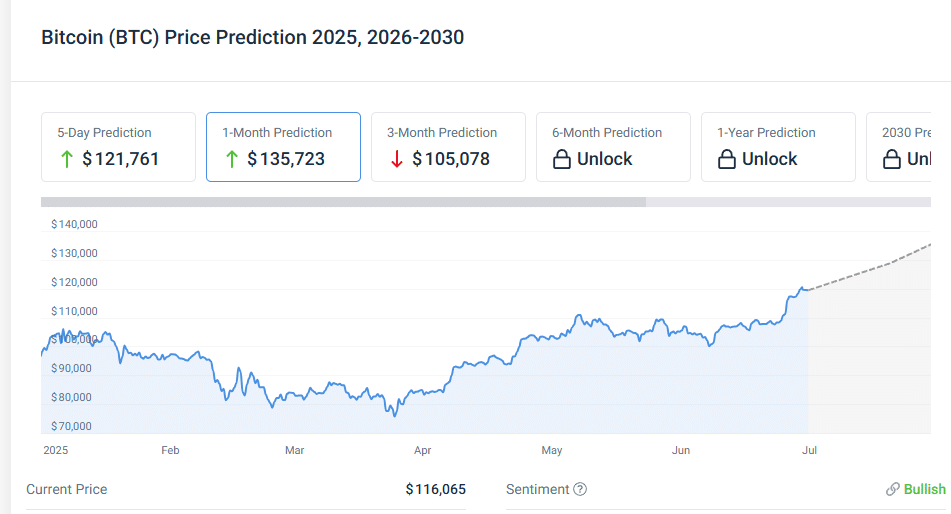
CoinCodex predicts that Bitcoin’s price will drop in three months, going down to $105,078 from its $135,723 estimate for August 2025.
BeInCrypto (Barron’s) cautions a steep volatility that ranges between $70,000 and $200,000 and flags a potential $200,000 to $225,000 by 2026.
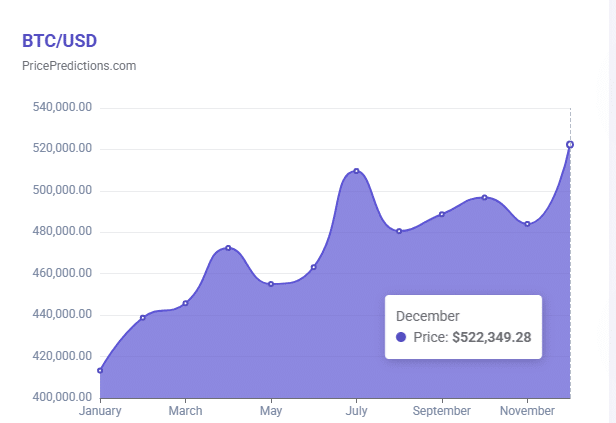
Finally, PricePredictions.com projects a peak of $557,000 in 2026.
Bottom line: ChatGPT’s mid-range fits with most analyst bands: near-term $120,000-$180,000 is well aligned.
Still, these long-term predictions are widely speculative, since Bitcoin has experienced such tremendous volatility over the years.
If the classic Bitcoin narratives (thinking “it will replace gold”) actually come true, it’s more than possible that its price reaches the upper ranges of these predictions. But if not, it could just as easily slide or simply trade sideways.
ChatGPT Ethereum Price Prediction
Next, we asked ChatGPT about Ethereum‘s future, and here is what it forecast:
1 year (mid-2026): “Assuming Ethereum continues to scale post-‘The Merge’ and maintain its dominance in DeFi and NFTs, ETH could land around $3,500–$4,000.”
According to the AI tool, this would put Ethereum’s market capitalization near half a trillion dollars, so it should remain one of the strongest cryptocurrencies on the market. Still, ChatGPT emphasizes the unpredictable nature of crypto, sharing that supply dynamics and macro shifts can “throw everything off course.”
5 years (2030): “If Ethereum leads Web3 and institutional adoption grows, ETH could climb to $8,000–$12,000.”
The AI now warns that competition from other chains is a big threat to Ethereum, so its forecast this far in the future is highly speculative.
10 years (2035): “If Ethereum becomes the backbone of decentralized apps worldwide, there’s a shot at $20k+—but setbacks in scaling or major rivals could hold it back.”
There are quite a lot of “ifs” when it comes to long-term predictions with ChatGPT.
How Does This Compare With Expert Analysis?
Let’s see how these predictions compare to analysts’ expectations:
Changelly projects ETH will reach over $2,990 by the end of 2025, and it will rise to $8,549 by the end of 2026. According to their long-term estimates, Ethereum will grow to $38,294 by 2030 and $167,958 by the end of 2034.
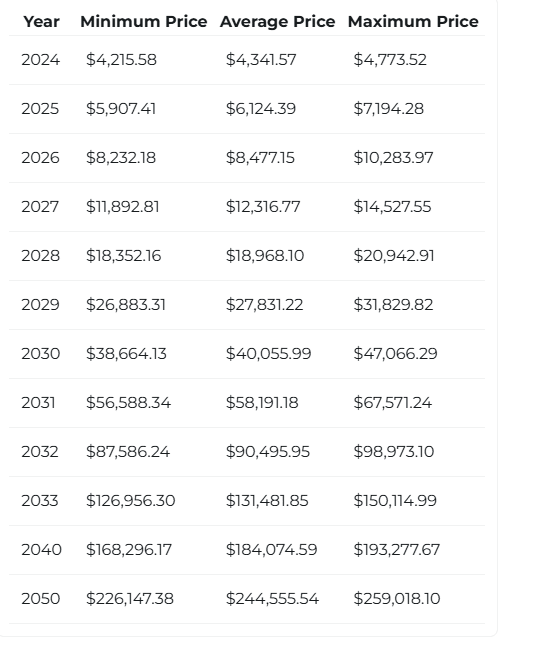
CryptoNews has other ideas. According to this source, Ethereum’s price target for 2025 is $2,500. By 2030, the coin should grow to $5,850-$9,190, which is significantly lower compared to Changelly’s prediction.
MarketWatch says ETH “may finally rise to a record high above $5,000 in 2026,” citing supply constraints and ETF inflows.
Bottom line: ChatGPT’s one-year prediction comes within bullish analyst ranges, but it is similar to most of the predictions we’ve seen. This is not a surprise considering that AI itself sources its estimates from trusted analyst sources. However, its 5-10 year estimates remain highly speculative, though they still align with the optimistic forecasts we’ve seen online.
ChatGPT Solana Price Prediction
Next, we wanted to know how Solana will perform going forward. Here is its forecast according to ChatGPT:
1 year (mid-2026): “With ecosystem growth and improved reliability, SOL could hit $200–$250.”
5 years (2030): “If DeFi/NFT usage expands, Solana could climb to $500–$800.”
10 years (2035): “If it maintains pace with rival Layer‑1 platforms, SOL might cross $1,000—though competition remains fierce.”
How Does This Compare With Expert Analysis?
So far, ChatGPT has responded with extremely positive forecasts for every coin, which is a bit concerning. Still, let’s compare its predictions to those of other sources:
The CurrencyAnalytics forecasts SOL to average $310-$510 in 2026 and rise to over $1,000 by 2030.
CryptoNews sees SOL reaching about $197 average by the end of 2026, with a high nearing $220. By 2030, its estimated average is $422.
Bottom line: ChatGPT’s 1-year guess is a bit conservative compared to analyst ranges. Its 5-year range is in line with most of the analyses we checked, while the long-term scenario is rather ambitious (though still, not impossible in this market).
ChatGPT XRP Price Prediction
Here is what ChatGPT predicts about XRP:
1 year (mid-2026): “If Ripple resolves its SEC case and scales banking partnerships, XRP could reach $2–$3.”
5 years (2030): “With mainstream cross-border use, XRP might climb to $5–$7.”
10 years (2035): “In a bullish environment, XRP could exceed $10—but regulatory issues or competition may cap its growth.”
How Does This Compare With Expert Analysis?
Here is what analysts think about the future price of XRP:
Benzinga says XRP could trade between $4.67 and $26.97 by 2030.
TheCurrencyAnalytics has more optimistic targets up to $27 by 2030 if Ripple gains clarity.
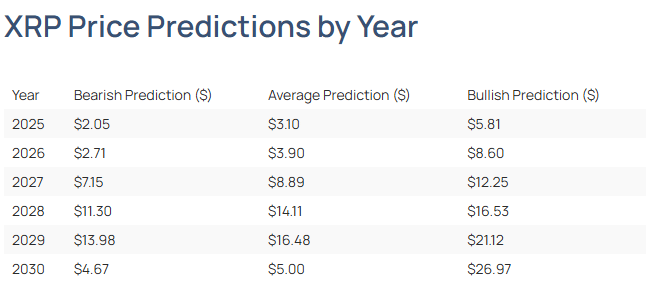
CoinGape forecasts a potential 60% rally to around $4.47 in the next few months.
InsideBitcoins predicts that its price will go up to $7.80 by 2030.
Bottom line: ChatGPT’s roadmap for XRP aligns well with most mainstream analyst targets, though we did come across some that suggest even more aggressive upside.
So far, ChatGPT has been more confident with its predictions. With XRP, its predictions are reliant on specific factors like Ripple’s SEC case, its cross-border use, and so on.
In December 2020, the U.S. Securities and Exchange Commission sued Ripple Labs, alleging that it illegally sold XRP as an unregistered security. In July 2023, a U.S. judge ruled partially in Ripple’s favor, stating that XRP is not a security when sold to the public on crypto exchanges.
As of mid-2025, the case is ongoing, though most experts agree that it is effectively over. The final outcome could significantly affect XRP’s retail sales, regulatory standing, and, of course, its price movement. That being said, it is no wonder that ChatGPT bases its forecasts on this one important event.
ChatGPT Dogecoin Price Prediction
ChatGPT predicts significant growth for DOGE, too, though not as much as some experts expect:
1 year (mid-2026): “With social-media hype and occasional celebrity boosts, DOGE might trade between $0.30–$0.50.”
5 years (2030): “If utility grows, DOGE could see $1+, though unlikely without major tech or use-case shifts.”
10 years (2035): “Without genuine utility, Dogecoin may plateau beneath $1—but a parabolic rally isn’t impossible.”
According to ChatGPT, Dogecoin might struggle to grow much beyond $1 if it doesn’t develop real-world utility, i.e., useful things people can actually do with it. A “parabolic rally” refers to a sudden, massive price spike driven by social media or other forms of viral attention. So, a surprise surge is still a possibility.
Much of Dogecoin’s success and popularity is thanks to Elon Musk. Musk first noticed it in 2018, tweeting to one of its co-founders to help with scam bots. In 2019, he publicly claimed DOGE his favorite crypto, which sparked mild price bumps.
Musk’s December 2020 tweet, “One word, Doge,” triggered a major 20% rally. During 2021, he continued tweeting about the coin, boosting its market profile. DOGE peaked at $0.73 after Musk introduced himself as “Dogefather” on Saturday Night Live, and in 2021, Tesla began accepting DOGE for merchandise.
Still, Musk’s tweets have drawn legal scrutiny, with investors filing lawsuits about his influence and market manipulation. In August 2025, a federal court dismissed a major suit, agreeing that his remarks were comical and not factual.
Today, Musk continues to shape DOGE’s narrative and has even changed Twitter’s logo to the Shiba Inu image.
How Does This Compare With Expert Analysis?
Let’s see what analysts have to say about DOGE:
Analytics Insight notes that DOGE rallied around 83% YTD at $0.20, with technical indicators pointing toward a 130% rally to $0.45. The same source suggests a possibility of a 900% run if certain technical indicators align.
Benzinga sees DOGE potentially getting to $1.5 by 2030.
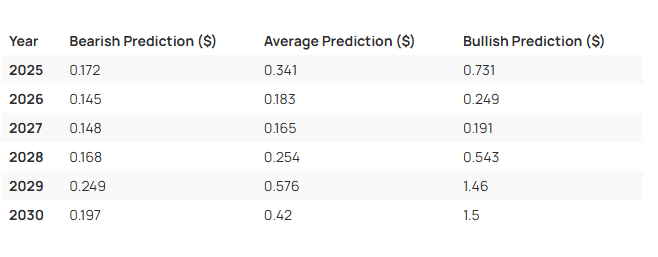
Bottom line: ChatGPT’s 1-year window for DOGE fits mid-line with the analysts. Its long-term projection is similar to that of bulls forecasting $1-$3 by 203
How to Use ChatGPT to Predict Crypto Prices
After using ChatGPT to predict prices on the cryptocurrency markets, we created a short guide on how you can get better and more informed insights from this tool. Still, remember that this is only speculation, and it is best to use it to complement your research, not as a source of insights directly.
1. Start with a Clean Historical Data
First, collect past price data such as daily and weekly charts, volume, market cap, RSI (relative strength index), and support/resistance levels. Yes, ChatGPT probably already has access to much of this, but it has access to so many sources, and the information between them can vary. If you want a better and more informed decision, feed it with data from reliable sources. You can use a prompt like this:
Here are Bitcoin’s past 12 months of daily closing prices and RSI trends. Can you spot potential bullish momentum or bearish patterns?
2. Ask ChatGPT to Interpret Technical Indicators
ChatGPT can break down RSI, moving averages, candlestick charts, and volume spikes. It’s best that you provide summaries of recent patterns to get better insights.
3. Ask It to Summarize Fundamentals, Sentiment, and News Flow
One of ChatGPT’s biggest strengths is its ability to summarize and break complicated topics down. You can feed it the project’s whitepaper, recent expert analysis, and other important data, and ask it to analyze and summarize it all for you. You can also paste in snippets like headlines about ETH scaling upgrades, XRP court rulings, and ETF inflows.
If you do this, you can expect context-rich feedback that links sentiment to price action.
4. Create Scenario-Based Prompts
There are any number of events that could entirely change the future of any given crypto, and it’s best to be ready for these scenarios. ChatGPT can help prepare you. An example of such prompts would be:
If Solana Virtual Machine sees a 50% increase in daily transactions and its blockchain volume doubles, what price range could SOL reach in a year based on its history?
This way, you can get a better conditional outlook instead of making random guesses. You can then follow these statistics and see if the token is on the right path, checking in regularly.
5. Validate Everything
Always remember that AI bots are far from perfect. Once you get some info from ChatGPT, test it by comparing its analysis with other analyst sources. You can also compare this with signals from TradingView and even Telegram bots.
Downsides of ChatGPT Crypto Price Predictions
ChatGPT predicts crypto prices, and it is free to use and yet only a select few make a fortune from crypto investments. This is not because no one has tested it yet. It is because this is a highly speculative tool, and while it can help you research, you shouldn’t use it as the main source for information for your crypto decisions.
Here are some of the downsides of using ChatGPT for your predictions about digital currencies:
- It doesn’t “understand” the facts. ChatGPT predicts the next word, not the next price. It gives answers shaped by patterns in its training data. It doesn’t use a real-time financial logic and it is not intelligent, despite the name.
- It can hallucinate and make wild guesses. When you ask ChatGPT to forecast rare and unpredictable events, it won’t always ground it real data. ChatGPT is known to invent plausible-sounding, but basically baseless projections.
- No live data. Unless you connect it to APIs or RAG systems, ChatGPT won’t see all relevant info such as new SEC rulings, exchange outages, or today’s price. You can’t expect it to give you the best prediction without recent data.
So, Can ChatGPT Predict Crypto Prices?
ChatGPT can be very helpful for scenario modeling, sentiment analysis, and summaries for your research. But you should not treat it like a prophet. If you are looking to cut through the noise and get some breakdowns and summaries, ChatGPT is great at filtering information and explaining content.
But, if you came here hoping that ChatGPT is a magic forecaster that can tell you which coin you can buy to get rich, you are barking up the wrong tree. ChatGPT will give you speculation, so treat it as a smart assistant and not as a financial advisor.
FAQs
Can ChatGPT really predict crypto prices?
Not accurately. It doesn't have live data or a crystal ball, so it will analyze online sources and trends and give you educated but wild guesses.
Is it safe to base my investment decisions on the predictions of ChatGPT?
ChatGPT shouldn't be trusted as the perfect forecaster, but it can be useful as a research tool in your toolbox.
Can ChatGPT understand technical indicators like RSI or candlestick patterns?
Yes. If you explain the patterns or provide them with summary data, it is pretty good at interpreting them.
Should I trust ChatGPT over analysts or trading platforms?
No. Use it alongside them. It's great for explaining and summarizing, but it cannot replace expert research or live data tools.
What is the best way to use ChatGPT for crypto analysis?
Give it specific data like price history, news, and sentiment, and ask it to build scenarios and explain patterns.
References
- How High Will BTC Price Go – CoinPedia
- BTC Price Prediction 2025, 2026-2030 – CoinCodex
- Bitcoin Could Surge to $200,000 – Barrons
- Bitcoin Price Predictions 2026 – PricePredictions
- Ethereum Price Prediction – Changelly
- Ethereum Price Prediction 2025-2030 – CryptoNews
- Ether May Finally Rise to Record High Next Year – MarketWatch
- Solana Price Prediction – CryptoNews
- Statement of SEC on Ripple Labs – SEC
- Ripple (XRP) Price Prediction – Benzinga
- XRP Price Prediction – TheCurrencyAnalytics
- XRP Price Prediction as XXRP ETF Hits Milestone – CoinGape
- “Call Me the Dogefather”: Elon Musk Explains Crypto – CoinDesk
- Dogecoin Price Prediction – Analyticsinsight
- Dogecoin Price Prediction – Benzinga