While experts say the quantum computing threat to crypto is still years away, developers are already building quantum-resistant projects with real utility. BMIC ($BMIC) is the first digital finance stack offering secure crypto storage, payments, and staking systems designed to remain secure in the quantum era.
Currently, the project is in its presale phase and has raised nearly $300,000 in a few weeks. In this BMIC price prediction article, we discuss the cryptocurrency’s growth potential in the coming years.
BMIC Price Prediction
BMIC isn’t the only platform offering post-quantum cryptography (PQC) asset storage. However, it is the first DeFi ecosystem to offer quantum-resistant staking and payments. Once it goes public, how will it perform? Here’s a breakdown of our BMIC price projections for 2026, 2027, and 2030.
BMIC Price Prediction 2026
2026 is a crucial year for BMIC, marking the project’s transition from foundational development to early validation. According to the whitepaper, BMIC plans to release the alpha version of its quantum-secure wallet by Q3. The release will showcase core functionality, including multi-asset storage, basic staking, and post-quantum key management.
A strong BMIC alpha crypto wallet launch could help build confidence among early investors and reduce speculation. It will also demonstrate the project’s utility, helping users better understand its future use cases.
Before the year ends, BMIC aims to exhibit an early version of its Quantum-Security-as-a-Service (QSaaS) API to institutions seeking quantum-resistant key management and encryption. This will lay the groundwork for future expansion as an enterprise-grade quantum computing infrastructure.

So far, the BMIC team has not announced when the presale will end, but we estimate the token generation event (TGE) will occur this year. The roadmap includes an upcoming top-10 crypto exchange listing announcement in early 2026, which often leads to a surge in investor interest and a token launch soon after.
Assuming BMIC successfully showcases its quantum-secure technology and launches $BMIC within the year, we believe the token could close 2026 at an average price of $0.2450. This would represent a 5x increase from the initial presale price and a fully diluted market capitalization of $367.5 million if no tokens are burned.
BMIC Price Prediction 2027
In 2027, BMIC plans to move from the concept validation stage into broader ecosystem participation and governance activation. Throughout the transition, the project will maintain its development momentum and continue improving its core features.
By Q1, we expect BMIC to successfully roll out the beta version of its quantum-resistant wallet, making the platform more accessible to a wider audience. The public launch would include broader token support, integration with decentralized applications (dApps), and cross-chain interoperability, allowing BMIC to expand beyond early adopters.
Additionally, BMIC will look to launch its token governance framework, further enhancing its value proposition. With this system in place, $BMIC holders will be able to vote on the protocol parameters, reinforcing the token’s role as both a utility and governance asset.
Our analysis also suggests that deflation would accelerate in 2027. With the BMIC wallet open to the public, the deflationary burn mechanism will reduce the token supply as revenue-backed buybacks increase with growing user adoption.
From Q2 to Q3 of 2027, BMIC will focus on the operations of its Quantum Meta-Cloud Integration. This will make the project available to both institutional and individual users who are either willing to contribute quantum computing hardware or need additional compute power. Furthermore, BMIC’s Burn-to-Compute Model creates more long-term scarcity as Meta-Cloud activity increases.
By the end of 2027, our price prediction model indicates that these developmental milestones could support an average price of $0.4750 per $BMIC token.
BMIC Price Prediction 2030
Based on our analysis, BMIC’s value as a quantum-ready crypto ecosystem strengthens over time as quantum computing becomes more powerful and relevant.
By 2028, the project is expected to launch the BMIC mainnet, enabling decentralized wallet access and QSaaS nodes operating at scale. It would also integrate a full decentralized autonomous organization (DAO) for decision-making, aligning long-term goals among users, developers, and institutional participants.
In 2030, BMIC is projected to become a more widely adopted ecosystem and compute infrastructure layer. Supporting the project’s economy and platform activity is a recurring utility from quantum-secure crypto staking, Meta-Cloud activity, and revenue-driven deflationary token burns.
One of the last features the BMIC plans to integrate into its ecosystem is AI-enhanced adaptive cryptography. It allows the platform to automatically update its protocol, adding another layer of protection for users, and helps it stay up to date with NIST’s global cryptographic security standards. This also allows BMIC to remain relevant to governments, insurers, healthcare providers, and other international enterprises that require quantum-resistant frameworks.
Given these roadmap accomplishments, our BMIC price forecast suggests the token could average $1.725 by the end of the decade. This prediction assumes consistent adoption and successful execution of BMIC’s roadmap targets, ultimately reflecting a 3,500% increase from the initial presale price.
A Look at the BMIC Presale & Tokenomics
BMIC launched its presale on November 14, 2025. In its initial fundraising phase, the project raised over $100,000 in just a few days, signaling strong demand among early adopters. $BMIC started at $0.048485, and the price will gradually increase leading up to the final presale phase.
The project is currently in Phase 3 of its presale, offering $BMIC at $0.048881. Upon launch, the token is projected to list on exchanges at above $0.058182, about 20% above the initial presale price.
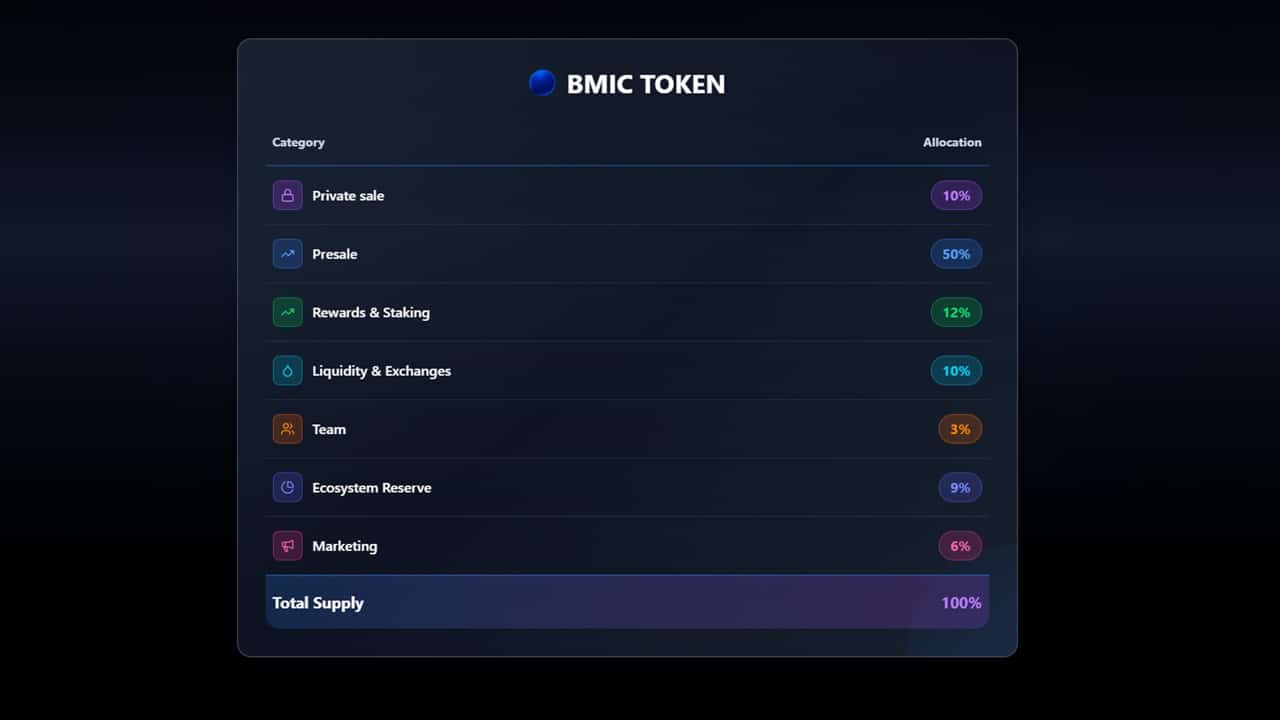
$BMIC is an ERC-20 token and is the native utility crypto of the BMIC ecosystem. With a fixed total supply of 1.5 billion tokens, the project is built for scarcity and long-term value growth via recurring utility.
50% of the total supply is reserved for presale buyers and represents the largest allotment of $BMIC tokens the project provides. This broad presale allocation is fully unlocked at TGE, ensuring wider distribution and adoption.
What Is BMIC?
BMIC is an upcoming crypto project focused on quantum security. It’s a blockchain ecosystem where users can store and manage their cryptocurrencies with a proprietary quantum-resistant wallet.
Quantum protection with BMIC doesn’t end with crypto storage. The platform offers quantum-secure staking and crypto payments powered by post-quantum cryptography (PCQ). BMIC’s staking and protected payment layer finally gives users a top DeFi crypto to buy while also mitigating quantum risks.
Although experts believe that quantum attacks on cryptocurrencies are still years away, current users remain vulnerable to “harvest now, decrypt later” (HNDL) risks. BMIC employs PCQ and signature-hiding smart accounts to protect users’ keys from HNDL attacks, keeping assets safe long before quantum computing poses a threat.
A significant part of BMIC’s infrastructure will be built on AI-driven cryptography. Specifically, the project uses AI to detect potential quantum attacks and to optimize the performance of its PQC protocol. The ecosystem’s AI layer benefits both institutional and individual users of BMIC’s quantum services, spanning the Meta-Cloud compute network and the QSaaS API.
Factors That Will Determine the Price Performance Of BMIC
Here are some of the key dynamics that can affect the price of $BMIC in the short and long term.
1. Presale Metrics
During its crypto presale, BMIC’s price dynamically adjusts based on early demand. As more investors participate in the presale, the project could progress faster through its fundraising stages, up until right before the TGE.
Presale buying surges may attract hype and drive more speculative purchases. However, BMIC is designed for long-term growth and price stability. So far, the presale has raised nearly $300,000, continually attracting investors as the team continues marketing and exposure efforts.
Once the $BMIC token officially launches, the team will ensure it is listed on exchanges at prices above the last presale tier to reward early adopters. Whether the token remains above that price after going public will depend on prevailing market sentiment.
2. Development Milestone Completion
Based on our analysis, the completion of the project’s core development milestones can significantly impact $BMIC’s price. For instance, launching the BMIC quantum-resistant to the public shows investors that the project’s concept is functional and scalable. This could increase investor confidence, leading to more $BMIC purchases.
A crucial milestone after the TGE is BMIC’s mainnet launch. At this stage, the project will transition from validation to full scalability and expansion. It opens the door for major institutions to consider BMIC’s technology, including the Meta-Cloud infrastructure and QSaaS APIs.
3. Platform Activity & Token Vesting
BMIC’s revenue-linked token-burning protocol ties scarcity to platform activity. Because a percentage of tokens used for BMIC products (wallet services, APIs, or cloud computing) is permanently burned, the token supply decreases as usage increases.
While 50% of the total token supply (for presale buyers) will be fully unlocked at the TGE, specific $BMIC allocations will be released in a structured manner to manage supply and keep post-launch prices stable. Private sale buyers’ tokens are vested linearly over 12 months, while ecosystem reserve and team token allocations are vested over 24 months to align with long-term goals.
4. Demand for Quantum Security
Analysts have observed price surges in privacy-focused tokens such as Zcash, which also offer some level of quantum resistance. If demand for quantum protection rises, we could see higher valuations for $BMIC as more users invest in PQC-powered projects.
Post-Quantum Cryptography and Web3 Security
Sufficiently capable quantum computers could undermine billions of dollars in crypto assets that are secure in many of today’s blockchain ecosystems. Even before developers can create quantum computers strong enough to crack public keys and gain access to users’ cryptocurrencies, HNDL threats leave many wallets vulnerable to future attacks.
Meanwhile, the world of DeFi already faces relentless threats, such as MEV attacks, smart contract exploits, and crypto bridge failures. As crypto adoption continues to grow and more users participate in DeFi activities, demand for adaptive, forward-looking Web3 security will inevitably rise, especially against quantum-level threats.
Some quantum-resistant platforms offer secure wallets, but for native Web3 users accustomed to maximizing their assets, storage alone may not be enough. This is why BMIC, with its full finance stack, is positioned to capture the next wave of quantum-resistant demand.
The project’s practical adoption of PQC, enhanced with AI-driven cryptography, enables BMIC to ensure quantum security for storage, yield, and crypto payments. The protection extends to its institutional services, Meta-Cloud network, and QSaaS API. In the future, it aims to scale adoption across finance, insurance, healthcare, and supply chain industries.
BMIC Price Potential – A Case Study
Since BMIC is still in its presale stage, price projections for $BMIC remain speculative. However, the project can be viewed alongside established cryptocurrencies that have achieved mass adoption. One top crypto example is Zcash ($ZEC), a privacy-focused coin based on advanced cryptographic research.
According to the official Zcash site, the project launched in 2016 to address the lack of privacy in Bitcoin. Zcash’s developers created a standalone protocol that enabled private transactions via zero-knowledge proofs.
Early $ZEC trading prices were relatively low and volatile, but demand for the token and its quantum-readiness has driven a nearly 800% increase over the past year. While Zcash is not currently quantum-secured, its developers have said it will soon support quantum recoverability, a system that can withstand future quantum attacks.
Meanwhile, BMIC is a fully quantum-focused crypto project that introduces a digital finance stack designed to protect users’ crypto during storage, staking, and payments. Like Zcash, BMIC has a public presale where anyone can purchase the token before it goes public. It will also have a private sale, allowing the project to raise development funds from institutional investors.
Although BMIC is a newer crypto project, some experts believe it offers a more quantum-resistant ecosystem than Zcash. $BMIC is purpose-built for the quantum era, yet it hasn’t been released on major exchanges.
As of this writing, Zcash has a fully diluted valuation (FDV) of $8.7 billion. At the same FDV, BMIC would be priced at $5.8.
Is BMIC a Good Investment?
Should you invest in BMIC today? Here’s why investors may want to consider buying $BMIC in 2026.
First Quantum-Secure Finance Stack
Quantum security is BMIC’s top priority, with its quantum-resistant wallet providing key protection and post-quantum cryptography. However, the project’s defining feature is its quantum-native ecosystem for digital finance, which includes yield generation through staking and shielded crypto payments.
As the first mover in the quantum era of DeFi, BMIC could gain broad market adoption before new platforms can significantly compete.
Community-Driven Tokenomics
Low-cap crypto projects with community-driven tokenomics often succeed despite liquidity and volatility risks. With 50% of its total token supply reserved for presale buyers, BMIC is designed to be supported by a broad base of holders.
As a governance token, $BMIC enables the community to decide on the project’s future protocol upgrades and direction. Token holders play an active role in the platform’s governance, helping the project overcome future challenges and adapt to the changing demands of the crypto market.
Activity-Driven Deflationary Burn Mechanism
BMIC holders seeking additional quantum computing power through the project’s Meta-Cloud integration will need to burn their $BMIC to generate BMIC Compute Credits (BCC). This model forms the backbone of the project’s burn-to-compute model, creating long-term scarcity as more users and institutions find more quantum computing power on the Meta-Cloud network.
Growing platform activity can also increase scarcity through the revenue-linked deflationary token-burning mechanism. As more users join the BMIC ecosystem and use the built-in services, a portion of the revenue generated is used to burn $BMIC, supporting the token’s price.
How To Buy BMIC – Quick Guide
Here’s a quick summary of how to purchase $BMIC at presale based on our existing guide on how to buy BMIC:
- Get a decentralized wallet that supports Ethereum (ERC-20).
- Add $ETH to your wallet.
- Visit the official BMIC presale and link your wallet.
- Determine how much $BMIC you want to buy.
- Approve the transaction to buy $BMIC.
For a detailed overview on purchasing $BMIC, read our guide on how to buy BMIC.
BMIC Social Media Channels
Get the latest official news and updates from BMIC’s social media handles:
Our Verdict
Although BMIC is still in its presale, we can make predictions on its future performance based on its fundamentals. The project’s future-ready concept, sustainable tokenomics, presale performance, and clear roadmap make it an early-stage cryptocurrency worth considering.
By the end of 2026, our $BMIC price prediction suggests the token could average $0.2450 after its TGE. In our long-term forecast, $BMIC could close the decade at an average price of $1.725, bringing its FDV to over $2.5 billion.
FAQs
What is BMIC?
Will the $BMIC price go up in the coming year?
References
- What is post-quantum cryptography (PQC)? (Cloudflare)
- BMIC White Paper (BMIC)
- Post-Quantum Cryptography (NIST)
- Zcash: Privacy-protecting digital currency (Zcash)
- “Harvest Now Decrypt Later”: Examining Post-Quantum Cryptography and the Data Privacy Risks for Distributed Ledger Networks (The Federal Reserve)
- More Ready Than Bitcoin? How Zcash Developers Are Preparing for the Quantum Threat (Yahoo Finance)