In the early days of the crypto market, it was known and praised for its anonymity. You could create a wallet, trade coins, and even move large sums of crypto without anyone asking who you were. Those days are mostly gone now, at least on major exchanges.
These days, if you try to sign up with platforms like Binance, Coinbase, or Kraken, one of the first things they’ll ask for is your ID. These exchanges don’t want to uncover your identity as a crypto holder or attack your privacy. It’s part of a broader process called Know Your Customer (KYC), which is required in most jurisdictions.
Whether you are a casual trader or a crypto whale, chances are you’ve come across KYC verification at some point. Why does this matter, you wonder? What are the risks of skipping it? Let’s break it all down.
What Is KYC?
KYC, or Know Your Customer, is a standard identity verification process used by financial institutions like banks, fintech platforms, and yes, crypto exchanges. It involves collecting personal information, such as:
- Your full name
- Address
- Date of birth
- Government-issued ID
- Sometimes, even a live selfie to verify it
The goal of KYC is to verify the customer’s identity and ensure they are a genuine individual, not someone attempting to launder money or finance illicit operations. In the crypto world, where pseudonymous transactions are the norm, KYC has become a crucial checkpoint for platforms, as well as regulations.
Some financial institutions and exchanges even go a step further and verify a proof of address (usually with a bank statement or a utility bill). Larger platforms may also use biometric verification. All this is part of making crypto safer and more compliant with global financial laws.
Why Is KYC Important?
At first glance, Know Your Customer (KYC) can feel like an invasion of privacy, especially since crypto is often considered to be anonymous. However, KYC serves a few major purposes, including:
- Preventing money laundering and financial crime
Cryptocurrency has been very attractive to bad actors because of its secretive nature. KYC helps break that anonymity on regulated platforms.
In 2024, over $2.2 billion was stolen in crypto, which was linked to illegal activity like money laundering and cybercrime. Tracking wallets and enforcing KYC make it harder for criminals to exploit exchanges.
The Financial Action Task Force (FATF), a global authority on financial crime, has emphasized how important KYC regulations are in its latest report. The FAFT urges countries to intensify their efforts to regulate crypto assets.
- Meeting global regulatory standards
Governments worldwide are pushing exchanges to comply with anti-money laundering (AML) and counter-terrorism financing (CTF) regulations. KYC is the first step in the compliance process.
FAFT’s guidelines require virtual asset service providers (VASPs), which include exchanges, to identify their users and report suspicious transactions or activity. These standards are now being adopted in over 200 jurisdictions.
- Improving platform security and user trust
KYC does much more than satisfy the regulators. Its main task is to protect users. By verifying customer information, exchanges can better detect fraudulent activities like phishing attacks and account takeovers.
For example, if someone hacks an account and tries to withdraw funds, platforms with robust KYC and security checks (like two-factor authentication (2FA), biometric verification, and manual reviews of suspicious activity) can freeze those transactions to prevent financial crime.
According to the 2025 CoinLaw report, exchanges with strict KYC policies report 15% higher average daily trading volumes compared to platforms that aren’t compliant. This increase suggests that users feel more secure and are more likely to choose a platform that prioritizes customer security.
- Enabling institutional promotion
The adoption of KYC and AML practices is very important for cryptocurrency exchanges that aim to attract institutional investors and comply with regulatory standards. Financial institutions, pension funds, and other large entities require assurance that the platforms they use adhere to compliance measures.
- Reducing the risks for the average trader
For individual traders, engaging with exchanges that enforce KYC verification offers several advantages. The first is enhanced security, since KYC processes help prevent unauthorized access and fraudulent activities.
The second is legal protections, since traders are more likely to have recourse in cases of disputes or issues when they deal with regulated platforms.
How KYC Works in Crypto
When you create an account on a crypto exchange like Binance, for instance, one of the first steps you’ll encounter is the Know Your Customer (KYC) verification process. This is a requirement designed to confirm your identity and ensure that the platform complies with AML and CTF regulations.
Binance has one of the strongest KYC verification processes of crypto exchanges, so we will use it as an example. Note that the process might differ on different exchanges, but the fundamentals remain the same.
For most users, Binance requires completing these steps:
- Personal information collection, such as your full name, date of birth, and country of residence, along with a valid government-issued ID (passport, driver’s license, or national ID card).
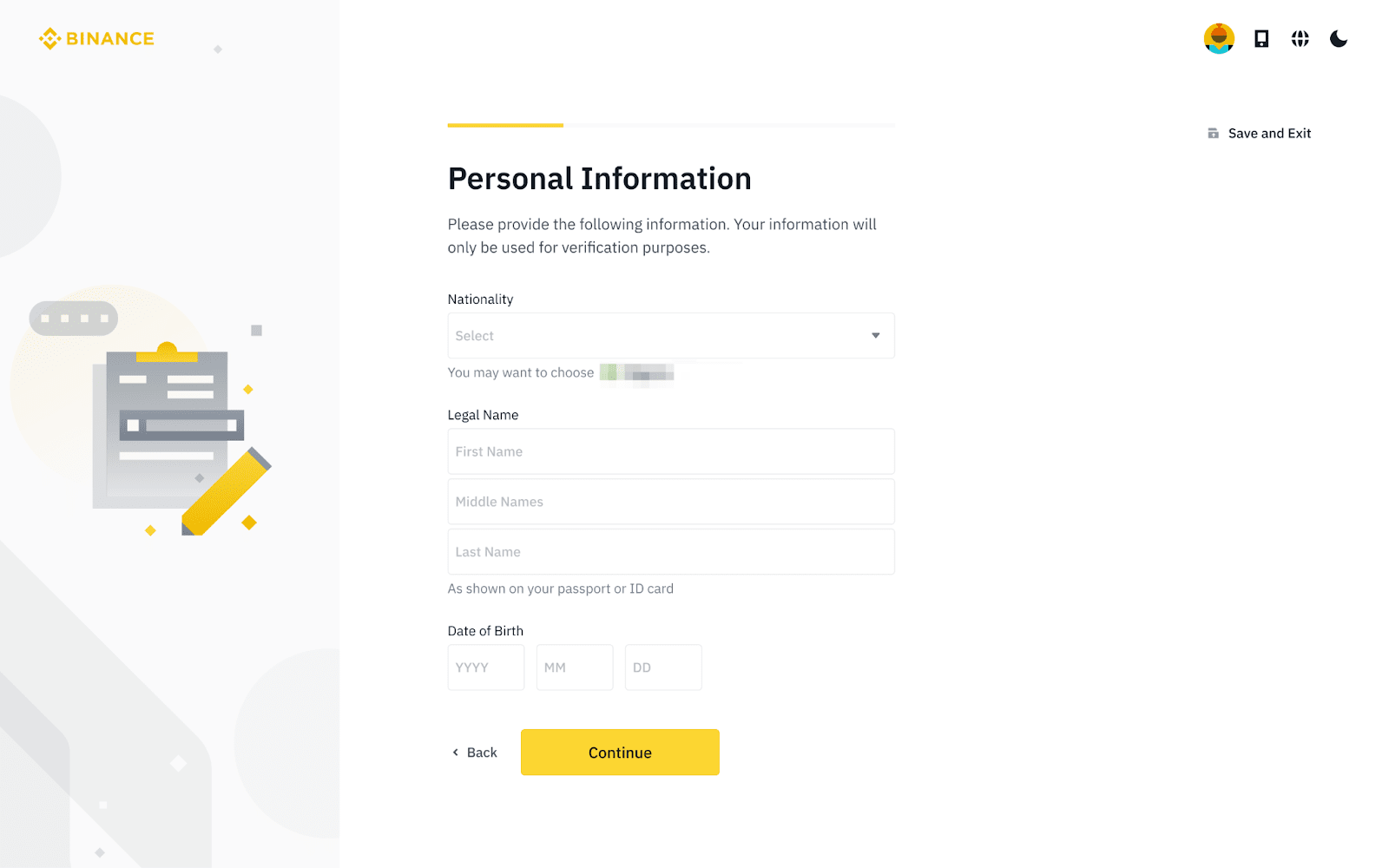
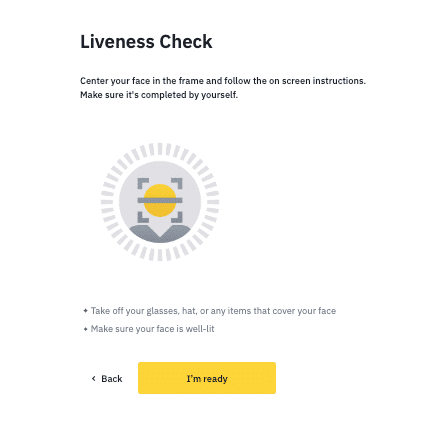
- Liveness and identity check. To prevent impersonation, Binance uses real-time facial recognition technology. This involves a “liveness check” where the user’s live selfie is matched against the photo of their ID.
- Screening against risk databases. Binance cross-references user information against global watchlists like World-Check, which tracks politically exposed persons (PEPs), sanctioned individuals, and other high-risk entities.
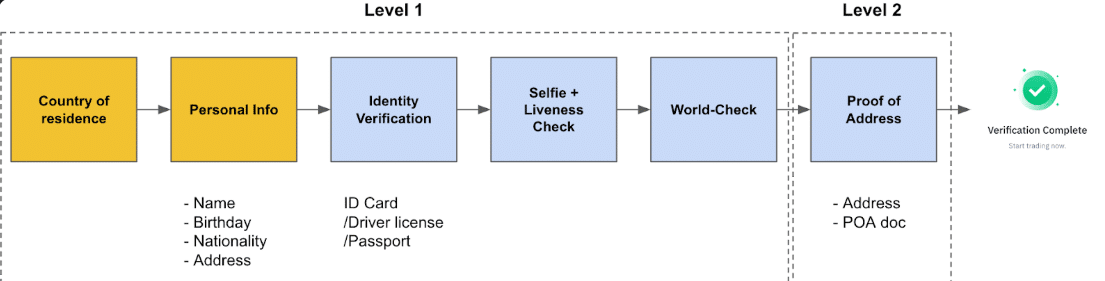
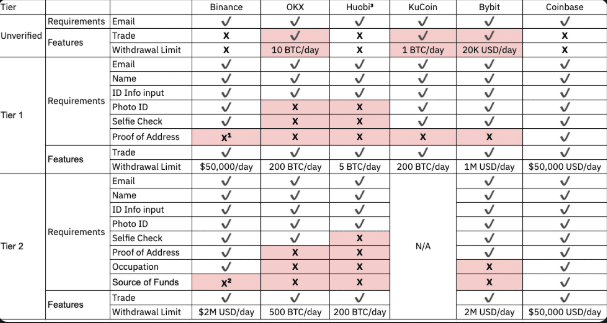
- Proof of address (for EU users and higher withdrawal limits). EU residents must submit a valid proof of address to Binance to fully access its services. Non-EU users only need this if they wish to raise their daily fiat withdrawal limits above $50,000 up to $2 million.
Completing Tier 1 and 2 allows users to trade crypto, deposit, and withdraw funds. Without these steps, users can only browse Binance’s ecosystem and claim gift cards or NFTs, but they won’t be allowed to trade or move funds.
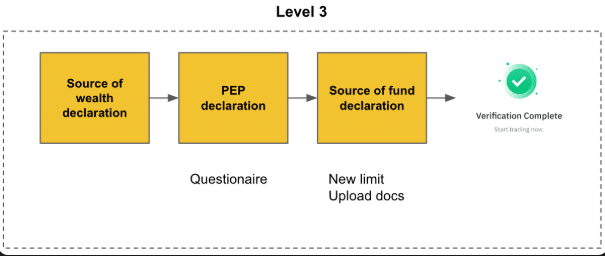
For users who want significantly higher deposit and withdrawal limits, Binance has a Tier 3 level, which requires additional KYC documents and verifications:
- Declaration of the source of wealth and funds
- Disclosure of any political exposure for the user or their family (PEP status)
To compare its KYC processes with those of other major platforms, Binance has created the following table:
Top 5 KYC-Compliant Crypto Exchanges
Now that we’ve explored what KYC is, how it works in crypto, and why it’s important, let’s dive into the best KYC-compliant crypto exchanges on the market.
1. Binance
Binance is the world’s largest crypto exchange by trading volume, beating out all other exchanges by a massive margin. It operates globally and has invested heavily in its compliance framework to meet regulatory demands across over 200 jurisdictions.
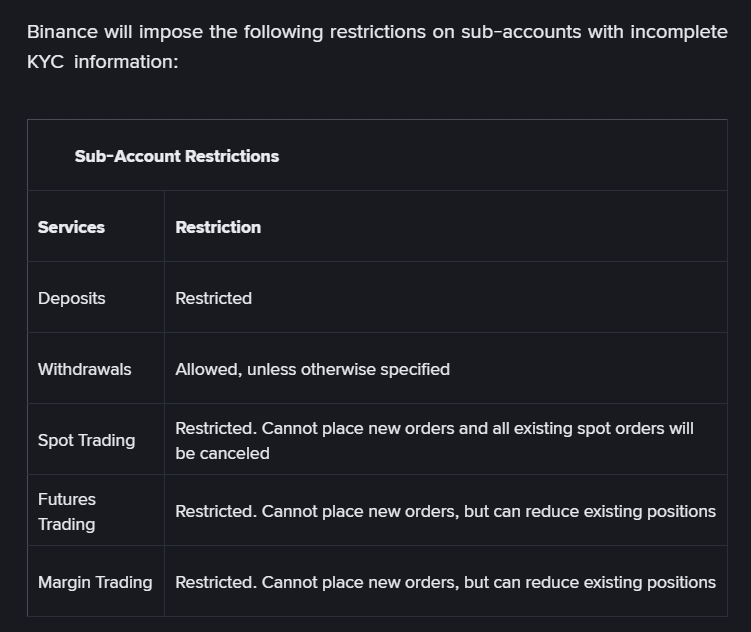
In 2024, Binance announced its plans to expand its compliance team by 34%, aiming to have 645 compliance staff by the end of the year. Starting from March 20, 2024, the exchange implemented mandatory identity verification for all sub-accounts, ensuring that all users meet KYC requirements before they can access certain features.
Best for:
- High-volume traders and professionals
- Access to a wide variety of tokens and funding pairs
- Advanced trading tools (futures, margin, derivatives)
KYC verification:
Binance uses a tiered KYC system requiring government-issued ID, facial recognition, and proof of address for higher limits. Their customer identification program includes automated document verification and biometric liveness checks.
2. Coinbase
Coinbase is the larges crypto exchange in the US. It is a publicly traded company with a strong focus on transparency and security. It is well known for its KYC process as it is generally more strict than other platforms and asks for more information. However, the process is still quite quick and even crypto beginners should be able to complete it in a few minutes.
In mid-2025, Coinbase deepened its industrial relevance by acquiring Deribit, a major derivatives platform, in a deal worth $2.9 billion.
Best for:
- Beginners and casual investors
- US-based users seeking secure trading
- Access to educational resources and staking options
KYC verification:
Coinbase requires users to submit a government-issued ID, verify their phone number, and pass facial recognition. Additional information, like proof of address, may be requested based on the user’s location and activity level.
3. Bybit
Bybit is another remarkably popular crypto and derivatives exchange with a massive selection of coins and trading tools. The platform enforces a mandatory, tiered KYC system across all of its users as part of its commitment to global regulatory standards. As of mid-2023, the platform mandates KYC for every user, meaning that no one can trade, deposit, or withdraw without having verified their identity on the platform.
In July 2025, Bybit launched Bybit.eu, a platform specifically for European Economic Area (EEA) users aligned with MiCAR regulations. This requires all EEA users to create new accounts and meet the new KYC requirements.
Best for:
- Derivatives and futures trading
- Experienced users who want advanced order types
- Traders seeking competitive fees and fast execution
KYC verification:
Bybit requires identity verification via government ID and facial recognition. Users must complete KYC before they increase their withdrawal limits or access derivatives products.
4. MEXC
MEXC has a mandatory two-tiered Know Your Customer (KYC) system for all traders, which applies equally to spot and futures markets. This approach is designed to boost security, meet the regulations from the financial industry regulatory authority, and ensure compliance across supported jurisdictions.
The first and primary KYC at MEXC gives users access to deposit and trade crypto, and daily withdrawal limits up to 80 BTC. The advanced KYC level comes with higher withdrawal limits of up to 200 BTC per day, as well as eligibility for bonuses, staking, trading contests, and fiat on/off ramps.
Best for:
- Altcoin and DeFi enthusiasts
- Traders seeking a big token selection
- Users interested in staking and launchpads
KYC verification:
MEXC’s KYC processes involve submitting a valid government-issued ID and performing facial verification.
5. Kraken
Kraken has two main verification levels for personal accounts – intermediate and pro personal. Each of these unlocks specific features and withdrawal limits. The first offers withdrawals up to $100k a month, as well as fiat trading, staking, and margin trading. The second one offers all this plus more API keys, OTC desk access, and withdrawal limits of over $100k a month.
Best for:
- Security-conscious users
- Institutional and high-net-worth traders
- Users needing advanced compliance and reporting features
KYC verification:
Kraken requires government-issued ID, proof of residence, and biometric verification.
Pros and Cons of KYC Verification
Know Your Customer (KYC) verification has become a standard requirement in most regulated crypto exchanges, as well as most financial institutions. It is designed to confirm the customer’s identity, assess risks, and ensure that platforms meet anti-money laundering obligations. Still, this type of checks and ongoing monitoring come with a set of disadvantages, too. Let’s explore both sides of KYC.
| Pros | Cons |
| Enhanced security: Verifying users reduces fraud, identity theft, and illegal account use. | Privacy concerns: Sharing documents and personal data can be a concern for users who value anonymity. |
| Regulatory compliance: Platforms that follow KYC requirements remain compliant with local and global laws. | Exclusion of users: People in certain regions may not have access to the documents required to verify their identity. |
| Institutional confidence: KYC-compliant platforms are more likely to attract payment providers, users, and large investors. | Delays and downtime: KYC reviews can lead to long wait times, account freezes, and, in some cases, wrongful denials. |
| Reduced abuse: Helps prevent criminal activity like money laundering or the misuse of crypto by uncovering people behind shell accounts. | Data breach risks: Centralized databases of sensitive user data can become targets for cyberattacks. |
How to Prepare for KYC Verification
Preparing for KYC means understanding what the process requires and avoiding delays. Exchanges conduct customer identification procedures to verify the identity of the user and ensure that their funds come from legitimate sources. Let’s see what you need for this.
- Government-issued ID: Passport, national ID, driver’s license, scanned clearly.
- Proof of address: Utility bill, bank statement, or lease agreement dated within the last 3 months.
- Selfie or live photo: Some platforms require a real-time image or even a short video for identity verification.
- Source of funds: For higher limits, you may need to explain where your crypto or fiat funds come from.
Here are some tips for a smoother process:
- Double-check that your KYC documents are up to date and match your account details.
- Use a high-resolution scan or photo. Blurry images often lead to rejection.
- Ensure your name and address are consistent across all documents and your account.
- Respond promptly if the platform requests clarification or additional info.
- Be ready to provide extra legal documentation for pro or institutional accounts.
Conclusion
The crypto industry continues to mature, and KYC compliance is no longer optional – it is essential. From verifying the customer’s identity to enabling secure customer relationships, KYC plays a big role in protecting both the exchange and the user. It’s a frontline defense against fraud, money laundering, and other illicit activities.
For exchanges, robust customer due diligence processes not only reduce legal risks and non-compliance costs but also build trust among users, partners, and regulators.
For traders, preparing for KYC is a simple step toward safer and more transparent access to digital assets.
FAQ
Is KYC mandatory on all crypto exchanges?
No. Not all crypto exchanges enforce KYC, but most regulated platforms do.
What documents are usually required for KYC verification?
Most exchanges will request a valid government-issued ID, a selfie or facial verification, and sometimes proof of address. Some might also ask for information about the beneficial owners if you are registering a business account.
Can I trade crypto without KYC?
Some decentralized platforms (DEXs) and offshore exchanges allow limited trading without KYC. However, you might face restrictions like fewer trading pairs, a lack of fiat support, and lower withdrawal limits.
How long does KYC verification take on crypto exchanges?
This depends on the platform. Some exchanges complete the process within minutes using automated tools. Others may take a few hours up to a couple of days during peak time. Advanced verification tiers or accounts flagged for review may take longer.
What happens if I fail KYC verification?
If your document verification is invalid, you'll usually be asked to resubmit the documents. Failing KYC may result in limited access or full suspension from the platform, depending on their compliance policies.
Do crypto exchanges share KYC data with governments?
Most regulated platforms are required to report suspicious activity and cooperate with law enforcement in cases related to money laundering, fraud, or terrorist financing. However, your data is typically protected by strict privacy or data-handling regulations, such as GDPR.
References
- $2.2 Billion Was Stolen in Crypto-Related Hacks – TRMLabs
- Targeted Update on Implementation of the FATF Standards on Virtual Assets – FAFT
- Compliance in Crypto Statistics 2025 – CoinLaw
- How to Complete Identity Verification for a Personal Account – Binance
- KYC in Crypto – A Comparison – Binance
- Binance Boosts Compliance Team as It Strengthens Regulatory Efforts – Cryptodnes
- Coinbase Strikes $2.9 Billion Deal for Major Crypto Options Platform – WSJ
- Bybit Launches Bybit.eu for European Crypto Market Compliance – AInvest
- How to Perform KYC Verification on MEXC – MEXC