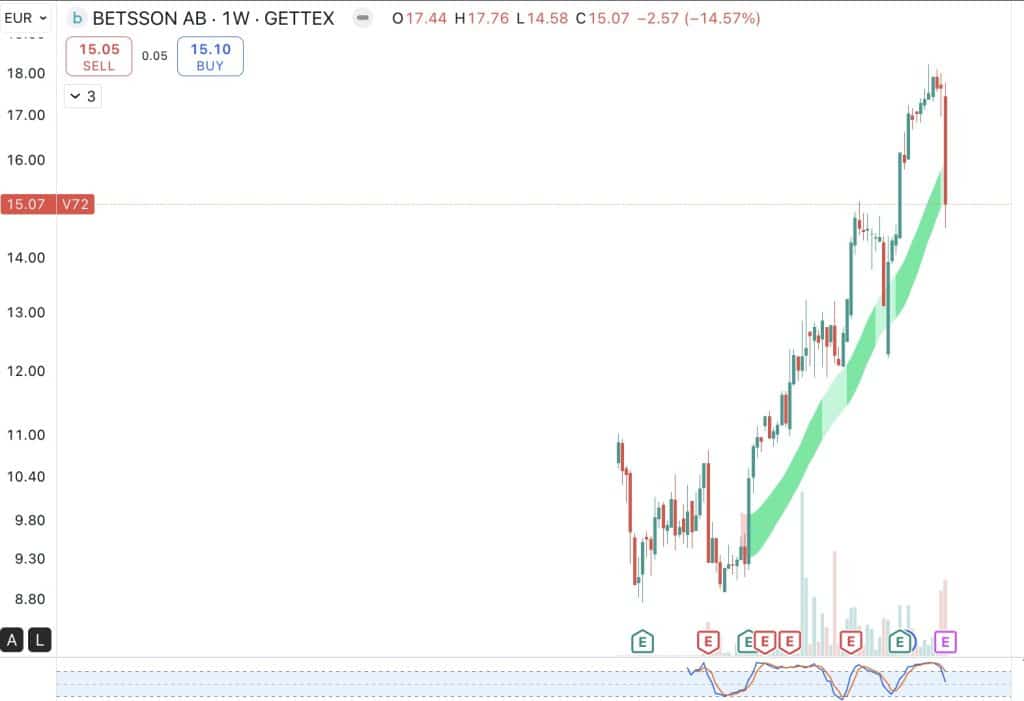
The online gambling industry has been buzzing with discussions about Betsson Group’s unexpected stock decline following what many considered impressive Q2 2025 financial results. While the company delivered robust double-digit growth across key metrics, investors responded with caution, sending shares tumbling more than 15% in a move that highlights the complex dynamics shaping Europe’s evolving gaming landscape.
Gaming Giant’s Solid Foundation
Betsson’s story begins in 1963 with humble origins—a single slot machine placed in Swedish restaurants by founders Bill Lindwall and Rolf Lundström. What started as AB Restaurang Rouletter has evolved into a gaming powerhouse operating across 25 countries with gaming licenses, employing approximately 2,200 individuals from over 70 nationalities. This transformation reflects not just corporate growth, but the digitization of an entire industry.
The company’s metamorphosis from traditional slot machine operator to digital entertainment provider reached a pivotal moment in 2003 when Cherry (the company’s previous name) acquired a stake in the UK-based Betsson brand. By 2006, the entire operation had rebranded as Betsson, marking the beginning of its modern era as a comprehensive online gaming operator.
Today, Betsson operates through more than 20 gaming brands including Betsson, Betsafe, NordicBet, and betFIRST, offering casino games, sports betting, poker, and bingo across multiple markets. The company’s headquarters may be legally based in Malta, but its operational heart remains in Stockholm, Sweden, where it’s listed on the Nasdaq Stockholm Large Cap List.
Q2 2025: Numbers That Tell a Story
The Q2 2025 results that sparked market controversy showed Betsson’s group revenue reaching €303.7 million, representing a 12% year-over-year increase and a notable 16% organic growth. This performance aligned closely with analyst expectations around €305 million, suggesting the market reaction wasn’t driven by missed forecasts.
Casino operations remained Betsson’s cornerstone, generating €212.4 million and representing 70% of total group revenue with an 11% growth rate. Sports betting demonstrated even stronger momentum, climbing 15% to €90 million with the sportsbook margin improving to 9.5% from the previous year’s 8.6%. These figures reflect a company successfully navigating the competitive online gaming landscape while maintaining healthy profit margins.
The company’s EBITDA reached €84.1 million with a margin of 27.7%, while operating income (EBIT) stood at €69 million, both marking 8% increases. Net income rose to €49.2 million, equivalent to €0.36 per share, demonstrating Betsson’s ability to convert revenue growth into bottom-line profits.
For the first half of 2025, Betsson’s cumulative performance was equally impressive, with group revenue reaching €597.3 million (up 15% year-over-year) and net income totaling €97.3 million, or €0.71 per share. These six-month figures represented an 18% organic increase, underscoring the company’s underlying business strength.
Industry Context: A Booming Market
Betsson’s performance comes against the backdrop of explosive global gaming industry growth. The worldwide online gambling market is projected to reach $117.5 billion by 2025, nearly doubling from approximately $64 billion in 2020. This surge is driven by mobile-first platforms, cryptocurrency payment integration, and expanding regulatory frameworks in key markets.
Sports betting specifically is experiencing unprecedented expansion, with the global market estimated at $100.9 billion in 2024 and projected to reach $187.39 billion by 2030, representing an 11% compound annual growth rate. The U.S. market alone generated a record $13.7 billion in sports betting revenue during 2024, up from $11.04 billion in 2023.
These market dynamics create both opportunities and challenges for operators like Betsson. While the expanding total addressable market offers growth potential, increased competition from both established players and new entrants intensifies pressure on market share and profit margins.
Latin American Success Story
Perhaps the most compelling aspect of Betsson’s recent performance has been its Latin American expansion. The region delivered a remarkable 35.4% revenue increase to €84.7 million in Q2 2025, with Argentina and Peru leading the charge. This growth has transformed Latin America into a cornerstone of Betsson’s global strategy, accounting for 26% of total revenue in Q4 2024.
Argentina stands out as a particular success story, where Betsson has established partnerships with iconic football clubs Boca Juniors and Racing Club. The company’s commitment to the market materialized in March 2025 with the opening of a new office in Buenos Aires—its second Latin American hub. This expansion reflects Betsson’s localized approach, combining technological innovation with deep cultural engagement in sports-passionate markets.
Peru represents another growth driver, where Betsson secured multiple gaming licenses in 2024 for both its Betsafe and Betsson brands. The company’s 17-year presence in Latin America, dating back to 2008, has positioned it advantageously as markets like Brazil implement new regulatory frameworks.
Competitive Landscape: David Among Goliaths
Betsson operates in an increasingly crowded field dominated by gaming giants. Flutter Entertainment, the parent company of FanDuel, commands a massive market capitalization of £36.99 billion compared to Betsson’s approximately €2.38 billion valuation. Flutter’s recent guidance targeting $21 billion in revenue by 2027 with a 14% compound annual growth rate illustrates the scale advantages larger competitors possess.
DraftKings, another major rival, has demonstrated strong momentum with 39% revenue growth in Q3 and a 55% increase in monthly unique payers to 3.6 million. The company’s stock has gained over 52% in the past year, outperforming many industry peers.
In the European market, Betsson faces direct competition from established operators like Bet365, which reported £3.72 billion in group revenue for fiscal 2024. Bet365’s dominance is particularly evident in the UK, where it holds an estimated 10% market share across online betting and gaming.
Evolution AB, the Swedish gaming technology company, represents a different type of competitive threat as a B2B provider serving over 800 operators. Evolution’s business model focuses on live casino solutions, generating revenue from the same operators that compete with Betsson in consumer-facing markets.
Nordic Challenges and European Regulatory Pressures
While Latin America drives growth, Betsson faces headwinds in its traditional Nordic markets. Sweden and Finland have presented particular challenges, with Nordic revenue declining in several recent quarters due to increased regulatory scrutiny and higher taxation.
CEO Pontus Lindwall has been vocal about regulatory challenges across Europe, arguing that some authorities have misunderstood their role by implementing measures that drive operators out of regulated markets rather than protecting consumers and generating tax revenue. Germany exemplifies these concerns, where a 5.3% turnover tax on online slots introduced in 2021 has reduced tax revenues as players migrate to unregulated sites.
The Netherlands presents another regulatory challenge, where Betsson faced license application rejections and ultimately acquired Goldrun Casino for €27.5 million to maintain market access. Dutch gambling taxes increased from 30.5% to 34.2% in 2025, with further increases to 37.8% planned for 2026.
These regulatory pressures have forced strategic adjustments, including market exits that contributed to a 3.7% decline in registered customers to 30 million despite overall revenue growth. Betsson’s experience illustrates the delicate balance online gambling operators must maintain between compliance, profitability, and market presence.
Stock Performance: When Good News Isn’t Enough
The 15% stock decline following Q2 results announcement reflects several market concerns beyond headline financial performance. Analysts noted that while Betsson met revenue expectations, the results failed to exceed forecasts sufficiently to justify continued optimism.
Market sentiment has been influenced by broader industry challenges, including rising gaming taxes across European markets and margin pressure from increased competition. The company’s EBITDA margin declined to 27.7% from 28.6% the previous year, attributed partly to higher gaming taxes and service costs.
Betsson’s stock trades at approximately 9.69 times forward earnings with a dividend yield of 5.42%, suggesting the market views the company as fairly valued despite growth prospects. The company approved a dividend of €104.4 million (€0.76 per share) for fiscal 2024, including a special dividend of €0.10 per share.
Technical indicators show mixed signals, with the stock trading near SEK 167.10 following the earnings decline, representing a significant drop from recent highs. However, the company maintains strong fundamentals with a beta of 0.56, indicating lower volatility relative to broader market movements.
Technology Platform and Innovation Focus
Betsson’s competitive positioning increasingly depends on technological capabilities and platform scalability. The company has invested heavily in mobile optimization, with mobile revenue representing 79% of sportsbook income and 84% of casino revenue. This mobile-first approach aligns with industry trends toward smartphone-based gaming experiences.
The company’s technical platform supports multiple brands across diverse markets, enabling rapid deployment in new jurisdictions. Recent achievements include launching a new mobile app in Argentina, implementing the flagship platform in Georgia and Lithuania, and integrating the proprietary sportsbook with Belgian operator betFIRST.
Platform scalability becomes particularly important as Betsson expands into emerging markets where local customization requirements vary significantly. The company’s ability to adapt payment methods, language support, and cultural preferences while maintaining operational efficiency represents a key competitive advantage.
Future Outlook and Strategic Direction
Looking ahead, Betsson faces both opportunities and challenges that will shape its trajectory. The global sports betting market’s projected growth to $187.39 billion by 2030 provides a substantial addressable market, while regulatory evolution in key regions like Brazil offers expansion possibilities. Its performance is similar to other high performing betting market sectors such as crypto betting platforms.
CEO Pontus Lindwall expressed confidence about Q3 prospects, emphasizing continued focus on product development, data-driven marketing, and responsible gaming initiatives. The company’s strategy emphasizes building long-term presence and scale in priority regions rather than pursuing aggressive short-term expansion.
Latin America remains central to growth plans, with Brazil representing a significant opportunity following Betsson’s license acquisition in February 2025. The region’s combination of sports enthusiasm, increasing digital adoption, and evolving regulatory frameworks creates favorable conditions for sustained expansion.
However, European market challenges require careful navigation. Balancing compliance costs with profitability while maintaining competitive positioning against larger rivals will test management’s strategic capabilities. Success will likely depend on operational efficiency improvements and selective market focus rather than broad geographic expansion.
The company’s diversified brand portfolio and geographic presence provide resilience against localized regulatory or competitive pressures. This diversification strategy, combined with strong Latin American momentum, positions Betsson to weather European challenges while capitalizing on global gaming industry growth.
Related Pages
- Hacksaw Gaming’s Strategic IPO Move: Riding the Wave of European iGaming Success
- Sweden’s Comprehensive Review of the Gambling Act Following 2024 Financial Report
- Best Crypto Stocks To Buy Now As Coinbase, Circle Soar And Sol Strategies Seeks Nasdaq IPO
- Online Advertising’s Influence on Youth: A Closer Look at Gaming and Gambling