
Join Our Telegram channel to stay up to date on breaking news coverage
Crypto has seen countless narratives come and go, but very few projects have affected how the market actually works. Ethereum did exactly that in its early days by introducing programmable execution and smart contracts at a time when Bitcoin was still viewed mainly as digital money. That unlocked an entirely new layer of utility.
Today, a similar conversation is starting to form around LiquidChain ($LIQUID). The comparison is about utility, timing, and solving a structural problem that becomes more visible as the market matures.
As capital spreads across Bitcoin, Ethereum, Solana, and other ecosystems, fragmented liquidity has become one of crypto’s biggest bottlenecks. LiquidChain is built specifically to address that issue through unified execution, which places it in a position that echoes Ethereum’s role during its early growth phase.
Why $LIQUID Mirrors Early $ETH Utility and Network Impact
Ethereum was successful because it expanded what blockchains could do. It introduced a programmable execution layer that allowed developers to build directly on-chain instead of relying on external systems. That shift changed how value moved and how applications were created.
LiquidChain enters the market with a similar mindset, but focuses on liquidity rather than computation alone. Instead of creating another isolated ecosystem, it operates as a Layer-3 execution and liquidity layer that connects major blockchains.

The core idea behind LiquidChain is simple but powerful. Liquidity should not be trapped inside individual chains. Bitcoin liquidity, Ethereum liquidity, and Solana liquidity all serve different markets, yet they rarely interact efficiently. LiquidChain treats liquidity as a shared resource that can be routed across ecosystems through a unified execution environment.
This mirrors Ethereum’s early value proposition. Ethereum did not replace Bitcoin. It expanded the functionality of the broader crypto market. LiquidChain follows the same logic by enhancing how existing chains interact instead of asking users or developers to abandon them.
Utility plays a central role in this comparison. Ethereum’s early demand came from developers deploying smart contracts and users interacting with decentralized applications. LiquidChain’s demand is tied to execution fees, liquidity routing, and network participation across chains. In both cases, token relevance is driven by usage.
Why LiquidChain Is Driving Crypto Presale FOMO
Infrastructure narratives tend to build quietly before they become obvious. Ethereum’s early adoption happened long before mainstream attention caught up. LiquidChain appears to be following a similar path during its crypto presale phase.
LiquidChain’s crypto presale has been producing good results. Nearly $500,000 has already been raised, a notable figure in a period where many crypto presale projects struggle to maintain momentum. This indicates confidence in the underlying execution model.
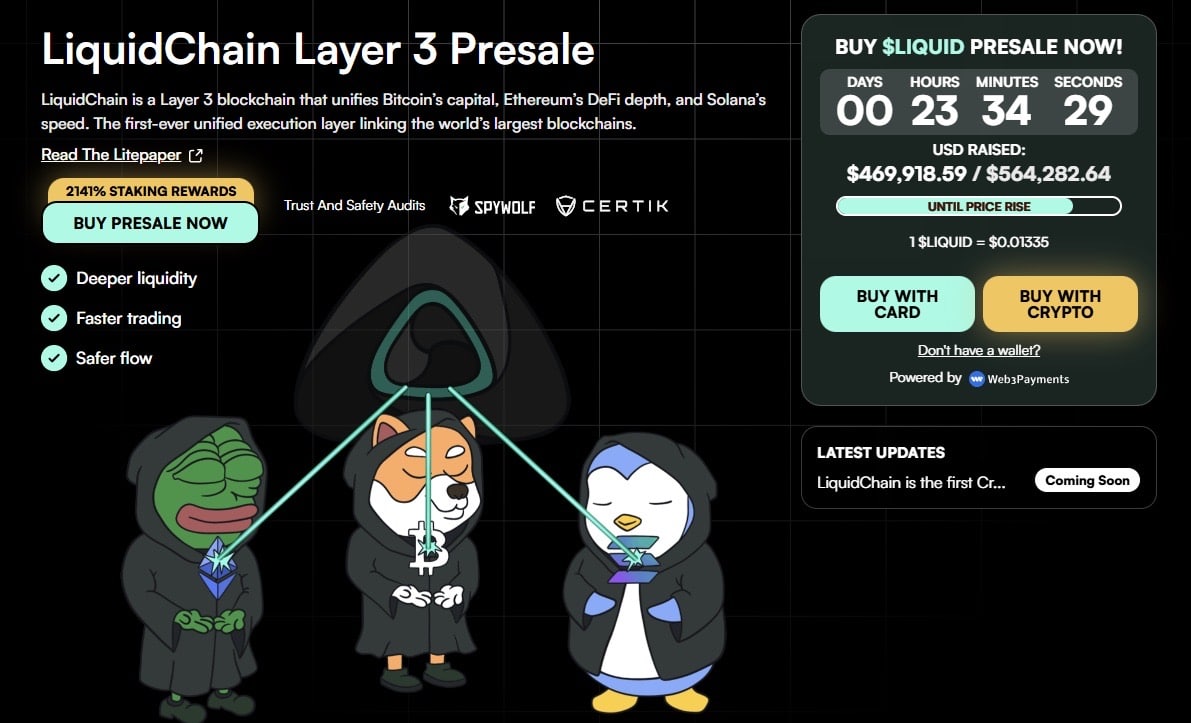
An additional layer of context is added by stake activity. More than 27 million $LIQUID tokens are already staked, reducing early circulating supply and aligning participants around long-term network usage. Early staking behavior often signals that buyers are positioning around utility and protocol growth.
That focus on execution efficiency is why LiquidChain is ranked as the best crypto to buy candidate among infrastructure-led projects. The ongoing crypto presale shows this positioning, with steady capital inflows and strong early staking participation.
Fragmented liquidity affects execution quality, pricing, and capital efficiency across the entire ecosystem. LiquidChain’s focus on this problem places it in a strong position as focus returns to foundational infrastructure.
Why $LIQUID Is the Best Undervalued Altcoin to Buy in 2026
Ethereum’s rise was fueled by necessity. The market needed programmable execution, and Ethereum delivered it at the right moment. LiquidChain’s positioning follows the same principle.
As multi-chain activity increases, capital efficiency becomes more important than ever. Investors and developers want access to liquidity without unnecessary complexity. LiquidChain provides that through unified execution.
The $LIQUID token sits at the center of this system. It is used for execution fees, liquidity routing incentives, and participation across the network. Demand is linked directly to usage, creating a clear connection between network growth and token relevance.
Supply mechanics reinforce this structure. With a fixed total supply of 11,800,000,100 tokens and allocations focused on development, ecosystem growth, rewards, and listings, the design favors long-term expansion over short-lived incentives.
When evaluating altcoins to buy for 2026, positioning matters as much as narrative. Mature assets often require massive inflows to move meaningfully. This positioning places $LIQUID firmly in the best crypto to buy conversation as we go deeper into 2026.
Explore LiquidChain and its ongoing crypto presale:
Presale: https://liquidchain.com/
Social: https://x.com/getliquidchain
Whitepaper: https://liquidchain.com/whitepaper
Join Our Telegram channel to stay up to date on breaking news coverage