Join Our Telegram channel to stay up to date on breaking news coverage
Quantum resistance is no longer a futuristic talking point. NIST has standardized post‑quantum cryptography. Governments and banks are preparing for the shift. And crypto investors have started asking which projects will survive when quantum computers arrive. Two names come up in the conversation: Algorand and BMIC.
Algorand gets a lot of attention. The project has a strong brand, a known team, and a loyal following. BMIC is newer, quieter, and still in its presale phase. But being first does not always mean being best. When you look under the hood at what quantum resistance actually means, the better choice becomes clear.
BMIC ($BMIC) is currently in presale at $0.051009 per token. The project has already raised nearly $500,000. Here is how the two compare.
Algorand: Partially There, Not Fully Ready
Algorand has done more than most blockchains to address quantum threats. The team added FALCON signatures, a NIST‑selected post‑quantum lattice scheme, to cryptographically sign the entire chain history every 256 rounds. That happens about every 12 minutes. This protects past transactions against future quantum attacks. If a quantum computer appears years from now, Algorand’s historical data stays safe.
That is a good first step. But it is only a first step.
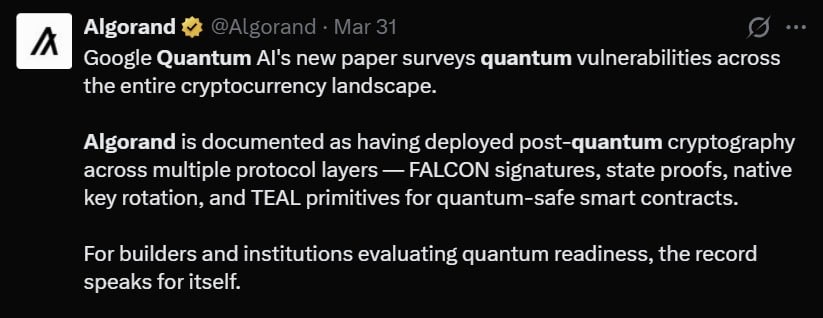
Source: X/@Algorand
Algorand’s core consensus mechanism still runs on classical elliptic‑curve cryptography. Most user accounts sign transactions with classical keys. That means new transactions are not yet protected by post‑quantum schemes. The team has been transparent about this. They describe Algorand as being “about a third of the way” to full quantum security. Ongoing work continues to migrate account keys and consensus to post‑quantum cryptography, but that work is not finished.
Here is the problem. A quantum computer does not need to break old blocks to steal your funds. It needs to break your active wallet keys. If your account still uses classical signatures today, those signatures are exposed on‑chain. A future quantum computer could replay that exposure and drain your wallet the moment it goes online.
Partial protection is better than none. But partial protection leaves the door open.
BMIC: Built Quantum‑Native From Day One
BMIC took a different path. Instead of retrofitting an existing blockchain with patches, BMIC built the entire stack for the quantum era. No classical assumptions and no half‑measures.
The platform uses signature‑hiding smart accounts based on ERC‑4337 standards. Your public key never appears on‑chain. That removes the single biggest attack vector quantum computers will target. Transactions route through private L2 layers with hybrid post‑quantum signatures. Your keys stay invisible at all times.
BMIC combines three core products into one quantum‑secure stack. A wallet that never exposes your public key. A staking system where keys stay hidden while you earn yield. A payment layer with PQC authentication that makes spending safe. No other platform offers all three.
The AI layer monitors activity for threats and optimizes cryptographic performance as NIST standards evolve. The roadmap includes a Quantum Meta‑Cloud with a burn‑to‑compute model, where every quantum workload permanently removes tokens from circulation.
The architecture is already defined, the cryptography is NIST‑approved, and the presale is funding development right now.
BMIC Tokenomics and Presale Opportunity
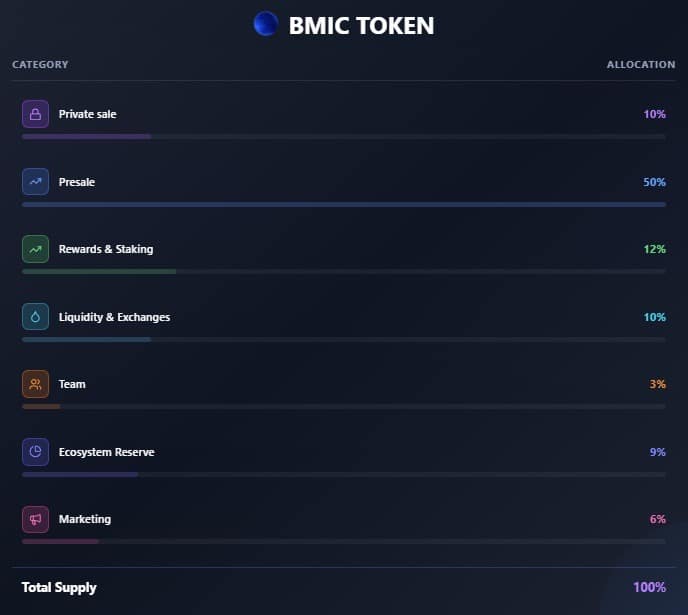
The BMIC token runs on Ethereum as an ERC‑20 standard with a fixed total supply of 1.5 billion tokens. No new tokens will ever be minted.
Allocation breaks down as follows:
- Presale – 50% (750 million tokens)
- Private sale – 10%
- Rewards & Staking – 12%
- Liquidity & Exchanges – 10%
- Ecosystem Reserve – 9%
- Marketing – 6%
- Team – 3%
The presale is structured across up to 50 phases. The current price sits at $0.051009. That price increases gradually to $0.058182 across later phases. The public launch price will be set above the final presale tier, rewarding early participants with preferential entry.
Over $500,000 has already been raised. Phase 1 includes a confirmed top‑10 exchange listing. Once that listing happens, the window for sub‑$0.06 tokens will close.
Why BMIC Is the Better Quantum‑Resistant Crypto to Buy in 2026
Algorand deserves credit for starting the quantum conversation. The FALCON signature implementation for chain history is valuable. But partial protection on a classical foundation leaves active users exposed. A quantum computer that breaks elliptic‑curve signatures would still compromise every Algorand account that has not been migrated.
BMIC does not have that problem. Zero public‑key exposure means there is nothing for a quantum computer to find. The signature‑hiding architecture works today, not after a series of future upgrades.
The market cap difference also matters. Algorand already carries a multi‑billion dollar valuation. BMIC is still in presale at a fraction of that. The upside asymmetry is not even close.
For investors looking for true quantum resistance, the choice is simple. You can buy an established project that is one‑third of the way to the finish line. Or you can buy a quantum‑native project that solves the core problem from day one, at presale prices that will never return.
Algorand has hype. BMIC has the architecture. The best quantum‑resistant crypto to buy in 2026 is the one that actually protects your keys right now.
Meet the future of quantum-secure Web3 with BMIC:
Presale: https://bmic.ai/
Social: https://x.com/BMIC_ai
Telegram: https://t.me/+6d1dX_uwKKdhZDFk
Join Our Telegram channel to stay up to date on breaking news coverage