Idle crypto shouldn’t just sit in a wallet. Two platforms come up constantly when the conversation turns to earning interest on digital assets: CoinDepo and Binance Earn.
One is a dedicated interest-account platform, built from the ground up around a single job: turning deposits into daily yield. The other is a savings feature bolted onto the world’s largest crypto exchange, backed by Binance’s scale and liquidity.
This guide compares both platforms on the things that actually matter: interest rates, supported coins, loan options, fees, security, and everyday usability. By the end, you’ll know which one fits your goals.
CoinDepo vs Binance Earn: Our Summary
CoinDepo is built purely for passive income. Deposit stablecoins or major cryptocurrencies and the platform pays fixed annual rates as high as 23%, with daily compounding and no lockup required. It also offers an instant credit line, letting users borrow against their portfolio without freezing it, and charges no fees on deposits or withdrawals.
Binance Earn takes a different approach. As part of the broader Binance ecosystem, it gives users access to Flexible and Locked savings products across more than 180 cryptocurrencies. Rates are variable and generally more modest than CoinDepo’s, but the sheer range of supported coins and the exchange’s liquidity are hard to match.
Overall, CoinDepo comes out ahead for anyone whose main goal is yield. Its fixed, published rates and zero-fee structure are difficult for a general-purpose exchange to compete with. That said, Binance Earn remains a strong pick for traders who want their earning account to sit inside the same platform they already trade and borrow on, especially if they hold smaller altcoins CoinDepo doesn’t support.
| Feature | CoinDepo | Binance Earn |
| Supported assets | 30+ major coins & stablecoins | 180+ cryptocurrencies |
| Stablecoin yield | 18% – 23% APR (fixed) | Roughly 2% – 10% APR (variable) |
| Major crypto yield | 12% – 18% APR (fixed) | Roughly 0.5% – 3% APR (variable) |
| Payout frequency | Daily, weekly, monthly, quarterly, semi-annually or annually (your choice) | Per-minute (Flexible) or at maturity (Locked) |
| Lockup period | None on any account type | None (Flexible) / 7–120 days (Locked) |
| Compounding | Daily, on every account type | Real-time on Flexible; fixed lump sum on Locked |
| Fees | None | None to subscribe; standard exchange fees apply elsewhere |
What Are CoinDepo & Binance Earn?
CoinDepo is a centralized finance platform founded in 2021 that operates more like a non-bank crypto savings platform than a crypto exchange. Its entire product line centers on compound interest accounts and crypto-backed credit lines, funded by deploying user deposits into over-collateralized lending. The platform has grown to more than 100,000 users and over $220 million in assets under management.
Binance Earn is the savings arm of Binance, the largest crypto exchange in the world by trading volume. Rather than a standalone product, it’s a suite of tools — Simple Earn’s Flexible and Locked products chief among them — built directly into the Binance app and website. Users can move funds between spot trading, earning, and borrowing without leaving the platform.
Which Platform Has the Best Crypto Interest Rates?
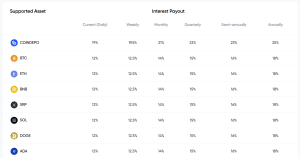
Rates are where the two platforms diverge most sharply. CoinDepo publishes fixed annual percentage rates that don’t move with market lending demand: 17% to 23% on stablecoins like USDT, USDC and DAI, and 12% to 18% on major coins like BTC, ETH, XRP and LTC. The rate you get depends only on how often you choose to receive payouts — daily, weekly, monthly, quarterly, semi-annually or annually — with less frequent payouts earning a higher headline rate. You can use our CoinDepo review for a more detailed breakdown.
Binance Earn works differently. Flexible Savings pays a Real-Time APR that updates by the minute and moves with market conditions — historically averaging somewhere between 2% and 6% on stablecoins and well under 3% on BTC or ETH. Locked Savings pays roughly double the Flexible rate in exchange for committing funds for a set term, usually 7 to 120 days, with interest paid as a fixed lump sum at maturity rather than compounding.
Both platforms compound interest on their most flexible products, but the mechanics differ. CoinDepo compounds daily on daily accounts and monthly for monthly accounts, so the effective annual yield is always higher than the stated APR — a stablecoin account with an 18% “current” rate actually earns closer to 19.7% once compounding is factored in. Binance’s Flexible Savings also compounds by crediting rewards every minute, but on Locked products, interest is calculated as a flat rate over the term with no compounding at all.
For a direct comparison, take USDC: CoinDepo currently pays up to 23% APR, while Binance Earn’s flexible USDC or USDT products have typically sat in the single digits to low double digits depending on market demand and ongoing promotions. That gap holds across most supported assets, and it’s the single biggest reason CoinDepo wins on pure yield.
The trade-off is predictability versus flexibility. CoinDepo’s rates are contractually fixed until you change account types, so what you see is what you get. Binance’s rates can rise sharply during high-demand periods or promotional campaigns, but they can also drop just as fast when lending demand cools.
Score: CoinDepo 4.5/5 | Binance Earn 3/5
Supported Cryptocurrencies on CoinDepo and Binance Earn
CoinDepo takes a curated approach, supporting roughly 30 high-liquidity assets — think Bitcoin, Ethereum, Litecoin, XRP, Solana, Dogecoin and major stablecoins like USDT, USDC and DAI. That’s a deliberate trade-off: fewer assets, but deeper liquidity and more stable yield generation behind each one.
Binance Earn supports well over 180 cryptocurrencies, spanning everything from top market-cap coins to smaller altcoins that rarely appear on dedicated crypto interest platforms. If you’re holding a long tail of tokens and want to earn on all of them without moving funds elsewhere, Binance has the far wider net.
For most retail savers, the practical difference comes down to what’s already in your portfolio. Stablecoin and major-coin holders won’t notice CoinDepo’s smaller list. Anyone diversified across dozens of smaller-cap tokens will lean toward Binance by default.
Score: CoinDepo 4/5 | Binance Earn 4.5/5
Loan Options
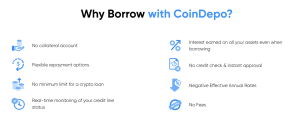
CoinDepo’s Instant Credit Line is arguably its most distinctive feature. Rather than transferring assets into a separate collateral account, your existing CoinDepo deposits serve as collateral automatically, and you keep earning interest on them while you borrow. Loans are available up to 50% loan-to-value across 15 supported assets, can be drawn down and repaid repeatedly within your credit limit, and come with no credit checks or paperwork.
Binance Loans (also called Flexible Loan) is a more traditional crypto-backed lending product, letting users borrow from a list of 60-plus currencies against 25-plus types of collateral. Interest accrues by the minute based on real-time rates, loans can be repaid at any time with no early-repayment penalty, and Binance offers a separate VIP Loan tier for larger institutional borrowers. Margin calls typically trigger around 75% LTV, with liquidation at higher thresholds and a 2% liquidation fee if it happens.
Both platforms avoid the paperwork and credit checks of traditional lending, which is standard for the crypto-loan space. CoinDepo’s edge is that it doesn’t require a separate frozen collateral account — your deposits keep earning while pledged. Binance’s edge is scale and asset variety, plus a proven track record running loan products at exchange volume.
Score: CoinDepo 4/5 | Binance Earn 4/5
CoinDepo vs Binance Earn Fees
CoinDepo doesn’t charge fees on deposits, withdrawals, or interest payouts. Outside of standard blockchain network fees for moving assets on-chain, using the platform costs nothing.
Binance Earn’s Simple Earn products carry no subscription fee either — you don’t pay to open a Flexible or Locked account. The catch is on Locked Savings: redeeming before maturity is possible on many products, but you’ll forfeit some or all of the accrued interest. Binance’s broader fee schedule (spot trading fees around 0.1%, reduced with BNB) also applies if you move funds elsewhere on the platform, something CoinDepo users never encounter since it isn’t a trading exchange.
For anyone using these platforms purely to earn passive income and nothing else, both are effectively fee-free at the point of deposit. CoinDepo’s simplicity — one product, no fee schedule to learn — gives it a slight edge for savers who never plan to trade.
Score: CoinDepo 4.5/5 | Binance Earn 4/5
Security & Regulation
CoinDepo secures client assets through Fireblocks, an institutional custody provider that uses Multi-Party Computation to split private keys across multiple parties so no single point of failure can compromise funds. The platform has undergone third-party security audits from CertiK and Hacken, and holds licenses including a BSP license in El Salvador, with its holding structure based in Panama. As a five-year-old platform, it doesn’t yet carry the regulatory track record of a major exchange, and deposits aren’t covered by government deposit insurance — a trade-off common to nearly every high-yield crypto platform.
Binance operates its own Secure Asset Fund for Users (SAFU), an emergency reserve funded from trading fees that has covered user losses during past security incidents, including a 2019 hack. The fund currently holds around $1 billion and is being converted into Bitcoin. On the regulatory side, Binance agreed to pay a $4.3 billion settlement to US authorities in November 2023 and now operates under multi-year regulatory oversight — a legal history worth knowing, even though the exchange has continued operating without further incident since.
Both platforms take security seriously, but the risk profile is different. Binance’s scale gives it deeper reserves and a longer public track record; CoinDepo’s institutional custody and audits are strong for its size but come from a younger, smaller company. Neither offers protection equivalent to FDIC-insured bank deposits.
Score: CoinDepo 4/5 | Binance Earn 4/5
UX: Which Is Most User Friendly?
CoinDepo’s dashboard is simple by design — deposit, pick an account type, and watch interest accrue. Reviewers on Trustpilot, where CoinDepo holds a rating of around 4 out of 5 stars from more than 250 reviews, consistently mention how easy the platform is to navigate for a first-time user. The most common complaint isn’t the interface itself but the lack of a native mobile app; CoinDepo is currently browser-only, though it’s optimized for mobile browsers.
Binance’s app is far more mature, reflecting years of iteration across a much bigger product suite. It scores highly on app stores — around 4.5 to 4.8 out of 5 across millions of ratings. Its Trustpilot rating tells a different story, sitting closer to 1.5 to 2 out of 5 from thousands of reviews, largely driven by complaints about withdrawal holds and slow account-verification support — a pattern common to large exchanges handling huge transaction volumes.
Borrowing and other features: Binance Earn wins on lending breadth and product variety thanks to its exchange-wide ecosystem. CoinDepo stays narrowly focused on earning, which shows in a cleaner, less cluttered experience but fewer bells and whistles.
Score: CoinDepo 4/5 | Binance Earn 4.5/5
Conclusion: Is CoinDepo or Binance Earn Best in 2026?
CoinDepo’s strength is singular and clear: it pays some of the highest fixed rates available on crypto deposits, with no lockups, no fees, and daily compounding across a curated list of major coins and stablecoins. It’s best suited to savers who want a straightforward, high-yield home for BTC, ETH or stablecoins and don’t need trading or a huge asset list.
Binance Earn’s strength is breadth. Backed by the resources of the world’s largest exchange, it supports far more assets, integrates directly with trading and lending, and gives active traders a way to earn on idle balances without leaving their existing workflow. Its rates are lower and more variable, but its scale and product ecosystem are unmatched.
Weighing both together, CoinDepo comes out as the stronger choice for anyone whose primary goal is passive income. Its rate advantage is substantial enough to outweigh Binance Earn’s broader coin selection for most stablecoin and major-crypto holders. Traders who already live inside the Binance ecosystem, or who hold a long tail of smaller altcoins, may still find Binance Earn the more convenient option — but for yield alone, CoinDepo is difficult to beat.
Our Methodology
This comparison draws exclusively on first-party information published by CoinDepo and Binance — official rate pages, terms of service, security disclosures, and product documentation — cross-checked against recent third-party reporting and verified user reviews on Trustpilot.
Each section was scored out of 5 based on the criteria most relevant to that category: for rates, we weighed yield level, stability and compounding structure; for security, custody technology, audit history and regulatory track record; for UX, ease of use, app availability and verified customer feedback. Scores reflect the tools and terms available at the time of writing and may shift as either platform updates its offerings.
FAQs
Is CoinDepo or Binance Earn better for beginners?
CoinDepo’s simpler product line makes it easier to understand at a glance, but Binance’s mobile app is more polished for users who also want to trade.
Which platform pays higher interest?
CoinDepo’s fixed rates, up to 23% APR on stablecoins, are consistently higher than Binance Earn’s variable rates on the same assets.
Do either platform charge withdrawal fees?
No. Both are free to deposit and withdraw, aside from standard blockchain network fees. Binance’s Locked Savings can forfeit interest on early redemption.
Can I borrow against my deposits on both platforms?
Yes. CoinDepo offers an Instant Credit Line with no separate collateral account, while Binance Loans offers a wider range of borrowable assets with more traditional LTV-based terms.
Is my crypto insured on either platform?
Neither offers government-backed deposit insurance. CoinDepo provides custody insurance powered by Fireblocks and third-party audits; Binance backs user funds with its SAFU emergency fund and publishes Proof-of-Reserves data.
Which platform supports more cryptocurrencies?
Binance Earn, by a wide margin — over 180 assets compared with CoinDepo’s roughly 30 curated coins and stablecoins.