
Join Our Telegram channel to stay up to date on breaking news coverage
Hedera has not enjoyed favorable price action over the past year. The HBAR price has fallen nearly 50% across the last 12 months, mirroring broader weakness across altcoins as the bear market hits crypto and risk appetite. Retail confidence has thinned, and many portfolios have absorbed heavy drawdowns.
Yet even in this kind of market, capital has become selective. That selectivity is visible both in institutional positioning around established networks and in early-stage infrastructure plays like the LiquidChain ($LIQUID) crypto presale, which continues to have steady participation despite challenging market conditions.
Secondary markets struggle, but some presale ecosystems have shown pockets of resilience. LiquidChain’s crypto presale has raised almost $600,000 so far, which signals that investors are still willing to back architecture-focused projects when the thesis is clear and execution is defined.
Canary Capital Accumulates HBAR; A Long-Term Signal Amid Weak Price Action
The recent alert that Canary Capital increased its HBAR holdings came out in late February. With a capped supply of 50 billion tokens, that position reportedly represents roughly 1.1% of total supply concentrated within one institutional vehicle. The message circulating alongside the purchase was familiar: retail panics, institutions accumulate.
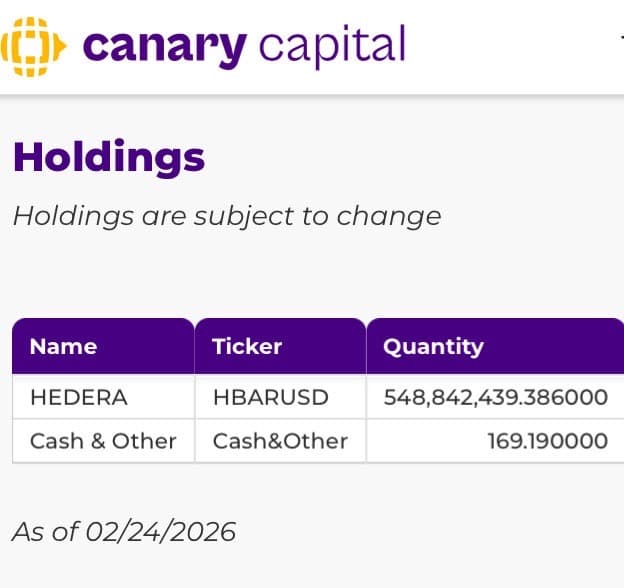
Source: X/@markchadwickx
Hedera remains a technically strong network with enterprise partnerships and a distinct consensus model. Its governance structure and throughput capabilities have attracted corporate interest over the years. Institutional accumulation at depressed price levels can be interpreted as a confidence signal in long-term infrastructure value.
At the same time, price performance has been subdued. The HBAR price continues to trade far below previous highs, and momentum has not yet returned in a meaningful way. Institutional buying does not automatically translate into short-term upside. Markets in bearish cycles often compress valuations for extended periods before recovery takes shape.
This illustrates a broader truth: capital rotation is underway, but it is moving toward infrastructure depth and interoperability, not simply single-chain exposure. Institutions accumulating HBAR reinforces the idea that foundational networks matter. Yet the next phase of growth may favor systems that unify liquidity across major ecosystems rather than rely on one chain alone.
LiquidChain ($LIQUID): A Multi-Chain Infrastructure Thesis
LiquidChain enters this discussion with a different structural focus. Instead of competing as another base-layer network, LiquidChain operates as a Layer 3 execution and settlement layer designed to unify liquidity across Bitcoin, Ethereum, and Solana.
The core problem it addresses is fragmentation. Billions in capital sit siloed across chains, forcing users to rely on bridges, wrapped assets, and duplicated deployments. This creates friction, fees, and security exposure. LiquidChain verifies Bitcoin UTXOs, Ethereum state, and Solana accounts directly within its architecture, allowing cross-chain transactions to settle atomically.

Unified liquidity pools enable assets from these ecosystems to interact in shared markets without synthetic wrappers. This design aims to deepen liquidity, improve execution quality, and reduce reliance on external bridge infrastructure. A high-performance virtual machine executes multi-chain logic in real time, allowing developers to deploy once and access liquidity everywhere.
From a token standpoint, the $LIQUID crypto presale ties directly into network functionality. The total supply stands at 11.8 billion tokens, with allocations emphasizing development, ecosystem expansion, rewards, and listings. $LIQUID powers transaction fees, liquidity staking, and developer grants, embedding the token into protocol usage rather than abstract narratives.
Entry pricing remains positioned at early-stage levels, which has contributed to growing presale participation despite broader market hesitation. In a period where many altcoins are retracing, early infrastructure positioned around cross-chain execution presents a distinct thesis. The presale momentum of nearly $600,000 in raised capital underscores that capital is still flowing toward projects built for structural relevance.
For investors evaluating positioning during downturns, the contrast is clear: single-chain accumulation versus multi-chain coordination. LiquidChain’s bet centers on the idea that the next major wave of decentralized finance will depend on seamless interaction between Bitcoin, Ethereum, and Solana liquidity.
Why Infrastructure Presales Stand Out in Bear Markets
Bear markets reward durability. When speculative excess fades, projects grounded in real execution layers tend to separate from noise. The LiquidChain ($LIQUID) Crypto Presale aligns with this dynamic by targeting one of crypto’s most persistent bottlenecks; cross-chain liquidity fragmentation.
Institutional HBAR accumulation demonstrates confidence in foundational networks. LiquidChain extends that logic by building above multiple foundations simultaneously. Instead of competing for dominance, it aims to coordinate liquidity across dominant chains.
As markets remain sluggish, infrastructure-focused tokens often gain visibility because their value proposition is tied to function rather than hype. In that context, many analysts view early-stage cross-chain infrastructure as among the best cryptos to buy during downturn phases, particularly when entry valuations remain compressed.
LiquidChain’s thesis rests on unified liquidity, atomic settlement, and developer efficiency across ecosystems. In a market where resilience matters more than narrative momentum, projects structured around coordination and execution may prove better positioned for the next expansion cycle.
Explore LiquidChain and its ongoing crypto presale:
Presale: https://liquidchain.com/
Social: https://x.com/getliquidchain
Whitepaper: https://liquidchain.com/whitepaper
Join Our Telegram channel to stay up to date on breaking news coverage