When Genius Sports released its third quarter financials, the news couldn’t have been clearer: this company is firing on all cylinders. With group revenue climbing 38% year-on-year to reach $166.3 million, the London and New York-based sports technology firm is proving itself as one of the most dynamic players in the global sports ecosystem. What makes this moment particularly noteworthy isn’t just the headline growth number, but rather the underlying story about how the company is reshaping the intersection of sports, betting, and media.
A Decade and a Half of Building Infrastructure
To truly appreciate what Genius Sports accomplished this quarter, it’s worth understanding where the company came from. Founded in 2000 as Betgenius by Mark Locke, the company started with a simple but powerful observation: as sports betting moved online and in-play wagering became possible, there was an urgent need for real-time, low-latency sports data. The company’s early years focused precisely on this opportunity, supplying the lifeblood of information that betting operators needed to set accurate odds and keep customers engaged.
The path to becoming the global powerhouse it is today involved strategic expansion and consolidation. In 2016, Betgenius merged with SportingPulse International, creating what would become known as Genius Sports. A year later, private equity firm Apax Partners invested in the business, providing the capital needed for growth. Then came April 2021, when Genius Sports went public through a SPAC merger with dMY Technology Group II, beginning its journey as a publicly listed company on the New York Stock Exchange under the ticker symbol GENI.
Today, the company sits as a trusted technology partner to over 700 sports organizations worldwide. This portfolio includes some of the biggest names in global sports: the NFL, English Premier League, NBA, MLB, NCAA, and a constellation of leading sportsbooks like DraftKings, FanDuel, and bet365. The company operates its technology platform across more than 150 countries, processing over 240,000 live sports events annually. These aren’t vanity metrics. They represent genuine competitive moats built through years of partnerships, trust, and technical excellence.
Three Divisions Firing Together
The most striking aspect of Genius Sports’ third quarter performance was the breadth of growth across its business. The company doesn’t rely on a single revenue engine, and this diversified approach is paying dividends.
The Betting Technology, Content and Services division remained the largest contributor to the company’s top line, generating $110 million in revenue, up 28.5% year-on-year. This segment powers the betting infrastructure for major sportsbooks globally, providing the official data, trading tools, and content that operators depend on. The growth here reflected higher pricing achieved during contract renewals, the rollout of new products into the market, and a consistently expanding customer base hungry for premium data and services.
But the real headline grabber was the Media Technology, Content and Services division. This segment nearly doubled its contribution quarter-over-quarter, exploding 89% to reach $41.8 million. For a company traditionally known for powering betting operations, this shift toward media monetization represents a profound strategic pivot. The growth here was driven by surging demand for programmatic advertising data, new marketing technology integrations, and deepening relationships with premium brands looking to activate sports fans.
The Sports Technology and Services arm, meanwhile, reported revenue of $14.5 million, up 16.4% year-on-year. This segment focuses on performance analytics, audience intelligence, and other technology solutions that sports teams and leagues use directly. While smaller than its sibling divisions, its steady double-digit growth reflects the strong adoption of sophisticated tools that teams now view as essential to competitive performance.
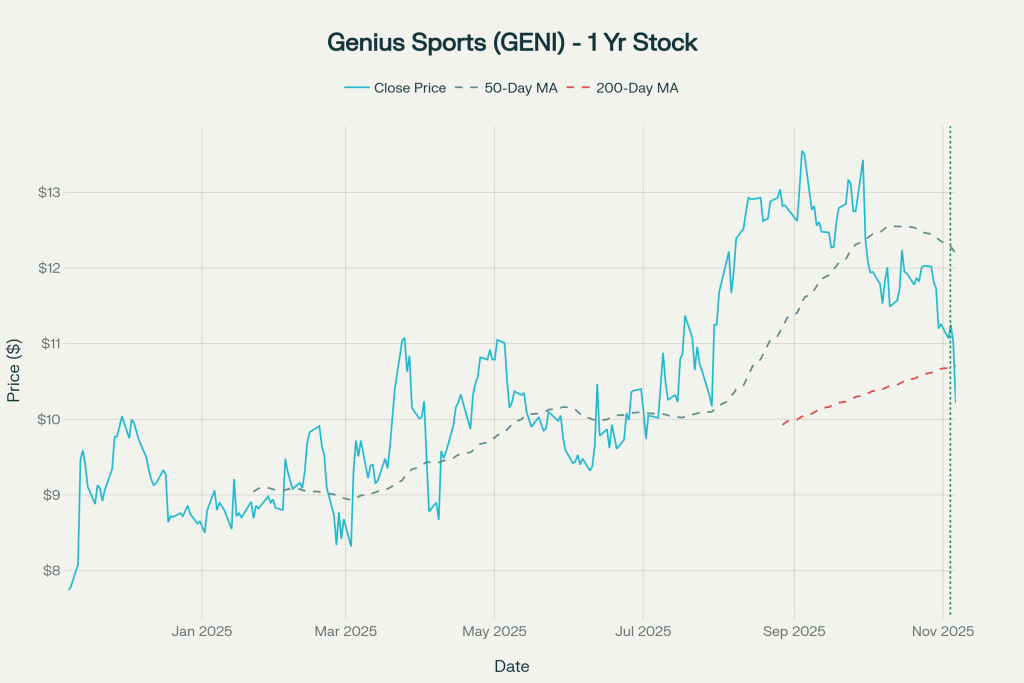
Genius Sports (GENI) stock performance over the past year with key financial metrics, moving averages, and Q3 earnings announcement impact
The Adjusted EBITDA Story
Beneath the surface of the revenue growth lies another important metric that caught Wall Street’s attention. Adjusted EBITDA increased 32% to $34 million, suggesting that the company isn’t just growing revenue but doing so efficiently. When the company reported a net loss of $28.8 million, investors might have initially worried, but management clarity mattered here. That loss was largely attributable to a $7.5 million foreign currency impact, the timing of recognizing certain new data rights agreements, and non-recurring litigation costs. These are items that cloud the picture of underlying operational health without reflecting the trajectory of the actual business.
For the full year 2025, Genius Sports now expects to generate approximately $655 million in group revenue and around $136 million in adjusted EBITDA. These figures represent growth of 28% and 59%, respectively, compared to 2024. Perhaps most notably, management guided that the company would generate positive annual cash flow for the full year. This progression toward cash generation is meaningful because it signals that the investments the company has been making in product development and market expansion are beginning to translate into sustainable financial performance.
Strategic Acquisitions and Partnership Momentum
Beyond the financial results, Q3 was characterized by strategic activity that shapes the company’s future position. The quarter saw Genius Sports complete its acquisition of Sports Innovation Lab, a Boston-based firm specializing in fan data and analytics. This deal materially expands the company’s footprint in the media space by combining official sports data with comprehensive fan intelligence. Sports Innovation Lab had built sophisticated models tracking billions of transactions annually, everything from ticket purchases and attendance patterns to viewership and merchandise consumption. By integrating this capability with its existing FANHub advertising platform, Genius Sports is now positioned to offer an unprecedented 360-degree view of the modern fan journey.
The company also expanded its long-standing partnership with Hard Rock Bet Sportsbook, adding the company’s flagship BetVision product to the platform. BetVision deserves special attention because it represents where sports betting technology is heading. Rather than segregating the betting experience from the viewing experience, BetVision merges low-latency live streaming with real-time statistics, data overlays, and seamless betslips, all within a single interactive interface. The product first launched for NFL games in 2023 through partnerships with Caesars and FanDuel, and its expansion to other sports demonstrates genuine market traction.
In an important expansion of its media business, Genius Sports secured exclusive official data and streaming rights with Serie A through 2029, further ensuring that BetVision content will reach fans across the world’s most popular sport. The company also recently launched BetVision for soccer, making the product available across 120-plus competitions globally, from the French Ligue 1 to Brazil’s Serie A.
The Technology Layer Powering Everything
Understanding Genius Sports’ future potential requires recognizing the technological foundations it has built. In August 2024, the company launched GeniusIQ, a next-generation artificial intelligence platform that represents a fundamental advancement in how sports data is processed and deployed. Rather than simply delivering static data, GeniusIQ uses machine learning and generative AI to ingest billions of data points in real-time and extract actionable insights.
The platform operates across multiple applications. For performance analysis, it powers the WNBA teams’ ability to extract rich insights about player efficiency and game dynamics through Second Spectrum’s optical tracking technology. For fan engagement, it enables the generation of automated highlight reels and contextual storytelling that enhances broadcasts. For advertising, it creates opportunities for data-driven sponsorship activation aligned with the emotional moments in live play. For sportsbooks, it optimizes in-game handle and betting volume by surfacing the most compelling betting opportunities at the precise moments when fans are most engaged.
The Crypto Connections
Genius Sports, like other leading data and technology providers in the global sports and betting sector, has actively explored the integration of blockchain and crypto technologies, albeit in a nuanced and strategic manner rather than through full-scale crypto-native business models. The company acknowledges that innovations in digital payments and blockchain-enhanced data management are reshaping the commercial, regulatory, and fan-engagement dimensions of the sports industry, just as the online gaming landscape has been reshaped by the emergence of crypto gaming platforms.
One promising area is the rise of stablecoins and regulated digital payment systems. Genius Sports tracks policy shifts, such as the U.S. “GENIUS Act,” which creates a regulatory framework for stablecoin issuers. These frameworks pave the way for sports clubs, leagues, and Genius Sports’ partners to leverage stablecoins for faster, borderless payments—streamlining sponsorship settlements, international player transfers, and even enabling fan-to-club micropayments for digital experiences and engagement. Analyst commentary suggests the sports data ecosystem is now attuned to the opportunities presented by regulated digital assets, such as reducing transaction costs and providing compliant sponsorship avenues that mitigate counterparty risks for rightsholders and commercial partners.
Genius Sports also explores crypto-adjacent innovations for fan tokens, NFTs, and verifiable data trails. The regulated adoption of NFTs for ticketing, digital collectibles, and gamified fan experiences presents long-term commercial possibilities for their partner leagues and clients. While not directly issuing coins or launching proprietary blockchains, Genius Sports positions itself as a technologic enabler—ready to support clients wishing to pilot blockchain-driven fan engagement or transaction products, provided such systems meet strict compliance and data integrity standards.
On the operational side, blockchain’s promise of transparent, immutable record-keeping aligns well with Genius Sports’ mission to provide verified, tamper-resistant data to sportsbooks and leagues. With the emergence of more widespread distributed ledger infrastructure and smart contracts in sports media, Genius Sports is likely to expand its partnerships around blockchain-enhanced integrity solutions and data delivery. While these efforts have so far been cautious and regulatory-driven, the company is well-placed to be a key infrastructure partner as sports crypto and fintech projects mature and scale globally.
How It Stacks Against Competitors
Within the sports data ecosystem, Genius Sports primarily competes with Sportradar, a larger European firm, and a handful of smaller players. What distinguishes Genius Sports is its specialized focus on the betting and media infrastructure layer, whereas Sportradar maintains significant exposure to lower-margin audiovisual distribution. This structural difference has historically meant that Genius Sports operates with better unit economics, despite Sportradar’s larger scale.
The competitive landscape saw a significant shift in September 2025 when Sportradar announced its acquisition of IMG ARENA, the sports data division of entertainment company Endeavor. This deal consolidated additional data rights in IMG ARENA’s portfolio, including properties like UFC, MLS, and tennis federations. However, industry observers note that both companies now face a maturing market where scale and margin management matter more than simply acquiring incremental rights. The real battleground increasingly centers on technology, latency optimization, and the ability to package data in compelling ways that drive monetization across betting and media channels.
A Company Diversifying Its Revenue Foundation
The acceleration in the Media Technology division reveals something profound about management’s strategy. For years, Genius Sports was primarily understood as a data provider to sportsbooks. The business model was straightforward: secure exclusive data rights from leagues and sell that data to betting operators. This model remains profitable and sticky, but it has limitations. Media diversification opens entirely new revenue pools.
Through FANHub, which launched in late 2024, the company offers brands a sports-focused advertising and media activation platform. The platform aggregates audience data from multiple sports properties and allows advertisers to execute campaigns across programmatic channels, social networks, and premium sports inventory. By combining this with Sports Innovation Lab’s consumer intelligence, Genius Sports can now tell brands exactly which fans are most likely to purchase their products, attend their events, or engage with their content. This represents a fundamental shift from selling data to sportsbooks to selling audience precision to premium brands.
Consider the economics. In the United States alone, team sponsorships were valued at $7.6 billion in 2024. As competitions for sponsorship dollars intensify, team and league partners increasingly demand accountability, they want to prove to sponsors that investments are driving real fan engagement and transactions. Genius Sports’ integrated platform of official data plus fan intelligence plus programmatic advertising creates a complete solution for this exact problem.
Looking Toward the Rest of 2025
The revised guidance that Genius Sports announced with these Q3 results speaks to the confidence management has in sustaining momentum. A projected $655 million in full-year revenue would represent 28% growth compared to 2024. The adjusted EBITDA projection of $136 million would mark 59% growth and imply a 21% margin. For a company that was still in scaling mode just a few years ago, these profitability metrics demonstrate the operating leverage of the model.
Perhaps equally important, management’s guidance for positive annual cash flow signals that the company is transitioning from investment phase to cash generation. This matters for investors because it reduces the risk that the company will need to dilute shareholders through secondary offerings or constrain growth to manage cash.
Several catalysts could drive further upside from here. First, the geographic expansion of sports betting legalization continues to open new markets. As additional U.S. states legalize wagering or new countries regulate their betting markets, Genius Sports gains access to operators that need official data and technology. Second, the adoption of prediction markets and other emerging betting verticals could create new demand for data and infrastructure services. Finally, the maturation of in-play betting, where Genius Sports has significant technological advantages, should continue rewarding the company’s investments in low-latency streaming and AI-driven product innovation.
The Takeaway
Genius Sports’ third quarter results demonstrate a company that has successfully navigated from being a specialized data provider to becoming an essential technology and media infrastructure player across the entire sports ecosystem. The 38% revenue growth rate, the acceleration of its media division, and the strategic acquisitions and partnerships announced during the quarter all point toward a business model that is increasingly resilient and diversified. With over 700 sports organizations relying on its technology, partnerships spanning from the NFL to the Premier League to emerging betting markets, and a newly launched AI platform that promises to unlock new applications of sports data, the company appears well-positioned for sustained expansion. The raised guidance suggests management sees significant runway ahead, and the path to profitability appears increasingly clear.
Related Pages
- The Growing Battle Over Sports Prediction Markets: States Fight Back Against Federal Trading Platforms
- The Potential of In-Play Betting to Drive Revenue Growth in the US Sports Betting Market
- The Complex Fallout of Legalized Sports Gambling
- Prediction Markets Face New Realities: Analysts Downplay Threat to Sportsbooks While Polymarket Eyes US Return