On this Page:
Bitcoin is the first cryptocurrency ever invented. It lets holders send and receive payments without a bank or other middleman. No company or government owns it, and anybody on the planet can send or receive Bitcoin at any time of day.
No government issues or controls Bitcoin, and its supply is capped at 21 million coins. That fixed supply is one of the main reasons people value it.
If you have ever wondered why Bitcoin is worth so much, the short answer is that it was the first system to make digital money work without a trusted third party, and that idea created an entirely new asset class that is still growing.
Bitcoin is also more than a coin. It is a complete system made of open-source software, a set of protocol rules, a global network of nodes, miners who secure the network with proof of work, and a shared ledger called the blockchain. This guide explains each of those parts and how they fit together, then covers Bitcoin’s history, price, risks and what comes next.
Key Takeaways
- Bitcoin is the first and most valuable cryptocurrency ever created.
- It is a complete system: open-source software, protocol rules, nodes, miners and a public blockchain work together so that no intermediary is needed.
- Mining with proof of work validates transactions and secures the network.
- Its value rests on scarcity (21 million cap), demand and security, not on physical backing.
- Scaling happens on two levels: upgrades to the base layer (Layer 1) and networks built on top of it, such as the Lightning Network (Layer 2).
What Exactly Is Bitcoin?
Bitcoin was created by a single individual, or perhaps a group of individuals, going by the name Satoshi Nakamoto. The Bitcoin whitepaper was published in 2008 and the network went live in January 2009. To this day, no one knows who Satoshi actually is. Cryptocurrency as a working concept simply did not exist before Bitcoin came along.
- It is rare: There will only ever be 21 million BTC.
- It’s digital and borderless: It’s fast and easy to send Bitcoin to anyone, anywhere in the world.
- It’s open-source and decentralized: Bitcoin does not belong to a corporation. It is run by a public network of users who all follow the same rules.
How Does Bitcoin Work?
Unlike physical currency, Bitcoin has no central bank behind it. It is a peer-to-peer network: people transfer BTC to one another directly, not through a middleman.
The basis of Bitcoin is blockchain technology. In simple terms, the blockchain is a public ledger that records every transaction ever made, so anyone can check that the history is complete and that no coin has been spent twice.
Let’s say you wish to transfer Bitcoin to somebody else. The transaction is not confirmed instantly. Your wallet signs it with your private key and broadcasts it to the network. Nodes check that it follows the rules, and miners, who run specialized and very powerful computers, compete to bundle it into the next block. Once a miner finds a valid block, the transaction is added to the blockchain. This process secures the network and prevents double-spending.
The whole system runs on economic incentives. Miners are rewarded for securing the network, users pay small fees to have their transactions processed, and everyone gets a payment network that operates 24/7 without central control. The sections below look at each component in turn.
The Bitcoin protocol
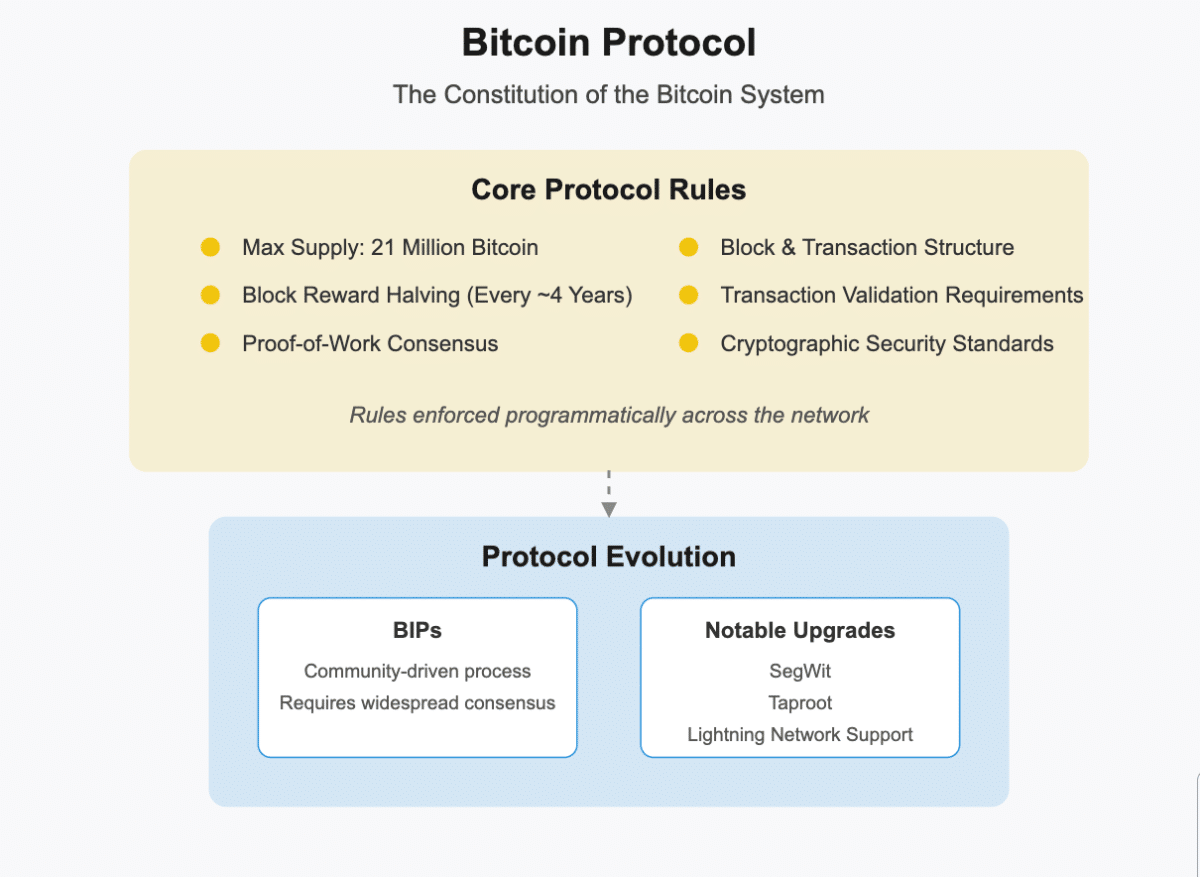
The Bitcoin protocol defines the core rules for how the Bitcoin network operates. It is essentially the constitution of the Bitcoin system: a set of standards and procedures that every participant must follow to remain part of the network.
The main rules include:
- The maximum supply (21 million BTC).
- The block reward halving schedule (every 210,000 blocks, roughly every four years).
- The consensus mechanism based on proof of work.
- The structure of blocks and transactions.
- The validation requirements for transactions.
- The cryptographic standards used for security.
These rules are expressed in code within the software rather than in a separate legal document. That way they are enforced automatically and consistently across the entire network.
Protocol evolution. While the protocol’s core principles stay stable, Bitcoin can change through proposals called Bitcoin Improvement Proposals (BIPs). An upgrade needs wide agreement among developers, node operators, miners and users before it activates. This slow, consensus-driven process is Bitcoin’s form of decentralized governance. Notable upgrades include SegWit (Segregated Witness) in 2017 and Taproot in 2021, both of which added features while staying backward compatible with older software.
Open-source software
The rules of the protocol live in open-source software that anyone can download, read, run and propose changes to. The most widely used implementation is Bitcoin Core, which descends directly from the code Satoshi Nakamoto released in 2009. Volunteer and sponsored developers maintain it in public, and every proposed change is reviewed openly before it is merged.
Because the code is open, nobody has to trust a company’s word about how Bitcoin works. Anyone can audit it, and anyone who disagrees with a change can choose not to run it. Other implementations also exist, but they all have to follow the same consensus rules to stay on the same network.
Nodes in the Bitcoin network
Nodes form the backbone of the Bitcoin network. A node is any computer running Bitcoin software that connects to other computers in the network. Together, nodes store, validate and relay the blockchain, which keeps the network honest and decentralized.
Full nodes download the complete Bitcoin blockchain and verify every transaction and block against the rules themselves. They pass valid transactions to other nodes and reject invalid ones. The full chain now takes well over 700 GB of disk space and keeps growing, so full nodes need decent storage and bandwidth, but they offer the best security and privacy to the person running them while helping keep the network healthy.
Beyond standard full nodes, there are several specialized node types:
Light nodes (SPV nodes)
Lightweight nodes, also called SPV (Simplified Payment Verification) nodes, download only block headers rather than complete blocks. They check that a transaction is included in a block using a simplified method that needs far less storage. You’ll find them in many mobile wallets and devices with limited resources. They give up some security and privacy in exchange for convenience.
Mining nodes
Mining nodes compete to create new blocks. When they find a valid block, they earn the block reward plus transaction fees. Mining today typically uses specialized hardware called ASICs (Application-Specific Integrated Circuits) designed only for Bitcoin mining.
Pruned nodes
Pruned nodes download and verify the whole blockchain, then delete older block data to save disk space. They still enforce all the rules, but they cannot serve old blocks to other nodes.
Archival nodes
Archival nodes keep the complete blockchain history and often extra indexes. They support services such as block explorers that need fast access to historical data, and they need the most storage of all node types.
This variety lets people with very different hardware and needs take part in the network, which helps keep Bitcoin decentralized.
The blockchain
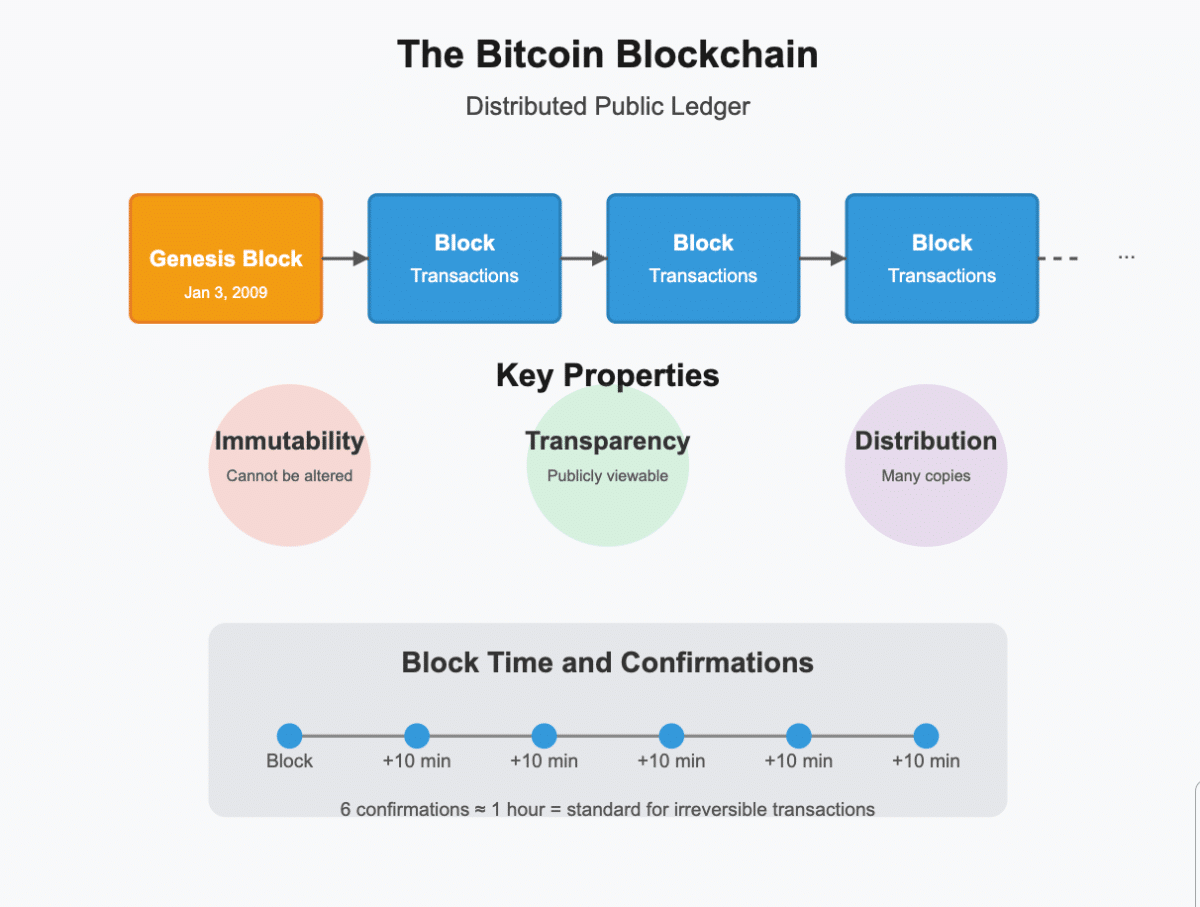
The blockchain is the distributed public ledger at the heart of Bitcoin. It records every Bitcoin transaction in order, in a continuous chain of blocks.
Each block contains a block header with metadata, a reference to the previous block (which creates the “chain”), a bundle of transactions and a proof-of-work solution. Each block builds on the one before it, creating an unbroken chain that goes back to the “genesis block” mined by Satoshi Nakamoto on January 3, 2009.
The design gives the blockchain three key properties:
- Immutability: Once a transaction is confirmed and buried under later blocks, it becomes extremely hard to alter. Changing any block would mean redoing the proof of work for that block and every block after it, which gets harder as the chain grows.
- Transparency: The entire blockchain is public. Anyone can view every transaction that has ever happened on the network, while users stay pseudonymous behind their addresses.
- Distributed storage: The ledger is not kept in one place but copied across thousands of nodes worldwide, so no single party controls it and it stays available even if many nodes go offline.
Block time and confirmations. A new block is added roughly every 10 minutes. When your transaction is included in a block, it has one “confirmation”. Each later block adds another. Six confirmations (about one hour) is the traditional standard for treating a payment as final, although many services accept fewer for small amounts.
Bitcoin mining and proof of work
Mining is how new bitcoins are created and how transactions are confirmed. It is both the security system of the blockchain and the issuance system for new coins.
The mining process works like this:
- Miners collect unconfirmed transactions from the network.
- They organize these transactions into a candidate block.
- They compute a cryptographic hash of the block header.
- They repeatedly change a value in the header (the “nonce”) and hash again until they find a result below the network’s difficulty target.
- When a valid solution is found, they broadcast the block to the network.
- Other nodes verify the solution and, if it is valid, add the block to their copy of the blockchain.
Finding a valid hash takes an enormous number of attempts, which is why mining uses so much computing power.
Proof of work (PoW) is the consensus mechanism that secures the network. Miners must prove they spent real computing resources to produce a block. Its main properties are:
- Difficulty adjustment: The network adjusts mining difficulty every 2,016 blocks (about two weeks) to keep the average block time near 10 minutes.
- Resource intensity: Mining requires real hardware and electricity, which makes attacks expensive.
- Verifiability: A solution is hard to find but easy for any node to check.
Economic incentives. Miners earn two kinds of reward. The block subsidy is the new bitcoin created with each block: it started at 50 BTC in 2009, halves every 210,000 blocks, and has been 3.125 BTC per block since the April 2024 halving. Transaction fees are paid by users and collected by the miner who includes their transactions. Together they create a self-sustaining security model in which miners are paid to protect the network.
Mining equipment. Bitcoin mining has moved from ordinary computer processors to specialized hardware:
- ASICs: Custom chips designed only for Bitcoin mining.
- Mining farms: Large-scale operations running thousands of ASICs.
- Mining pools: Groups of miners who combine their computing power and share rewards in proportion to the work each contributes.
Because mining uses a lot of electricity, many miners look for cheap or surplus energy, including renewable sources.
Cryptographic security
Cryptography is what lets people own, transfer and verify bitcoin without a trusted third party. Bitcoin uses public key (asymmetric) cryptography:
- Private keys: Secret numbers known only to the owner. Whoever holds the private key controls the coins.
- Public keys: Derived from private keys and used to create Bitcoin addresses.
- Digital signatures: Created with the private key to authorize a transaction without revealing the key itself.
Anyone can check that a transaction was authorized by the rightful owner, while the private key stays secret. Our guide to public and private keys explains this in more detail.
Hash functions. Bitcoin uses the SHA-256 hash function throughout, for transaction hashing, Merkle trees, proof-of-work calculations and linking blocks together. Hashes make it quick to confirm that large amounts of data have not been changed.
Cryptographic challenges. Bitcoin’s security relies on mathematical problems, such as the discrete logarithm problem behind its signatures and the pre-image and collision resistance of its hash functions, that cannot be solved with today’s technology. Advances in quantum computing could eventually threaten parts of this model, which is why developers are researching quantum-resistant signature schemes.
Wallets and address generation
Bitcoin wallets are apps or devices that manage the keys needed to use the network. Despite the name, wallets don’t hold coins. They hold the keys that prove ownership of coins recorded on the blockchain. The main types are:
- Software wallets: Desktop applications, mobile apps and browser-based wallets. They are convenient but more exposed to online attacks.
- Hardware wallets: Physical devices such as Ledger, Trezor and Coldcard that keep private keys offline and add strong protection against online threats.
- Paper wallets: Printed private keys and QR codes kept fully offline. They need careful handling to avoid damage, loss or theft.
- Brain wallets: Keys derived from a memorized passphrase. They are generally not recommended because weak passphrases can be guessed by brute force.
Address generation. An address is created by generating a private key, deriving the public key, hashing the public key and encoding the result, for example with Base58Check for older address types or Bech32 for SegWit and Taproot addresses. The address is what you share to receive funds.
Hierarchical deterministic (HD) wallets. Most modern wallets follow the HD standard (BIP32), which generates many keys and addresses from a single seed. You only need to back up one seed phrase to recover every address in the wallet.
Bitcoin transactions
A Bitcoin transaction moves value between addresses. It contains:
- Version number: Indicates which rules the transaction follows.
- Inputs: References to earlier transaction outputs being spent.
- Outputs: New unspent transaction outputs (UTXOs) created by this transaction.
- Locktime: The earliest time or block at which the transaction may be added to the blockchain.
- Witness data: In SegWit transactions, the signature data, kept separate from the main transaction data.
The UTXO model. Bitcoin uses the Unspent Transaction Output (UTXO) model. Coins exist as “unspent outputs” of earlier transactions. Each new transaction consumes existing UTXOs as inputs and creates new ones as outputs. The difference between total inputs and total outputs is the fee paid to the miner. This is different from the account-balance model used by banks.
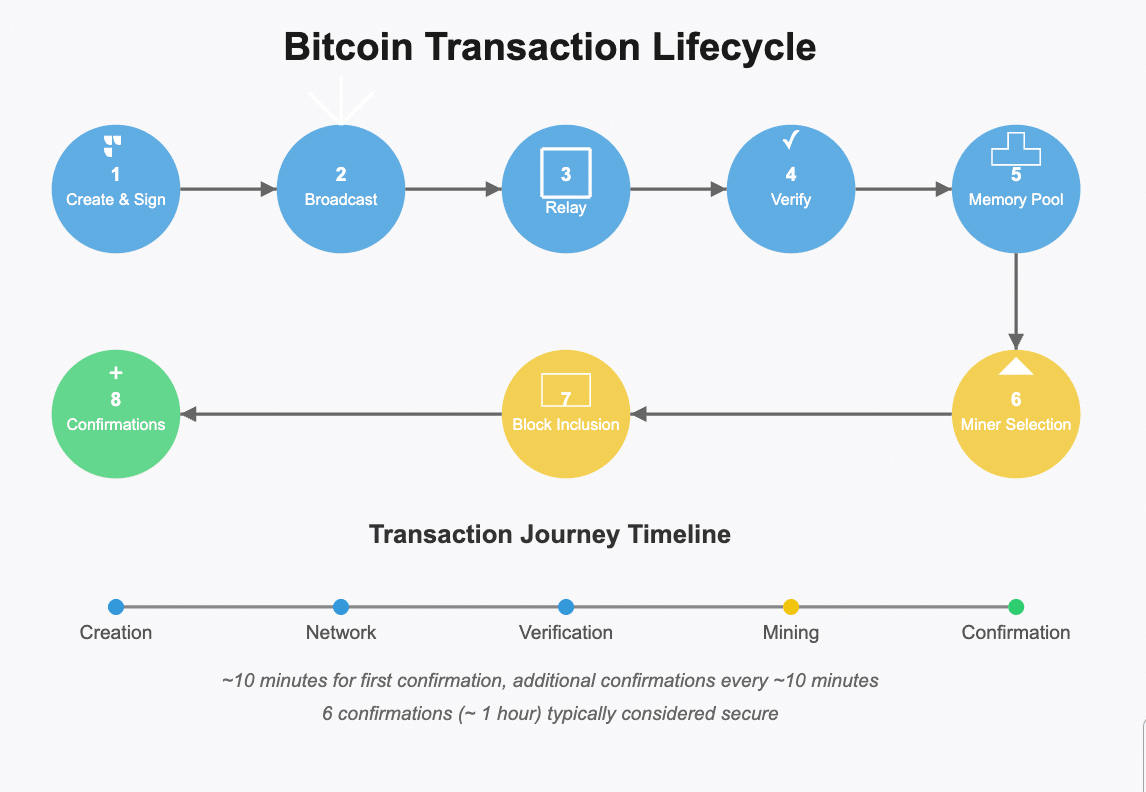
Transaction lifecycle. A typical transaction goes through these steps:
- A wallet creates and signs the transaction.
- The transaction is sent to the Bitcoin network.
- Nodes check that it is valid and relay it to their peers.
- Valid transactions wait in the memory pool (mempool) of pending transactions.
- Miners pick transactions from the mempool, usually those paying the highest fee rate, for the next block.
- The transaction gets its first confirmation when it is included in a block.
- Each later block adds another confirmation.
Transaction types. Bitcoin supports several script types, including P2PKH (legacy), P2SH (script hash), native and nested SegWit, and Taproot (P2TR), the newest type, which improves privacy and efficiency for complex spending conditions such as multi-signature setups.
Consensus and forks
A consensus mechanism is how every node in a decentralized network agrees on the state of the ledger without a central coordinator.
Bitcoin uses what is often called “Nakamoto consensus”: proof of work combined with the rule that nodes follow the valid chain with the most accumulated work. This lets the network agree even when some nodes are offline or dishonest. Every node checks each transaction and block against the rules independently and rejects anything invalid.
When two miners find valid blocks at nearly the same time, a temporary fork occurs. It resolves on its own as soon as one branch gets the next block and becomes the chain with the most work. Planned protocol changes come in two forms: soft forks, which tighten the rules in a backward-compatible way (SegWit and Taproot were soft forks), and hard forks, which change the rules in a way older software rejects and can split the chain, as happened with Bitcoin Cash in 2017.
Network security
Bitcoin’s security combines cryptography, economic incentives and the size of the network. It is designed to resist several kinds of attack:
- Double-spending: The blockchain tracks every transaction, so the same coin cannot be spent twice once a payment is confirmed. Each additional confirmation makes reversal less likely.
- 51% attacks: An attacker controlling more than half of the network’s mining power could in theory reverse recent transactions. The cost of the hardware and electricity needed makes this economically irrational, especially against payments with several confirmations.
- Sybil attacks: Creating many fake nodes does not help an attacker, because influence over block production comes from computing power, not node count.
The network also has no single point of failure, nodes and miners are spread across many countries, the open code is reviewed continuously, and developers run responsible disclosure processes for reporting vulnerabilities.
Scalability and decentralization challenges
As Bitcoin has grown, it has faced the challenge of increasing transaction capacity without giving up decentralization. Like most blockchains, it faces the “scalability trilemma“: it is hard to improve scalability, decentralization and security all at once, because gains in one area usually cost something in another.
Block space is limited. Bitcoin originally had a 1 MB block size limit. SegWit replaced it with a block weight limit of 4 million weight units, which allows somewhat larger blocks, but base-layer capacity is still commonly estimated at around 7 transactions per second. When demand is high, users compete for block space and fees rise. Keeping blocks small, on the other hand, keeps the cost of running a full node within reach of ordinary users, which protects decentralization.
Running a full node also gets more demanding over time. The blockchain grows every year and already needs well over 700 GB of storage, plus enough bandwidth and uptime to keep up with the network. Pruned nodes are one way to reduce the storage burden.
Layer 1 and Layer 2 solutions
To address these limits, Bitcoin scales on two levels.
Layer 1 (the base layer) is the Bitcoin blockchain itself, where final settlement happens. Key base-layer upgrades include:
- SegWit (Segregated Witness): Activated in August 2017, it moved signature data out of the main transaction data, increased effective block capacity and fixed transaction malleability, which made Layer 2 networks like Lightning practical.
- Schnorr signatures and Taproot: Activated in November 2021, they made multi-signature transactions more efficient, improved privacy for complex transactions and extended Bitcoin’s scripting abilities.
Layer 2 solutions are built on top of the blockchain. They move many transactions off-chain and use the base layer for final settlement:
- Lightning Network: A network of payment channels for instant, low-fee payments. Two parties can make unlimited payments inside a channel, and only opening and closing the channel are recorded on-chain. This makes micropayments and much higher throughput possible. Read our guide to the Bitcoin Lightning Network for more.
- Sidechains: Separate blockchains pegged to Bitcoin that can use different rules, such as Liquid Network and Rootstock (RSK). See our explainer on sidechains.
- State channels: Similar to Lightning but designed for more complex interactions, such as off-chain contracts.
Together these approaches let Bitcoin handle more activity while keeping the security and decentralization of the base protocol.
How Are New Bitcoins Created?
New bitcoins are created through mining, the same process that verifies transactions. Each time a miner adds a valid block to the blockchain, the protocol pays that miner the block subsidy in newly created bitcoin, plus the fees from the transactions in the block.
All of this relies on proof of work, described above. Mining uses a lot of power, so miners compete for cheap electricity, and many turn to renewable or otherwise wasted energy sources. Many also join mining pools to combine their power and split the rewards, which gives smaller miners a steadier income.
The block subsidy keeps halving until it reaches zero around the year 2140, when all 21 million bitcoins will have been issued. As the subsidy shrinks, transaction fees are expected to become the main source of miner revenue, so the network’s security budget shifts from new issuance to fees.
What is Bitcoin Halving, and Why Does it Matter?
A Bitcoin halving happens every 210,000 blocks, which works out to roughly every four years. With each halving, the number of new bitcoins paid to miners per block is cut in half. This slows the rate at which new coins enter circulation.
Halvings took place in 2012, 2016, 2020 and April 2024, when the reward fell to 3.125 BTC. The next one is expected around 2028 at block 1,050,000, when the reward will drop to 1.5625 BTC.
In past cycles, Bitcoin’s price rose in the months after a halving, because the new supply shrank while demand held up or grew. Other factors were also at work each time, and past performance does not guarantee future results.
What Gives Bitcoin its Value?
Bitcoin is different from fiat currency because neither a government nor a physical commodity like gold backs it. Instead, its value comes from three sources: scarcity, demand and security.
- Scarcity: There will only ever be 21 million bitcoins, and more than 20 million have already been mined.
- Demand: People want it because it is decentralized, portable and hard to censor.
- Security: The proof-of-work blockchain has made it extremely hard to attack.
Bitcoin is often described as “digital gold” because many people use it as a store of value. As with gold, some investors hold it as a hedge against inflation and currency debasement.
Latest Bitcoin News


Bitcoin’s History and Major Milestones
Bitcoin has hit several milestones since 2008, when it all started.
- 2008: The Bitcoin whitepaper was published.
- 2009: The genesis block was mined on January 3, and the network launched.
- 2010: The first known real-world purchase took place when Laszlo Hanyecz bought two pizzas for 10,000 BTC.
- 2017: SegWit activated in August, and Bitcoin reached its first major high close to $20,000 in December. Bitcoin Cash split off in a hard fork.
- 2021: Taproot activated in November, and Bitcoin reached a new all-time high of over $68,000.
- 2023: The Ordinals protocol launched, allowing NFT-like inscriptions on Bitcoin.
- 2024: The US SEC approved spot Bitcoin ETFs in January, giving retail and institutional investors a regulated way in. The fourth halving took place in April, the Runes token standard went live at the same block, and Bitcoin passed $100,000 for the first time in December.
- 2025: Bitcoin set a series of new all-time highs, peaking at about $126,000 in October, as spot ETF demand and institutional buying grew.
- 2026: The 20 millionth bitcoin was mined in March, leaving fewer than 1 million coins still to be issued.
Since its founding, Bitcoin has faced numerous challenges, including crashes, exchange failures and regulatory pressure. Even so, it has gained acceptance from large institutions and companies and has moved from an internet experiment to an asset held worldwide.
What Is Bitcoin Worth Today?
Bitcoin trades at $80,712.00, with a market capitalization of $1.62T. Over the past 24 hours, its price has changed by −0.5%. Its all-time high stands at $126,080.00, set on 6th October 2025. More than 20 million of the 21 million BTC are already in circulation.
The card below shows Bitcoin’s live price, market cap, volume and rank from our data feed.
 Bitcoin BTC
$80,712.00 −0.52%24h
- Market cap
- $1.62T
- Volume, 24h
- $23.39B
- 7 days
- −1.1%
- All-time high
- $126,080.00
The chart below tracks Bitcoin’s recent price history, updated from our data feed.
For more data, see our Bitcoin price page, or compare BTC with other coins on our cryptocurrency prices page.
Many factors influence the price of Bitcoin, from supply and demand and market sentiment to regulation, news, technological progress and even market manipulation. Because it is decentralized and not tied to traditional assets, it is highly sensitive to these forces, which explains its well-known volatility.
What Happens If You Invest in Bitcoin Today?
Nobody can predict the future of Bitcoin, and past performance is no guarantee of future results. A look at Bitcoin’s past performance does show how large its swings have been.
- If you had invested $100 in early 2017 (when Bitcoin was around $1,000), your investment would have been worth over $6,000 at Bitcoin’s 2021 high (about $68,000).
- If you had invested $100 in early 2020 (when Bitcoin was at approximately $7,000), your investment would have reached more than $900 at the 2021 peak.
- If you had invested $100 at the start of 2023 (when Bitcoin was at approximately $16,500), your investment would have been worth more than $700 at the October 2025 high of about $126,000.
Bitcoin has also fallen by more than half from its highs several times, and buyers at a peak have had to wait years to break even. Like all other cryptocurrencies, it is highly volatile. Prices can change very quickly and fall as hard as they rise. Investing in Bitcoin carries real risk, so invest only what you are prepared to lose.
Can Bitcoin Be Converted to Cash?
Yes. Like other cryptocurrencies, you can exchange your bitcoin for cash. Here’s how (see our full guide on how to sell cryptocurrency):
- Exchanges: You can sell your Bitcoin on exchanges like Coinbase, Binance or Kraken and have the cash paid into your bank account.
- Bitcoin ATMs: Some Bitcoin ATMs let you sell Bitcoin for cash, usually at high fees.
- Peer-to-peer trading: Some platforms let you trade with buyers directly and sell your Bitcoin to them in exchange for cash or a bank transfer.
- Spend directly: Some merchants accept Bitcoin as payment for goods or services.
Is Bitcoin 100% Safe? Risks and Considerations
Bitcoin’s blockchain has proven extremely hard to attack, but there are risks you should be aware of when holding Bitcoin or any other cryptocurrency.
- Hacking: Wallets and exchanges can be hacked, even if the blockchain itself is not.
- Scams: Phishing scams and fake websites are used to trick people into handing over their Bitcoin.
- Volatility: Prices can change sharply in a very short period of time.
- Lost keys: This one matters most. If you lose your private keys or seed phrase, your Bitcoin is gone for good.
It is essential to keep your wallet secure. Hardware wallets keep your private keys offline on a physical device, while software wallets keep keys on an internet-connected phone or computer, which is more convenient but easier to attack.
There are custodial and non-custodial wallets too. With a custodial wallet, a third party such as an exchange holds your keys for you. With a non-custodial wallet, you hold the keys yourself and have full control, along with full responsibility for keeping them safe.
Can Bitcoin Go to Zero?
Technically, yes, but it would take a lot. Bitcoin has survived crashes, exchange collapses, regulatory crackdowns and competition, thanks to its large and decentralized network, its scarcity and its growing use.
Even so, risks such as heavy-handed regulation, a loss of confidence or a future technical threat, for example from quantum computing, could hurt its value.
Bitcoin has recovered from every major crash so far because of its decentralization, its community and its fixed supply. That history does not guarantee it will recover from future ones.
What Is a Bitcoin ETF?
A Bitcoin exchange-traded fund, or ETF, is an investment fund that tracks the price of Bitcoin. It trades on regular stock exchanges, so investors can get exposure to Bitcoin’s price through a normal brokerage account without buying or storing the coins themselves.
The US SEC approved the first spot Bitcoin ETFs in January 2024, and trading began the next day. These funds brought mainstream investors and institutions into the market and made Bitcoin easier to hold inside retirement and brokerage accounts.
What’s Next for Bitcoin?
Bitcoin’s future will be shaped by adoption, technical development and regulation. Key areas to watch include:
- Institutional adoption: Companies, funds and some governments now hold Bitcoin, and spot ETFs have made it easier for traditional investors to buy.
- Layer 2 scaling: Networks like the Lightning Network and sidechains aim to make Bitcoin payments faster and cheaper.
- Regulation: Governments are still refining their approach to Bitcoin, with some embracing it and others imposing restrictions.
- Halvings: The next halving, expected around 2028, will cut the block reward to 1.5625 BTC.
- Payments: More merchants and financial platforms are adding Bitcoin payments.
- Protocol research: Developers continue to discuss upgrades carefully. Proposals include covenants, which would restrict how coins can be spent in the future (for example OP_CHECKTEMPLATEVERIFY and OP_TXHASH); Drivechain, a proposal for sidechains with a two-way peg to the main chain; Stratum V2, a newer mining protocol that gives individual miners more say over which transactions go into blocks; better privacy tools such as CoinJoin; and quantum-resistant signatures.
Any of these changes would need broad consensus before activating, which is why Bitcoin evolves slowly and conservatively compared with other blockchains.
Final Thoughts on Bitcoin
Bitcoin has established itself as the leading cryptocurrency and changed how people think about money and payments. As a scarce, secure and censorship-resistant asset, it serves as a store of value and as a payment network. Its system combines open-source software, protocol rules, a global network of nodes and miners, cryptography and economic incentives, and each part keeps the others in check.
Its core challenge remains scaling without giving up decentralization or security, and Layer 2 networks are the main answer so far. Volatility is still high, so anyone investing should think carefully about security, regulation and their own risk tolerance before buying, and only invest what they can afford to lose.
FAQs
What are Bitcoin wallets?
Bitcoin wallets are software or hardware that store the private keys you need to send, receive and control your Bitcoin. Wallets don't hold coins themselves; the coins are recorded on the blockchain and the keys prove you own them. Wallets come in hardware and software forms, and in custodial and non-custodial versions.
How long do Bitcoin transactions take?
A new block is added about every 10 minutes, so a transaction usually gets its first confirmation within 10 minutes to an hour, depending on network congestion and the fee you pay. Six confirmations, about one hour, is the traditional standard for large payments. Lightning Network payments settle almost instantly.
Can Bitcoin be used for everyday purchases?
Yes, but acceptance is still limited. Some retailers take Bitcoin directly, often through the Lightning Network, and crypto debit cards let you convert Bitcoin to fiat at the point of sale.
What are Bitcoin forks?
A fork is a change to Bitcoin's software rules. Soft forks, like SegWit and Taproot, are backward compatible. Hard forks are not, and can split the chain into two networks, as with Bitcoin Cash in 2017.
What is Bitcoin Cash?
Bitcoin Cash is a 2017 hard fork of Bitcoin that tried to make transactions faster and cheaper by increasing the block size.
What is the Bitcoin protocol?
It is the set of rules that govern how the Bitcoin network operates, from the 21 million maximum supply to how transactions are validated and recorded. The rules are written into open-source software rather than a separate document, so they are enforced automatically across the entire network.
What role do nodes play in the Bitcoin network?
Nodes are computers running Bitcoin software. They store and validate the blockchain, check every transaction against Bitcoin's rules, relay valid transactions and blocks to other nodes, reject invalid ones and keep the network decentralized.
How does mining secure the Bitcoin network?
Proof of work requires miners to spend real computing power and electricity to create valid blocks, which makes attacking the network very expensive. Competition spreads block creation across many participants, and each new block makes it harder to rewrite earlier transactions.
What challenges does Bitcoin face in terms of scalability?
The main limits are block space, which caps base-layer throughput at a few transactions per second, the growing storage needed to run a full node, and fees that rise when demand is high. Balancing more capacity with security and decentralization has led to base-layer upgrades like SegWit and Taproot and to Layer 2 networks like Lightning.