Join Our Telegram channel to stay up to date on breaking news coverage
Analyst SMQKE shared a technical breakdown of Hedera on X. The post walks through Hedera’s hashgraph consensus, its asynchronous Byzantine Fault Tolerance, and how the network handles cryptography. One line stood out: Hedera can introduce new post‑quantum algorithms without a hard fork, just like it added ECDSA support after launch.
On paper, that sounds like a solid plan. Hedera uses CNSA 2.0 standards (384‑bit SHA‑2 hashes, 256‑bit AES keys, and RSA with 2048‑bit keys) and says it will swap in post‑quantum algorithms when the time comes. But here is the problem: “when the time comes” may already be here.
Google’s quantum breakthrough last week showed that a quantum computer could crack a private key in nine minutes. The threat is not a distant hypothetical. Hedera’s ability to upgrade without a hard fork is useful, but the network still relies on classical signatures like Ed25519 and ECDSA today. Those keys are exposed on‑chain. A quantum computer does not care about upgrade paths; it attacks what is live right now.
BMIC ($BMIC) took a different approach. The presale is already live, and the wallet was built from day one with post‑quantum cryptography and signature‑hiding architecture. No waiting for upgrades. No governance votes. No exposure.
What SMQKE’s Hedera Breakdown Misses
The image SMQKE shared details Hedera’s technical foundations: hashgraph, aBFT, and its layered cryptographic standards. Hedera points to its ability to adopt new algorithms without hard forks as a quantum readiness feature. But the real vulnerability lies in the fact that Hedera wallets and transactions still expose public keys using Ed25519 and ECDSA. Those signatures are quantum‑vulnerable today.
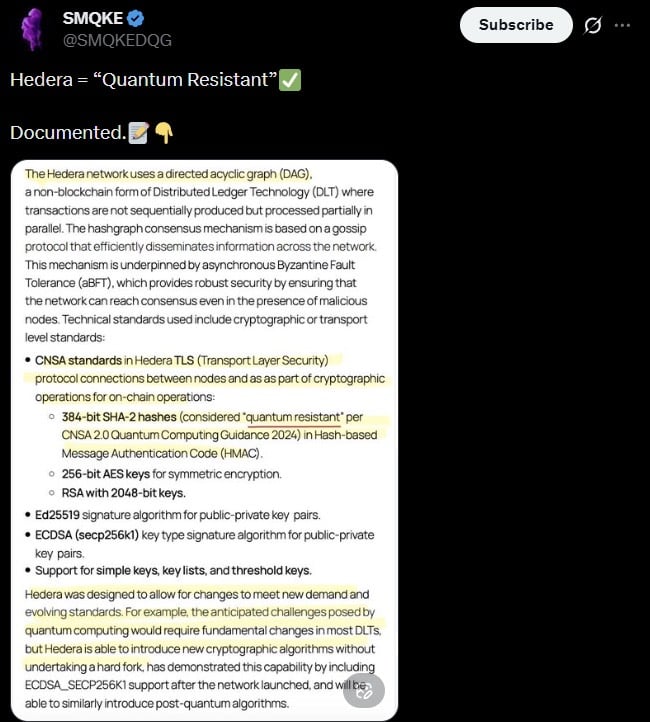
Source: X/@SMQKEDQG
Even if Hedera adds post‑quantum signatures next year, every transaction made before that upgrade sits on the ledger with exposed keys. Attackers can harvest that data now and decrypt it later. Hedera’s roadmap does not address the keys already in the wild.
BMIC solves this by never exposing public keys in the first place. The wallet uses signature‑hiding smart accounts (ERC‑4337 with private L2 routing). An attacker sees nothing to harvest. No public key, no attack vector. That is not a future upgrade—it is how BMIC works right now.
Why BMIC Stands Alone in the Quantum Race
BMIC is the first complete quantum‑secure finance stack, built from the ground up for the quantum era.
Here is what sets BMIC apart from projects like Hedera that are still planning their quantum migration:
- Zero public‑key exposure. Traditional wallets (whether on Hedera, Ethereum, or Bitcoin) expose public keys every time a transaction is made. BMIC hides those keys using signature‑hiding architecture. Quantum computers cannot attack what they cannot see.
- Hybrid post‑quantum signatures. BMIC uses NIST‑approved post‑quantum algorithms combined with classical fallbacks. The system automatically upgrades as NIST validates new standards, all without user intervention.
- AI‑driven security. An AI layer monitors threats, optimizes cryptographic performance, and balances workloads across classical and quantum environments. The wallet adapts in real time.
- Quantum‑secure staking and payments. Most staking platforms lock funds in smart contracts with exposed keys. BMIC’s staking system removes that exposure. The payment layer uses post‑quantum authentication, protecting users from future quantum fraud.
- Enterprise QSaaS. Banks, fintechs, and healthcare providers can plug into BMIC’s Quantum Security‑as‑a‑Service to add post‑quantum custody, key management, and secure communications without rebuilding their infrastructure.
BMIC’s crypto presale has already raised over $500,000. Current price sits at $0.049999 per token, with 50 phases ending at $0.058182. The exchange listing price will be above that final tier, giving early buyers a built‑in advantage. Each phase fills, the price moves up, and the lowest entry point is today.
Wrap Up – Why BMIC Is the Best Crypto to Buy This Year
Hedera deserves credit for planning ahead. Its ability to upgrade without hard forks is a genuine technical strength. But planning is not the same as protection. Hedera’s network still exposes classical signatures on‑chain today, and those signatures will be broken by quantum computers.
BMIC does not ask you to wait for a future upgrade. The wallet is quantum‑secure right now, with zero public‑key exposure, post‑quantum cryptography, and AI‑driven automatic evolution. For anyone holding crypto in 2026, that is the difference between hoping your assets survive and knowing they are protected.
If you are looking for the best crypto presale this year, BMIC offers something no other project does: a complete quantum‑safe finance stack that works today. The presale window is still open, and the price is still near the floor. Once the market fully understands what Google’s breakthrough means, those early phases will disappear fast.
BMIC has already built the solution. The question is whether you get in before everyone else does.
Meet the future of quantum-secure Web3 with BMIC:
Presale: https://bmic.ai/
Social: https://x.com/BMIC_ai
Telegram: https://t.me/+6d1dX_uwKKdhZDFk
Join Our Telegram channel to stay up to date on breaking news coverage