

Billions of dollars’ worth of crypto still sits in wallets doing nothing – and although that passive approach made sense when investors could realize huge gains simply by holding through market cycles, it’s become a suboptimal strategy now that holders can earn yield on the same coins and still generate profits when prices run. For the savviest holders, crypto interest has become a significant passive income stream, and the range of ways to maximize that income has become overwhelming. As a result, keeping up to date with the latest developments in the crypto finance space and carefully choosing the best available options are of paramount importance in 2026.
Most crypto investors already understand the basic math behind investing in digital assets. Bank savings rates in many countries still struggle to keep up with inflation (often paying only a few percentage points at most), while cryptocurrencies and tokens offer a straightforward way to stay ahead, store value, and ideally walk away with a sizable profit. Today, crypto interest platforms offer far higher rates not only on stablecoins and big names like Bitcoin and Ethereum, but also on altcoins and even their own native tokens.
In this guide, we’ll explore some of the best ways you can earn as much interest as possible on your crypto holdings, focusing on the most up-to-date strategies. During our research, we also found that CoinDepo is one of the best CeFi (centralized finance) platforms for generating crypto interest, due to its high yield rates, flexible account structure, and beginner-friendly interface. Keep reading to discover exactly how to make the most of the assets that are sitting in your wallet right now.
Key Takeaways
- Crypto interest is income paid for depositing cryptocurrencies or stablecoins with a yield platform. It turns idle holdings into a cash-flow and passive income stream without forcing you to sell your assets.
- Longer payout schedules usually beat daily accounts in terms of their headline APRs.
- Stablecoins typically pay higher yields than BTC or ETH, even on the same platform, because they are generally less affected by market volatility. For example, CoinDepo offers 12%–18% APR on major cryptocurrencies and 17%–23% APR on stablecoins.
- Holding a platform’s native token can provide useful benefits, such as higher yields on savings or lower interest on loans.
- CoinDepo pays interest in the same asset you deposit, including majors, stablecoins, and other tokens.
- Borrowing against deposits works better if your collateral continues to earn yield at the same time.
- Ensure you follow personal cybersecurity best practices when using any crypto-related platform, and comply with your local tax regulations to avoid fines and other penalties.
What Is Crypto Interest?
Crypto interest is income paid for supplying your digital assets to a lending or yield program. You deposit Bitcoin, Ethereum, a stablecoin, or another supported token, and the platform puts that capital to work (usually by lending it to others through credit facilities, such as loans), and shares a portion of the return with you on a published schedule.

The core concept will already be familiar to anyone who has used a savings account, but earning crypto interest involves two important differences. First, yields on digital assets are typically far higher than those on bank deposits. Second, the value of your deposited assets (principal) can still move in line with their market prices if you hold cryptocurrencies and tokens rather than stablecoins (which are pegged to the value of fiat currencies, typically the US dollar).
Passive income from crypto interest has become a core portfolio planning tool for modern investors. Trading requires good timing, technical and fundamental analysis, and frequent chart-watching sessions – but generating interest does not. If you’ve already decided that you want long-term exposure, you can keep your favorite assets and collect a yield on them while you wait. Depending on the size of your holdings, that income can offset fees, fund your living costs, or be reinvested so the balance compounds.
How Can You Earn Interest on Your Crypto?
On most mainstream crypto interest platforms, you earn interest by depositing your coins into an account that pays a published annual percentage rate (APR) and credits that interest according to a set schedule. Some programs pay in the same asset you deposited, while others convert your interest into rewards (such as a payout in a different coin, platform points, or the service’s own native token). The primary difference between the two main options (CeFi and DeFi platforms) is who holds the keys to your funds, and how consistent your returns are likely to be.
Centralized finance (CeFi) platforms will take custody of your assets. To get started, you open an account, usually complete identity checks (KYC), deposit your coins, and select your preferred crypto savings product. The platform manages lending and yield generation, then pays you the stated interest rate.
On the other hand, decentralized finance (DeFi) services will route your deposits into on-chain smart contracts. You connect a crypto wallet, approve transactions that send your coins to a liquidity pool or vault, and earn a variable rate that moves with demand – often with considerable volatility. You keep more direct control of your keys, but you also accept complex factors such as smart contract risk, blockchain gas fees, and the work required to monitor your positions.
Both models can pay interest, but CeFi is usually simpler and offers fixed schedules with little maintenance, while DeFi can be more flexible – but also much more hands-on. The right choice comes down to whether you prefer an account managed by a centralized platform or the on-chain control offered by DeFi services. For our purposes here, we’ll focus on CeFi options, as they tend to be more straightforward, and the best strategies evolve more slowly than in the DeFi space, where short-lived trends often dominate funding flows and even popular platforms can rise and fall practically overnight.

How to Maximize Your Crypto Interest in 2026
Crypto users who want to generate as much interest as possible usually start by considering the type of service they plan to use (we’ll stay focused on centralized finance platforms here) and then the asset they will deposit. Stablecoins such as USDT and USDC are tokens whose value remains close to $1, which makes it easy to track, predict, and budget for the interest you’ll receive. BTC, ETH, and other cryptocurrencies also pay interest, but their fiat values can fluctuate as they track live market price changes. Spreading funds across multiple coins is a simple way to reduce the impact of a drop in a single asset.
If you intend to spend your passive income quickly, stablecoins are generally a more suitable and popular choice – but if your goal is to keep a long-term position in a specific cryptocurrency and earn yield while you hold it over an extended period of time, CeFi services will also allow you to do so with minimal effort and fuss.
The next choice is the payout schedule. Many platforms pay a higher APR when interest is paid monthly, quarterly, or annually. Daily and weekly accounts will pay a lower rate, but the user can access the funds sooner. A longer schedule can work as long as the funds remain deposited for the required period, while shorter schedules are generally better for investors who may need to spend their funds quickly.
Interest also grows faster when payouts are compounded (left in the savings account to generate more interest), and the APY (annual percentage yield) metric indicates the total yield generated by compounding a basic APR (annual percentage rate). APR and APY rates can also vary depending on the chosen payout schedule. On the other hand, withdrawing the interest each time a payout is made prevents compounding growth, and on-chain transfer fees can also cut into returns, especially for small deposits sent over expensive networks.
What Is the Best Crypto Interest Platform Right Now?
In our view, CoinDepo is one of the best platforms for earning interest on crypto in 2026. It is a centralized digital-asset finance provider that opened in 2021. Users deposit supported coins into Compound Interest Accounts and choose one of six payout schedules: daily, weekly, monthly, quarterly, semi-annual, or annual. Interest is paid in the deposited asset; there is a minimum deposit requirement of just $1; and CoinDepo does not charge a deposit fee.
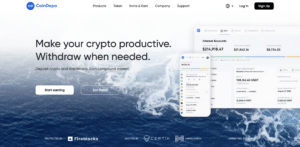
Principal can be withdrawn from any account type, and withdrawals are typically processed the next business day. On longer payout schedules, interest is paid only if the balance remains in place for the full compounding period.
The platform also lets users borrow against the same portfolio without moving those assets into a separate, frozen collateral vault. That portfolio can support an instant credit line of up to 50% LTV (Loan-to-Value). Borrowed funds are credited to a current interest account, so users can raise cash without selling the original holding.
Custody on CoinDepo runs through Fireblocks, which maintains insurance for certain custody-related events, subject to policy terms, limits, and exclusions. The platform has been audited by CertiK and Hacken. Its native token, COINDEPO, provides access to rate bonuses and governance rights, depending on the share of a user’s portfolio that is held in COINDEPO.
The firm currently has $243 million in assets under management and over 114,000 active users, and it paid an average yield of 15.8% during Q1 2026. For investors seeking clear and easy-to-follow rates, a simple account dashboard, and a way to tap into borrowing liquidity without selling their assets, CoinDepo is one of the leading options right now.
CoinDepo: Products, Services, Key Features
CoinDepo groups its offerings around earning crypto interest, borrowing funds via credit lines, an upcoming credit card, and the platform’s native COINDEPO token, which can be used to improve interest and borrowing rates for holders. We’ll look at each one in detail below.
Compound Interest Accounts
These are the core interest-earning products on CoinDepo. There are six payout schedules: daily, weekly, monthly, quarterly, semi-annual, and annual. Interest automatically compounds according to the schedule you choose and is paid in the same asset you deposited.

CoinDepo pays interest at rates of 12% to 18% APR on major coins like Bitcoin and Ethereum, while stablecoins such as USDT, USDC, and DAI earn 17% to 23% APR, and the platform’s native COINDEPO token delivers 19% to 25% APR. Tokenized gold in the form of PAXG and XAUt also produces an APR within the 17% to 23% range.
There is a minimum deposit of $1, no platform fee for deposits or withdrawals, and you can withdraw the principal from any account whenever you choose. However, if you withdraw before a given payout period ends, you will not receive interest on the amount you withdrew for the incomplete period.
Borrow
CoinDepo’s “Borrow” feature offers an instant credit line, allowing you to borrow directly against your portfolio balance (the funds in your Compound Interest Accounts) at up to 50% LTV (Loan-to-Value). You’ll receive your funds almost immediately, and you can borrow the cryptocurrency, token, or stablecoin of your choice, rather than being limited to the specific coins you already have in your savings accounts. You can repay the borrowed funds in full or in installments at any time, and the initial borrowing process does not involve credit checks, origination fees, or complicated paperwork.

What makes CoinDepo stand out in this respect is that collateral keeps generating interest even while the loan remains active. Depending on the situation, the interest earned on your collateral might surpass the interest owed on the loan itself, though such a result is not assured and may demand careful attention to your holdings and investment strategy. The borrowed amount is likewise held in a current interest account, meaning the borrowed balance can also accrue interest until you withdraw or spend it.
CoinDepo Credit Card
The CoinDepo Credit Card is expected to launch later this year and will allow holders to spend against their Instant Credit Line, with no monthly, annual, or origination fees. The card will be available in metal, plastic, and virtual formats and be compatible with more than 90 million merchants, with Apple Pay and Google Pay integration included. Cashback terms have yet to be confirmed, and may be paid into a Current Compound Interest Account, so the reward can start earning right away.
CoinDepo Token (COINDEPO)
COINDEPO is the platform’s native token and has a capped supply of 1 billion. Holders can deposit it into Compound Interest Accounts to access the platform’s highest advertised rates, vote on product and charity decisions, and enter the Advantage Program, where benefits depend on the share of your portfolio that is held in COINDEPO.
At a portfolio share of 15% or more (the top tier), interest rates can rise by up to 5% APR if you also take interest payouts in the token, and loan interest rates can fall by up to 3%. Smaller holdings get smaller extras. CoinDepo also uses 20% of its quarterly profits to buy back and burn COINDEPO tokens, and will continue to do so until half the supply is burned.
Which Crypto Assets Can You Earn Interest On?
CoinDepo pays interest on dozens of cryptocurrencies, large-cap and mid-cap altcoins, dollar stablecoins, a euro stablecoin, tokenized gold, and its native COINDEPO token. Each one sits in its own Compound Interest Account, which pays interest in the deposited asset, so BTC deposits earn in Bitcoin, USDT deposits earn in Tether, and so on.
Crypto interest rates on CoinDepo are determined by the deposited asset and the user’s chosen payout schedule (daily, weekly, monthly, quarterly, semi-annual, or annual). Current (daily) accounts sit at the low end of each band, while annual accounts sit at the high end.
Supported categories and example cryptos include (but are not limited to):
- Layer 1 Majors: BTC, ETH, SOL, BNB, ADA, AVAX, TON
- Legacy Altcoins: XRP, LTC, BCH, XLM, DOGE
- DeFi and Infrastructure Tokens: LINK, AAVE, ATOM, NEAR, FIL, ONDO
- Dollar-Based Stablecoins and Tokenized Gold: USDT, USDC, DAI, PAXG, XAUt
- Euro Stablecoin: EURC
- Platform Token: COINDEPO
The table below covers CoinDepo’s main APR bands, from daily payouts to annual payouts. However, we recommend checking CoinDepo’s official website for the latest rates, as they may change over time.
| Category | Examples | APR Range |
| Major Cryptos and Most Alts | BTC, ETH, SOL, BNB | 12%–18% |
| Dollar Stablecoins | USDT, USDC, DAI | 17%–23% |
| Tokenized Gold | PAXG, XAUt | 17%–23% |
| Euro Stablecoin | EURC | 10%–16% |
| Platform Token | COINDEPO | 19%–25% |
How Much Crypto Interest Can You Earn in 2026?
On CoinDepo, the bands listed in the table above provide a clear starting point for new users looking to earn interest on their crypto. Deposits in major cryptocurrencies can pay APRs between 12% and 18%; dollar-based stablecoins (USDT, USDC, DAI) pay 17%-23%, as does tokenized gold; the EURC (euro-pegged) stablecoin pays 10%-16%, and CoinDepo’s native COINDEPO token pays an APR of 19%-25%. As we’ve seen, daily interest payouts generate APRs on the low end of these bands, while annual payouts generate the highest APRs. COINDEPO holders can increase interest rates by up to 5% if their COINDEPO holdings make up 15% or more of their portfolio, and they also take interest payouts in COINDEPO.
During Q1 2026, CoinDepo paid an average yield of 15.8%, which reflects how individual users’ earnings are determined by the specific mix of assets in their Compound Interest Accounts, the payout schedules they choose, and whether they leave their assets in their accounts to enable automatic compounding.
In practice, you can increase the amount of crypto interest you earn on CoinDepo by choosing longer payout schedules (if you do not need the cash right away), taking interest payments in COINDEPO for the extra payout bonus, and holding enough of the token to reach a higher Advantage Program tier.
What Fees Do You Have to Pay When Earning Crypto Interest?
CoinDepo does not charge platform fees on ordinary earning activity. There is no fee required to deposit funds into an interest account, no platform fee for withdrawals, no account maintenance fee, and no origination fee on the Instant Credit Line. However, you may still need to pay blockchain network fees when you make deposits and withdrawals. Those fees will go to the network, not to CoinDepo, and the exact amount you’ll need to pay will depend on the asset and the chain.
CoinDepo also does not charge a monthly subscription – instead, it earns revenue from the return on the assets it deploys through an assortment of strategies. Examples include lending, interest on credit lines that users draw, and returns generated by CoinDepo’s diversified investment portfolio, which is fully covered in the platform’s Q1 2026 Report. Instant crypto swaps can also include a conversion spread.
For users who only make deposits and earn interest, the most common cost is network gas for deposits or withdrawals. CoinDepo does not take a cut of the interest it pays, and interest is credited in the same asset you deposited.
| Fee Type | Amount |
| Deposit | 0% |
| Withdrawal | 0% |
| Network / Gas | Paid to the blockchain; amount varies by asset and network |
| Account Management | 0% |
| Loan Origination | 0% |
| Loan Interest | Charged only on the amount you borrow |
What Are the Risks Involved With Earning Interest on Crypto?
Although crypto savings platforms allow users to deposit their funds and earn high yields right away, there are several practical risks that can be mitigated with simple actions and strategies.
First, cryptocurrency prices can be extremely volatile – and that market risk does not go away even when your funds are being held in a savings account. That means your assets can lose value after you deposit them, so as the interest you earn keeps accruing in the deposited coin, your account balance in token terms can rise even as the asset’s fiat value falls. Many investors use fiat-pegged stablecoins to generate yield without price-related risk, while others invest assets they have committed to holding over the long term, or simply choose shorter payout periods so they don’t lose out on interest if they want to cash out quickly.
Secondly, different types of platforms come with their own risks. For example, when using CeFi services, you rely on the operator to handle custody, liquidity, yield generation, and payouts. CoinDepo helps to mitigate this issue by using Fireblocks for custody and insurance, and the platform itself has been audited by respected firms, including Hacken and CertiK.

Thirdly, maintaining account security (and personal cybersecurity in general) is vitally important – especially as malicious actors are using AI tools to create sophisticated social engineering and hacking techniques. Therefore, we recommend checking every URL (and making sure you’re connecting to a platform’s official secure site) before you log into an account, enabling two-factor authentication and other available security measures, and completing identity checks as required.
Finally, make sure you read through a platform’s full terms and conditions (not just the headline APR rates), and consider how your crypto interest-generation strategy will work before you begin depositing funds. Don’t rely on a passive income source as your sole means of paying for everyday living costs, and keep a cash and savings buffer outside the platform to take care of near-term spending needs and emergencies.
Will You Have to Pay Tax on Crypto Interest?
Crypto interest is usually taxed in the year it is paid into your account. The figure most tax offices use is the market value of the coins on that day, converted into your local currency. If you later sell those coins, that sale can create a capital gain or a capital loss of its own.
The forms, categories, and specific regulations and laws involved will vary by country, so it’s important to check your local rules to ensure compliance. For example, interest may be reported as ordinary income, as a miscellaneous reward, or under a local crypto schedule, and some systems have a reporting threshold (below which you may not need to report your income at all). Some jurisdictions treat stablecoins differently from Bitcoin, Ethereum, and altcoins. A loan against crypto holdings can also have tax consequences, depending on local laws.
Follow personal finance and recordkeeping best practices when dealing with your crypto holdings. Keep dated records of deposits, interest credits, conversions, and withdrawals, with values in your own currency. If the interest is a material amount, consult a tax adviser in your jurisdiction, and note that the contents of this article do not constitute tax, financial, or investment advice.
Is CoinDepo Legit?
CoinDepo has been live since 2021 and has built a strong reputation not only for its high yields and range of supported assets, but also for its custody architecture, transparency, and advanced security measures.
Custody and Insurance
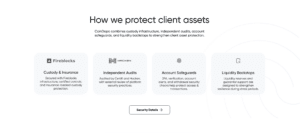
Client assets on CoinDepo are held through Fireblocks infrastructure, which uses hardware-based security, multi-party computation, and extremely strict policy controls, so no single key is a single point of failure. Custody is insurance-backed, with coverage for events such as errors, omissions, transfers, and storage, subject to policy limits. Fireblocks also meets the highest CCSS (Cryptocurrency Security Standard) requirements, holds SOC 2 Type II certification, and complies with ISO 27001, 27017, and 27018 standards.
The platform’s design also ensures that deposits remain in Compound Interest Accounts even when they are used to support a credit line, so they can continue generating interest that could (in some cases) offset the interest applied to loan repayments. User-side security measures include automatic email login-attempt notifications and confirmations via verification codes; 2FA (two-factor authentication); and adjustable security settings, including options for withdrawal confirmations and security holds (which delay withdrawals to allow the user to cancel them).
Audits and Standards
Security assessments of the CoinDepo platform have been carried out by Hacken, which performed a full platform audit, and CertiK, which reviewed the smart contracts. In addition, CoinDepo runs bug bounty programmes for external testers who find vulnerabilities, and its development team continuously oversees the platform’s security measures.
Regulatory Compliance
CoinDepo’s corporate entity is based in Panama. In El Salvador, CoinDepo has moved under the Bitcoin Service Provider regime and is pursuing Digital Asset Service Provider authorization.
Those arrangements require KYC and AML checks for all users who want unrestricted account access. Although some Web3 users prefer to avoid KYC procedures, this compliance layer is what allows CoinDepo to accept clients across borders while remaining inside existing virtual-asset rules and frameworks.
CoinDepo Pros and Cons
Pros
- Yields of up to 23% APR on stablecoins, up to 25% on the platform’s native COINDEPO token, and up to 18% on major cryptocurrencies
- Six compounding schedules to choose from (daily, weekly, monthly, quarterly, semi-annual, or annual)
- No platform deposit or withdrawal fees
- Assets keep earning while you borrow via credit lines
- Minimum deposit of $1
- COINDEPO token provides interest rate bonuses on Compound Interest Accounts, and discounted interest rates for loans
- Exceptional security measures, including Fireblocks custody and insurance, and independent third-party audits via Hacken and CertiK
Cons
- Full access requires identity verification (KYC) to ensure CoinDepo complies with regulatory requirements
- Yield rates are subject to change over time
- Centralized custody requires users to trust the platform’s security measures
How to Start Using CoinDepo
- Create an account with your email address, create a password, and confirm the code. You can also create a CoinDepo account by connecting your Google, Facebook, Apple, or X account via the Sign Up screen.
- Turn on two-factor authentication via your account’s security settings menu.
- Complete identity verification to gain full account access and remove deposit and withdrawal limits.
- You’ll start with a Current Compound Interest Account for each supported asset, which provides daily payouts. You can also choose to open additional weekly, monthly, quarterly, semi-annual, or annual accounts, and move your funds between those accounts via the dashboard interface.
- Send the supported asset to the deposit address shown for that coin and network, and move the funds to the required account if needed. Your interest will begin accruing as soon as the blockchain confirms the transfer.
The Best Way to Earn Interest on Your Crypto in 2026: Conclusion
Throughout this guide, we’ve explored a range of beginner-friendly and more advanced ways to maximize your crypto interest earnings in 2026. We’re primarily focused on the CeFi sector, where optimization strategies and trends generally last longer than in the DeFi space (which is subject to far greater volatility and unpredictability), and taken a deep dive into CoinDepo, which we have found to be one of the best CeFi crypto savings platforms currently available.
Some of the most practical takeaways here are fairly straightforward. On CoinDepo, idle crypto balances can earn without ever selling the underlying position; stablecoins typically offer the most predictable and highest yields; holding major coins like Bitcoin and Ethereum can still generate a meaningful rate; and payout schedules that run longer tend to show the highest headline APRs. Keeping your funds in a crypto savings account allows growth to compound, and aligning the interest payout calendar with your cash-flow needs will benefit your returns far more than continuously shifting coins between accounts.
CoinDepo brings all of those pieces together and allows users to manage their holdings through a beginner-friendly dashboard. To research the platform further and check the latest yield rates and account terms, click the button below.
FAQs
Which assets can I earn crypto interest on?
How much yield can I make through crypto interest platforms?
Is it safe to earn high crypto interest yields?
Is CoinDepo beginner-friendly?
Is CoinDepo safe and trustworthy?
Can I use CoinDepo in my country?
Will I need to complete KYC to use CoinDepo?
Do I have to pay tax on crypto interest?
References
- Centralized Finance in Crypto (Skrill)
- Compound Interest (Hargreaves Lansdown)
- CoinDepo Official Website (CoinDepo)